




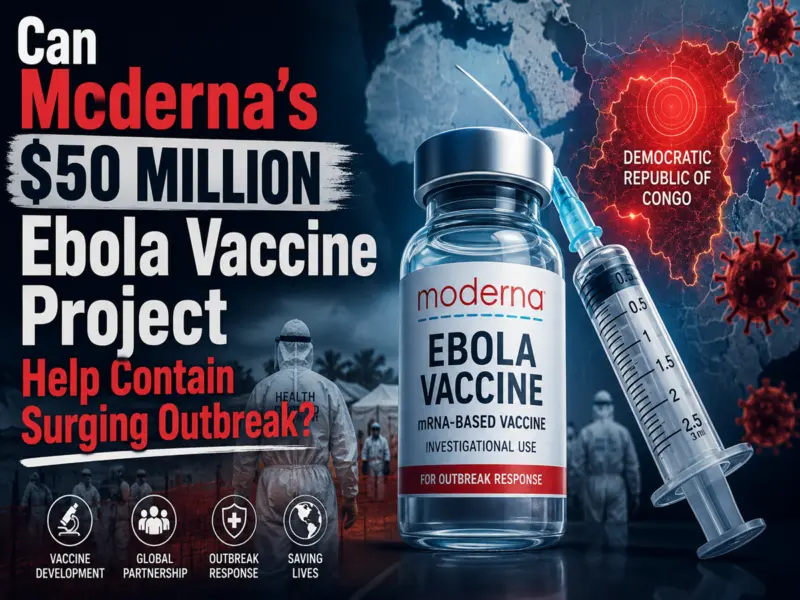

As the Ebola outbreak is getting bigger every day, the problem for health workers continues to surge. At this time, when there are more than 900 suspected cases and over 220 suspected deaths, the world is searching for the answer, and finally, something meaningful is happening.
Biotechnology giant Moderna announced on Monday that it is partnering with the Coalition for Epidemic Preparedness Innovations (CEPI) to develop a potential vaccine against Bundibugyo ebolavirus (BDBV), the strain responsible for the current outbreak.
To prevent the Ebola outbreak, this partnership will play a vital role. With the help of this agreement, CEBI has pledged up to $50 million to support the preclinical development and early-stage clinical testing of Moderna’s investigational vaccine candidate.
Moderna and CEPI Launch Vaccine Mission Against Bundibugyo Ebola
The announcement comes at a time when health authorities around the world are racing to find effective medical tools to contain the outbreak. Moderna also attracted attention after revealing research into a potential hantavirus vaccine, following a high-profile cruise ship outbreak.
But Moderna is not alone in the fight. CEPI has also committed to support of up to $8.6 million to a vaccine developed by the University of Oxford and manufactured by the Serum Institute of India. In addition, the organisation has allocated an initial $3.2 million for another vaccine candidate being developed by the International AIDS Vaccine Initiative. These investments show the growing concern to stay ahead of the virus and prepare multiple vaccine options.
2026 Ebola Outbreak: WHO Prioritises Experimental Treatments and Vaccines
Adding to the momentum, the World Health Organisation (WHO) recently recommended prioritising several experimental treatments and prevention tools for Bundibugyo Ebola. The list includes investigational antibodies, antiviral medicines, and vaccine candidates that experts believe could help reduce deaths and slow transmission.
Ebola Outbreak: Gavi and Pandemic Fund Strengthen Global Response
Meanwhile, global health organisations are expanding financial support for outbreak response efforts. Vaccine alliance Gavi announced a commitment of up to $50 million to help affected regions. The package includes up to $40 million to improve vaccine access and an additional $10 million to strengthen outbreak response activities.
The Pandemic Fund has also stepped forward, pledging up to $220.6 million in grants to address critical gaps in the Ebola response and support frontline health systems.
Together, these initiatives paint a picture of unprecedented global cooperation. Scientists, healthcare workers, governments, and international organisations are working side by side with a common goal: to stop the spread of Bundibugyo Ebola and protect vulnerable communities.
While challenges remain, the growing investment in vaccines, treatments, and emergency response efforts offers hope that the outbreak can be contained and future lives can be saved.
As researchers continue their work and health authorities monitor the situation closely, the world watches with cautious optimism, hoping that science and collaboration will once again prove stronger than disease.
From COVID-19 to Ebola: Moderna Broadens Its Vaccine Pipeline
Moderna is well known for its COVID-19 vaccine. It has increasingly turned its attention to other infectious diseases with epidemic potential. The company’s Ebola vaccine program is part of a broader strategy to develop rapid-response vaccines for future health emergencies. With CEPI committing up to $50 million to support early-stage development, Moderna is now among several organisations working to advance medical countermeasures against the Bundibugyo Ebola outbreak.