
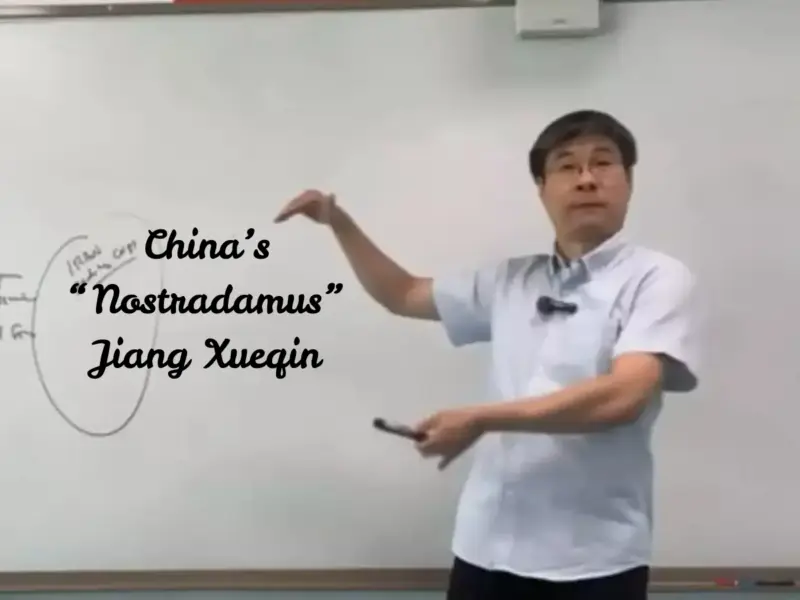
China's Nostradamus Prediction 2026: Global markets and geopolitical developments in 2026 have revived interest in an unusual figure often referred to online as "China's Nostradamus." The nickname belongs to Jiang Xueqin, a Chinese writer and analyst whose earlier predictions about global tensions and financial instability are now being widely discussed on social media and financial forums.
As wars, market volatility, and geopolitical rivalry dominate headlines, some observers claim that several of Jiang's warnings appear strikingly close to current events. While experts remain cautious about calling them prophetic, the renewed attention has placed Jiang at the center of a global conversation about forecasting, geopolitics, and economic risk.
Chinese Nostradamus Prediction 2026: Who is Jiang Xueqin?
Jiang Xueqin is a Chinese education consultant, writer, and public commentator known for his analyses of global politics, economics, and social trends. He has written widely on education reform and international affairs and has contributed opinion pieces to global publications.
Unlike traditional fortune tellers, Jiang does not claim supernatural abilities. Instead, his forecasts come from political analysis, historical patterns, and economic indicators.
However, because some of his earlier warnings appeared to anticipate global instability, online commentators began referring to him as "China's Nostradamus," drawing comparisons with the famous 16th-century French astrologer Nostradamus.
Chinese Nostradamus Prediction 2026: What Predictions Brought Him Global Attention?
Several predictions attributed to Jiang have recently resurfaced online. These include warnings about escalating geopolitical tensions, rising conflict risks, and potential economic turmoil in major global markets.
One of the most discussed predictions involves growing military tensions between major powers, particularly around the Middle East and global alliances. As conflicts and diplomatic tensions intensified in recent months, internet users began revisiting Jiang's earlier analyses.
Another widely shared claim relates to warnings about possible instability in the S&P 500 and broader US financial markets. Supporters argue that recent market fluctuations, inflation concerns, and geopolitical uncertainty reflect risks that Jiang previously highlighted.
Financial analysts, however, emphasize that many economists had warned about similar risks. Market downturn predictions are common in economic commentary, making it difficult to treat any single forecast as extraordinary.
Jiang Xueqin Prediction 2026: Why Are People Calling Him "China's Nostradamus"?
The comparison to Nostradamus largely comes from social media culture, where dramatic predictions often gain viral attention.
Nostradamus, famous for cryptic quatrains written in the 1500s, is frequently associated with predictions about wars, disasters, and political events. Over the centuries, many people have interpreted his writings to match modern events.
Similarly, Jiang's writings about global power shifts and economic instability have been reinterpreted online as prophetic insights.
Experts caution that such comparisons often exaggerate the original context. Analysts note that Jiang's work is rooted in geopolitical analysis rather than mystical forecasting.
Jiang Xueqin Prediction 2026: What Scientists Say About Such Predictions
Economists and political scientists generally warn against treating geopolitical commentary as prophecy.
Many predictions about global conflict or financial instability rely on observable trends. Rising debt, inflation, political rivalry, and supply chain disruptions have long been known risk factors for economic turbulence.
Because of this, experts say predictions that appear accurate may simply reflect informed analysis rather than supernatural foresight.
Still, the viral nature of social media means that analysts like Jiang can quickly gain international attention when real-world events seem to match earlier warnings.
Chinese Nostradamus Prediction 2026: How Social Media Amplified the Story
Much of the renewed interest in Jiang's predictions comes from social platforms where short clips, translated posts, and viral threads spread quickly.
Users across Asia, Europe, and the United States have shared screenshots of older writings and linked them to current events such as global conflicts and stock market volatility.
In many cases, these posts remove context or simplify complex analysis, turning academic commentary into dramatic predictions.
This phenomenon has become increasingly common in the digital era, where viral narratives often shape public perception faster than traditional reporting.
Chinese Nostradamus Prediction 2026: What Happens Next
Whether Jiang's predictions prove accurate in the long term remains uncertain. Financial markets and geopolitical developments depend on countless variables, including diplomacy, economic policy, and global cooperation.
However, the discussion surrounding Jiang Xueqin highlights a broader trend: growing public interest in forecasting global risks.
As uncertainty continues to shape the global economy and international relations, analysts, economists, and commentators will likely face increasing scrutiny for their predictions.
For now, Jiang's story serves as a reminder that in an interconnected world, ideas, whether analytical or speculative, can travel across borders and spark worldwide debate almost instantly.
Disclaimer: Predictions mentioned are based on public commentary and analysis. They are not guaranteed outcomes and should not be considered financial or geopolitical advice.