


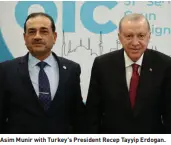

Turkey believes it can spark a sectarian crisis and then leverage United Nations diplomacy to empower Indian Muslims to further divide the country.
There has always been an undercurrent in Pakistani and Turkish Islamist discourse that no Indian Muslims should live under non-Muslim rule. On 6 August 2019, Pakistani Prime Minister Imran Khan said Pakistani founding father Muhammad Ali Jinnah had "supported the two-nation theory to give the Muslims of India a separate homeland that is free from bigotry and racism." Khan did not stop at the partition. He added that one day, "India will only be a country for the Hindus."
On 16 April 2025, Pakistani Field Marshal Asim Munir declared, "Our forefathers thought that we are different from Hindus in every possible aspect of life… We are two nations, we are not one nation."
Whereas much of Pakistan's earlier rhetoric focused on Kashmir, in recent years, as Pakistan's ally Turkey has pivoted toward a more Islamist foreign policy, Pakistan and Turkey have signalled sectarian ambitions beyond Kashmir.
At a 25 September 2019 UN hate-speech forum Turkey co-hosted with Pakistan on the sidelines of the UN General Assembly, President Recep Tayyip Erdogan asked, "In India, how will we defend Muslim youth who are being whipped, beaten by machetes and even sentenced to death just for eating beef?"
Speaking to young cadres from his own political party just five months later, Erdogan lamented the situation of Muslims living under Hindu rule. "India has become a country where massacres are rampant. What massacres? Massacres of Muslims. By whom? Hindus," he declared.
Turkey's state press is even more virulent. Ibrahim Karagül, the editor of "Yeni Safak", Erdogan's favourite newspaper and his regime's unofficial mouthpiece, on 29 April 2025, wrote, "If China and Turkey stand with Pakistan… India will be torn to pieces." He added, "The Mughal Empire, the Seljuks, the Ottomans, all will join this war!" On 8 May 2025, "Yeni Safak" published a guest editorial, India "has become unliveable for minorities," by Furqan Hamid, a prominent Pakistani columnist who heads the Urdu service for Turkish state television. The next day, columnist Hilal Kaplan wrote in "Sabah" that "An unnamed genocide of Muslims has been under way in India for some time…."
The irony, of course, is that Muslims enjoy far greater rights in India and Israel than in countries ruled by fellow Muslims. In Freedom House's latest annual rankings, Israel scores three points above Senegal and Albania, the high-ranking Muslim majority states. Freedom House analysts have historically been unfairly antagonistic to India, but even Freedom House acknowledges that India is far more tolerant and democrat than Indonesia, any Arab country, let alone Pakistan and Turkey which score alongside Algeria and Iraq.
The further irony of Munir and Erdogan's complaints, of course, is that both Pakistan and Turkey are the antithesis of tolerance. When Pakistan gained independence, it had large Christian and Hindu minorities and even considered major Christian and Hindu festivals and national holidays. Today, many Christians and Hindus have fled, as state-incited pogroms and maliciously applied blasphemy laws take their toll. And, while Pakistan supports the Khalistan movement in India, it fails to mention its eradication of Sikh communities in Pakistani Punjab.
India is the world's largest democracy and is almost among the most diverse countries in the world. It is both the most populous country not only for Hindus but also for Jains. Sikhs, Bahais, and Zoroastrians; it is the third-most populous country for Muslims. India's Christian population outnumbers the entire population of Australia. There are more than 270 languages with at least 10,000 mother tongue speakers, and more than 700 ethnic groups. Most citizens hold unquestioned loyalty to India and accept it as a multiethnic, multi-sectarian country.
For too long, Indian officials have assumed this attitude is immutable, but both Pakistan and Turkey, through media, social media, the organizations and charities they support now openly encourage radicalization, sectarian grievance, and entitlement to rule.
In the late 20th century, the greatest threat to countries came from invasion. China grabbed Aksai Chin, Pakistan seized about 30% of Kashmir. Elsewhere, North Korea invaded South Korea, North Vietnam annexed South Vietnam, Turkey seized a third of Cyprus, and Iraq invaded Kuwait. In the 21st century, insurgency and irregular warfare pose as great a threat. When Russia invaded Crimea, it did so first with irregulars. The Baltic countries acknowledge Russian outreach and incitement to their Russian-speaking minorities and expect both false flag crises and a campaign of sabotage to precede any broader invasion. Turkey also believes it can spark a sectarian crisis and then leverage United Nations diplomacy to empower Indian Muslims to further divide the country. With Erdogan now pushing his former foreign minister Feridun Sinirlioglu, the current Organization for Security and Co-operation in Europe secretary-general, to be the next UN Secretary-General, the threat is real.
It is far easier to incite Muslims to embrace extremism than to de-radicalise them. India faced a dry run in the 1980s as the Khalistan movement rained terror across India; should even one-tenth of India's 200 million Muslims respond to Pakistani and Turkish online radicalisation, India will face a civil war that at worst will be existential and more likely will hobble India's economy and investment for a quartercentury if not more. Unfortunately, too many in India's government and elite circles fail to understand Pakistan and Turkey's ideological outreach and desire to export their sectarian goals. India sleeps at its own risk.
Michael Rubin is Director of Policy Analysis at the Middle East Forum in Washington, DC, and a distinguished fellow at the Usanas Foundation.