




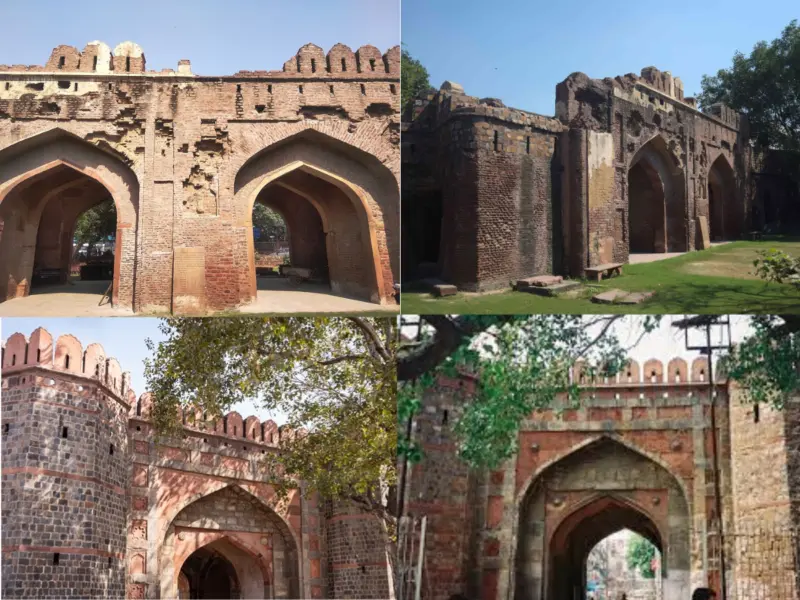

Whenever travelling in Delhi, one must have visited the Kashmere Gate Bus Terminal. Or arriving at the New Delhi Railway Station, one asks whether to exit from the Ajmeri Gate side or the Paharganj side.
You might think, what exactly are these gates, and what is the history behind it.
The Gates of Delhi- Strategic Importance
Gates were primarily built around Delhi for defence, crowd control, and access regulation. Historically, as empires and rulers established fortified cities like Shahjahanabad, massive walls and gates were erected to protect citizens from invading armies, monitor the entry of travellers and traders, and prevent fugitives or spies from entering.
The iconic historic gates-such as Kashmiri Gate, Turkman Gate, and Ajmeri Gate-were constructed as essential checkpoints in the walled city of Shahjahanabad, founded by the Mughal Emperor Shah Jahan in the 17th century.
The Gates of 7th City of Delhi- Shahjahanabad
To regulate trade, taxation, and military movement, the city wall was punctured by 14 major structural gateways and several smaller checkpoints (khirkis). Today, due to British demolitions following the 1857 Uprising and modern urban expansion, only 4 of the original 14 city gates stand completely intact, alongside one isolated gateway.
The 4 Surviving Gates
1. Kashmere Gate (The Northern Gateway)
Historical Significance: Named after the route leading toward Kashmir, Kashmere Gate served as an important entrance for Mughal rulers travelling north, including journeys to royal summer retreats.
1857 Revolt Connection: The gate played a crucial role during the 1857 Indian Rebellion, when freedom fighters used it as a defensive point inside the walled city. British troops eventually breached the gate by blowing apart its wooden entrance with explosives.
Architecture: Unlike most city gates, Kashmere Gate was later rebuilt by the British as a double-arched structure to allow easier military movement. Even today, marks from artillery attacks remain visible on the monument.
2. Delhi Gate (The Southern Gateway)
Historical Significance: Situated on the southern side of Shahjahanabad, Delhi Gate derived its name from its position facing the older settlements of Delhi, including Mehrauli, Firozabad, and Shergarh.
Architecture: Constructed using red sandstone, the gate features a large archway supported by strong defensive bastions and closely resembles the Lahori Gate of the Red Fort.
Current Status: Today, it functions as a prominent landmark and traffic junction between Old Delhi and New Delhi, near the Feroz Shah Kotla Cricket Ground.
3. Ajmeri Gate (The South-Western Gateway)
Historical Significance: Ajmeri Gate marked the route leading southwest toward Ajmer in Rajasthan, an important trade and pilgrimage destination.
Architecture: The structure features a tall central arch, decorative alcoves and defensive bastions that once accommodated guard rooms.
Current Status: Located opposite New Delhi Railway Station, the gate is now surrounded by a landscaped area that helps preserve it amid the busy commercial surroundings.
4. Turkman Gate (The Southern Border)
Historical Significance: Turkman Gate was named after Hazrat Shah Turkman Bayabani, a 13th-century Sufi saint whose tomb existed long before Shahjahanabad was built. Shah Jahan constructed the gate near the shrine as a mark of respect.
Architecture: Built using quartzite stone with red sandstone detailing, the gateway features a compact yet sturdy design with square-shaped guard spaces.
Modern History: The area around Turkman Gate later gained attention during the Emergency in 1976, becoming associated with the controversial demolitions and riots of that period.
The Other Gates
·Lahori Gate (Walled City): Located at the western end of Chandni Chowk. It faced Lahore (now in Pakistan) and was the most commercially bustling gate of the city. It was demolished in the late 19th century to expand the local markets, though the area is still known as Lahori Bazar. (Note: Do not confuse this with the surviving Lahori Gate of the Red Fort).
·Mori Gate: Situated on the northern wall near Kashmiri Gate. The word Mori means a drain or small opening. It was used to flush out urban waste and allow small livestock to pass. It was completely breached and dismantled by the British to widen roads for heavy vehicular traffic.
·Kabuli Gate: Located on the north-west side between Mori and Lahori gates. It was the starting point for the northern trade caravans travelling toward Kabul, Afghanistan. The structure was entirely erased during the British restructuring following the Revolt of 1857.
·Farash Khana Gate: Situated on the southwestern perimeter, it led out to the Royal carpet-weaving, tent-making, and storage yards (Farash Khana). The gate structure has vanished, but it remains a prominent residential and commercial locality name in Old Delhi today.
·Calcutta Gate: Built on the northeastern edge. It was named because it faced the direction of Calcutta (Kolkata) via the Grand Trunk Road. The British completely dismantled it in the late 1860s to lay down the first railway line network entering Delhi.
·Rajghat Gate: Located on the southeastern front, it provided access to the old riverbanks and the historic Akhbari Mosque. The gate vanished as the course of the Yamuna River naturally shifted eastward over time.
·Khizri (or Khairati) Ghat Gate: Built on the riverbank near the Zeenat-ul-Nissa mosque (Ghata Masjid). It was an imperial water-gate used by the royal family and high-ranking court merchants for riverine transit.
·Kela Ghat Gate: Situated between the Pani Burj and Nigambodh Ghat. It was named after the local riverside banana (Kela) wholesale markets. The remains of this gate were cleared during the construction of the modern Inner Ring Road.
·Badar (or Badarroo) Darwaza: A peripheral, minor gate located along the northeastern ramparts. It was used for local sanitation and military patrol access but was lost entirely to urban decay and post-independence development.
·Nigambodh Gate: It stands near the sacred Nigambodh Ghat and has a significantly lower clearance compared to the massive landward gates.