




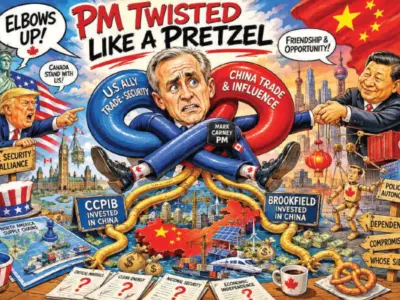

Canada's Prime Minister now confronts realities that no amount of political theatre can overcome. Geography matters. Trade matters. Security matters.
When President Trump r e – turned to office, one of his first targets was Justin Trudeau, for whom he had little regard. His early attacks on Canada included suggesting the country would be better off as the 51st state. Months later, Trudeau resigned under pressure from Liberal insiders, ushering in the Mark Carney era. Using Trump as a political foil and an "Elbows Up" strategy, Carney led the Liberals to victory over the Conservatives, who squandered one of the largest polling leads in Canadian history. Carney's message centered on distancing Canada from Washington. His government's renewed strategic partnership with China, followed by his widely discussed Davos speech advocating a new world order less dependent on the United States, underscored that approach. The speech was a sharp rebuke of Trump Republicans and their stance toward Europe and traditional allies. Meanwhile, the United States was pursuing a new security posture, advancing a modern Monroe Doctrine focused on threats from Venezuela, Iran, and, most significantly, China-a shift that forced Europe and other allies to reassess the changing global landscape.
Fast forward to a week ago Thursday and speaking before the Economic Club of New York, Carney revealed something markedly different in tone and substance. Addressing Wall Street investors and American business leaders, the Prime Minister called for what he described as a "true partnership" with the United States, one that would deepen strategic cooperation while strengthening Canada's economic resilience. He spoke of Canada becoming stronger, more sovereign, and more self-reliant while simultaneously arguing that North America's future prosperity depends on closer continental cooperation. Going so far as to say the path to making America Great Again was through a partnership and this statement had US Ambassador to Canada, Pete Hoekstra commending the PM for this statement. But before we get to the political and economic calculation let's follow the money. Canada's 714 billion (CAN) dollar pension fund administered by the Canada CCPIB has been divesting of China assets and conversely investing in the US according to the 2025 annual report. In fiscal 2024 CPPIB explicitly cited geopolitical tensions and regulatory uncertainty in China as reasons the market became more challenging. In fact, Asia-Pacific allocation dropped from 26 to 21% respectively a 19.2% decline. According to reports 9.8% of the portfolio or $69 Billion of Canadian taxpayer funds compared to US pension fund which has 95 B Canadian is invested in Chinese corporations. Brookfield Asset Management who secured a 256 million distressed assets loan arranged by the PM with Xi Jinping in 2024 still hangs over the PM's head in certain circles in Canada. Global investors have also voted with their feet. Foreign purchases of Chinese equities have collapsed from roughly US$100 billion in annual inflows to near US$5 billion, a staggering decline that underscores the loss of confidence in China's economic outlook.
What was once viewed as an indispensable growth market is now increasingly seen as a geopolitical and regulatory risk. The PM is a banker by trade, so it is clear he also understood that lack of confidence and risk in taking Canada down the strategic partnership path as opposed to improved trade with China to which the American's are also angling for as Trump fawned over Xi Jinping yet again during his trip to China. He won the politics of the day but the obvious question: What changed? The answer in part is that campaigning using a wedge issue and governing are two very different exercises. Carney now confronts realities that no amount of political theatre can overcome. Geography matters. Trade matters. Security matters. And increasingly, so does the American awareness of the growing convergence between organized crime, fentanyl trafficking, illicit finance, and foreign-state influence operations using Canada as a Hybrid Warfare backdoor to the United States. Buy using US democratic pundit James Carvelle famous quote, "it is the economy, stupid." And Canada is faltering on jobs and GDP growth. In New York, Carney argued that "a country that cannot feed, fuel or defend itself is not truly sovereign." He also acknowledged that economic integration has become "weaponized" in an increasingly unstable world. (AP News) Those remarks were significant not because they rejected North American integration, but because they reframed it through a Canada that seems to be embracing its role as a potential energy superpower. Rather than seeking distance from the United States, Carney appears to be attempting to renegotiate the terms of engagement. The emerging doctrine is not separation. It is something closer to a Fortress North America strategy, one in which Canada strengthens its own capabilities while embedding itself more deeply into a continental security and economic framework.
This is something many including myself have expressed for a number of years but between China's hold and some Canadian elite who loathe the US it has not been advanced. That shift becomes even more apparent when examining Ottawa's recent actions and new signals to Washington because we seemed to be rejecting the American's and our own best intelligence for years that suggested a much bigger issue with China than the mainstream media wanted to report about. For years, American lawmakers and security officials have expressed frustration over Canada's vulnerabilities relating to money laundering, fentanyl precursor trafficking, organized crime, and transnational criminal networks. Canada's reputation as a destination for illicit capital has increasingly become a source of tension within the bilateral relationship. In 2024 the TD Bank was fined 3.1 Billion US for their role (under Biden administration) in laundering billions in illicit funds derived through fentanyl trafficking. As part of the deal both the CEO and the Chair of the board resigned. The Carney government now appears determined to address those concerns. Ottawa has expanded anti-money laundering initiatives, strengthened intelligence-sharing mechanisms, elevated the role of Canada's fentanyl czar, and publicly acknowledged the growing threat posed by criminal organizations operating across borders. Canadian authorities are also increasing efforts to trace fentanyl production, human trafficking and disrupt organized crime financing networks. None of this is happening in isolation. With the mandatory review of the United StatesMexico-Canada Agreement (USMCA) approaching on July 1, Ottawa now seems to understand that securing economic stability will require demonstrating seriousness on border integrity, organized crime, defence spending and national security. (AP News) Yet the most important factor behind Carney's evolving posture may be China and what they may need to give up to get to where they want.
The address in NY came as Chinese Foreign Minister Wang Yi was set to land in Canada seeking more engagement, Ottawa was quietly sending signals to allies and the US on freedom of navigation. Last week, HMCS Charlottetown continued its IndoPacific deployment as part of Canada's commitment to the defence of international maritime norms by navigating and passing through the Taiwan Straight. Canada's continuing support for freedom-of-navigation operations and regional security cooperation sends a message that Ottawa remains firmly aligned with democratic partners confronting growing Chinese assertiveness. For those of us who have spent years examining the Chinese Communist Party's infiltration operations, transnational repression campaigns, organized crime relationships, and hybrid warfare strategies, this development is impossible to ignore given Canada was warned by China not to pass through the straight. Perhaps both the economic calculus and strategic environment have changed for the Carney Liberals for good. Time will tell. China's influence operations, the global fentanyl supply chains through Canada and Mexico, illicit finance networks, Arctic competition, and economic coercion are increasingly viewed by Western governments as interconnected challenges rather than isolated issues. That reality should naturally drive Canada closer to the United States. It also explains why U.S. Ambassador Pete Hoekstra responded positively to Carney's now-famous observation that a stronger Canada can help "make America great again." Washington is hearing a different message from Ottawa than it heard during the election campaign and through most of 2026. The confrontational language has not disappeared entirely, but it is being replaced by something more pragmatic: an argument that Canada is indispensable to American energy security, critical mineral supply chains, Arctic defence, manufacturing resilience, and continental security. In short, Mark Carney has not suddenly become an American enthusiast but rather, he appears to have concluded that Canadian sovereignty is strengthened and not weakened through a renewed strategic partnership with the United States and Mexico through a stronger CUSMA but he has China in his back pocket and many in Ottawa feel that they are more reliable than America under Trump.
The irony is striking. The politician who rose to power criticizing Washington may ultimately become the architect of the deepest Canada-U.S. strategic integration since the original free-trade era. The "elbows up" campaign may have won votes, but it also fostered suspicion of our closest ally while encouraging the dangerous illusion that China could somehow emerge as a credible alternative for trade diversification. It cannot. Canada cannot replace the American market, and the United States cannot easily replace Canada. Geography, economics, energy, critical minerals, and security bind us together in ways no political slogan can erase. The reality is that Beijing's economic coercion, dominance in critical mineral processing, and growing geopolitical ambitions make North American integration not merely desirable but increasingly necessary. What is quietly emerging is something closer to a continental strategy-what Ontario Premier Doug Ford has aptly described as "Fortress North America." Time will tell whether this strategic pivot endures, but Prime Minister Carney appears to have turned a corner, forced less by ideology than by the realities of the hand he has been dealt. The campaign warrior who rode to office with "Elbows Up" is now discovering that governing requires a steadier stance. The challenge ahead is that Canada is skating on very thin geopolitical ice. The cheers from the campaign trail have faded, and the hard work of protecting Canadian prosperity and sovereignty has begun. In that environment, "Elbows Up" may have been good politics- but "Elbows Down" may prove to be the better statecraft.
* Dean Baxendale is Columnist, Author and CEO of Optimum Publishing International.