
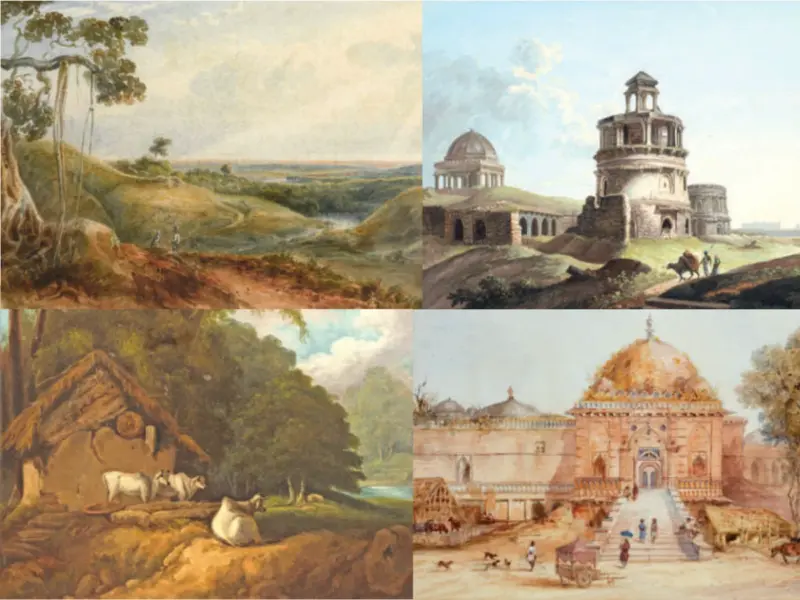

At its most basic, art is meant to delight and provide joy. Yet, it also plays an important role as a visual chronicle of history. One of the best custodians of art that offers a story is DAG, which has a vast collection of historic, classic and contemporary art.
For its latest show in Delhi, the team has put together an exhibition titled 'Indian Picturesque: Landscape Painting 1800-1850', presenting fantastic examples of British and Indian landscape paintings from the early nineteenth century. Curated by Giles Tillotson, Senior Vice President of DAG, the exhibition runs from March 28, 2026 for five weeks.
He explains, "Through the exhibition, we hope to examine the artistic interconnections and shared visual vocabulary of the landscape painters of that time from India and Europe. Tracing the evolution of the picturesque aesthetic in India, the exhibition highlights how artists across cultural contexts shaped a distinctive vision of the subcontinent. With a focus on the generation of artists active in the decades after pioneering British landscape painters such as William Hodges and Thomas and William Daniell, The Indian Picturesque charts the continued development of the picturesque idiom and its reassessment through painting, printmaking and travel imagery. In doing so, it reflects contemporary scholarly debates that consider the picturesque not only as a defining contribution to Western aesthetics but also as a visual language historically entwined with imperial expansion and territorial imagination."
Some of the most distinctive works on display include the large-format aquatints of Henry Salt and James Baillie Fraser, which were inspired by the Daniells, as well as more intimate rural landscapes by George Chinnery. The influence of these renowned artists encouraged numerous amateur painters across Bengal to create illustrated travelogues and prints, in turn expanding the reach of this picturesque imagery and shaping the idea of India's culture and landscape across the subcontinent and beyond it.
An accompanying publication furthers the idea of the exhibition by presenting oil paintings, watercolours and drawings; prints, including aquatints, engravings and lithographs; and ceramics. This shows that picturesque imagery had proliferated into popular culture with decorative arts as well.
These mediums show the variety of exchange between British and Indian artists, as well as the transition that was taking place in patronage from royal patrons of the courtly tradition to new forms of artistic production being made for commercial publishing and sale.
Ashish Anand, CEO and MD, DAG, notes, "Our appreciation of landscape is always tinged with nostalgia, and most of us are drawn to images of places before the incursions of modernity - the motorways, skyscrapers and the urban sprawl. So, even if we suspect that the view of India handed down to us by British artists of the past is a bit unrealistic, we are inclined to give them the benefit of the doubt. Their sanitised depictions of India's past accord with our own preferences for its less crowded, unspoilt corners. Besides, Indian artists also adopted the picturesque, as our collection clearly shows. Indeed, this exhibition is the first to display British and Indian landscape paintings of the early nineteenth century together, and to explore their interconnections."
He continues, "While oil paintings capture atmospheric rural scenes and monumental vistas, often reflecting European academic techniques, watercolours and drawings reveal the immediacy of sketching practices, especially among Company artists and amateur travellers. Aquatints and engravings demonstrate the commercial success of illustrated publications, enabling wider circulation of picturesque imagery, while lithographs and travelogues combine text and image to expand the genre of visual narrative. Ceramics and decorative objects further illustrate how picturesque motifs entered domestic and popular visual culture, particularly in Britain."
The works that capture this premise best are George Chinnery's 'Oxen by a Thatched Dwelling', 'India' and 'Figures by a Tomb in Bengal', Thomas Prinsep's 'View of the Chittagong Delta', a Murshidabad School depiction of 'The Tomb of Shaikh Ibrahim Chishti', prints such as Henry Salt's 'A View at Lucknow' and James Baillie Fraser's 'Gungotree, the Holy Shrine of Mahadeo', as well as works by Sita Ram, Robert Melville Grindlay, James Atkinson and Claudius R. W. Harris.
Tillotson says, "Complementing the exhibition is an accompanying publication that brings together new scholarship by leading experts and situates the project within broader intellectual and historical contexts. Essays explore the evolution of the picturesque in India from colonial to contemporary perspectives, the role of amateur sketching networks, and the exchanges between British and Indian practitioners that defined the period's visual culture."
His own essay in the book highlights artists who first arrived in the Indian subcontinent in the wake of the early pioneers in this field, and adapted the idea of the picturesque to new formats and subject matter. Sonal Singh explores the work of Indian artists in this context and Tom Young looks at the role of amateur practitioners in popularising this visual culture.
Anand summarises the appeal of this exhibition by saying, "Through its carefully curated selection of paintings, prints, drawings and decorative arts, 'The Indian Picturesque: Landscape Painting 1800-1850' invites audiences to reconsider the visual construction of landscape and modernity in India. By presenting British and Indian works in dialogue, the exhibition offers a nuanced understanding of artistic exchange, aesthetic transformation and the enduring appeal of picturesque imagery shaped by history and memory."
Noor Anand Chawla pens lifestyle articles for various publications and her blog www.nooranandchawla.com.