
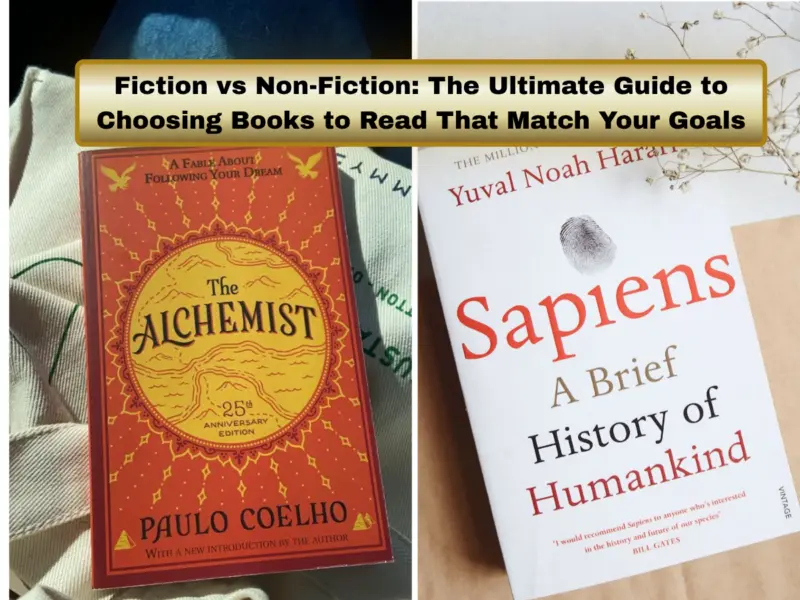
Choosing the right books becomes much easier when you understand both genres in depth. Fiction helps you escape into stories and imagination, while non-fiction builds real-world knowledge and practical understanding.
Below is a structured guide with each book explained separately to help you decide what to read next.
Fiction Books to Read: Stories That Entertain, Inspire & Stay With You
The Alchemist by Paulo Coelho
The Alchemist follows Santiago, a young shepherd who dreams of discovering a hidden treasure. His journey turns into a spiritual quest where he learns that true fulfillment comes from following one's "Personal Legend." The book blends simplicity with deep philosophy about destiny, purpose, and self-discovery.
1984 by George Orwell
1984 presents a chilling dystopian world ruled by constant surveillance and strict government control. The story follows Winston Smith as he quietly rebels against a system that manipulates truth and suppresses freedom. It remains a powerful warning about authoritarianism and loss of individuality.
Harry Potter Series by J.K. Rowling
The Harry Potter series follows a young boy who discovers he is a wizard and attends Hogwarts School of Witchcraft and Wizardry. Across seven books, Harry and his friends battle dark forces while learning about friendship, courage, and sacrifice in a richly built magical world.
The Kite Runner by Khaled Hosseini
The Kite Runner tells the emotional story of Amir and Hassan, two childhood friends in Afghanistan whose relationship is shaped by betrayal, guilt, and redemption. The novel explores themes of friendship, forgiveness, and the impact of political conflict on personal lives.
To Kill a Mockingbird by Harper Lee
Set in the American South, this novel follows young Scout Finch as her father, Atticus Finch, defends a Black man wrongly accused of a crime. The story addresses racial injustice, moral growth, and empathy through a child's perspective.
The Great Gatsby by F. Scott Fitzgerald
The Great Gatsby revolves around the mysterious millionaire Jay Gatsby and his obsession with Daisy Buchanan. Set in the glamorous 1920s, it explores wealth, love, illusion, and the emptiness hidden behind the American Dream.
The Book Thief by Markus Zusak
Narrated by Death, The Book Thief follows Liesel, a young girl living in Nazi Germany who finds comfort in stealing books. The story highlights the power of words and storytelling during times of war and suffering.
Non-Fiction Books to Read: Real Knowledge, Insights & Life Lessons
Atomic Habits by James Clear
Atomic Habits explains how small, consistent habits can lead to major life changes over time. It focuses on practical systems for building good habits, breaking bad ones, and improving productivity through incremental improvements.
Sapiens: A Brief History of Humankind by Yuval Noah Harari
Sapiens traces the journey of human evolution from early hunter-gatherers to modern civilization. It explores how biology, culture, and technology have shaped human societies and the way we live today.
Think and Grow Rich by Napoleon Hill
This classic self-help book outlines principles of success based on studying wealthy and successful individuals. It emphasizes mindset, desire, persistence, and belief as key drivers of financial and personal achievement.
The Power of Now by Eckhart Tolle
The Power of Now focuses on mindfulness and living fully in the present moment. It teaches readers how to break free from overthinking, reduce stress, and find peace through awareness.
Educated by Tara Westover
Educated is a memoir of Tara Westover, who grew up in a strict and isolated household but later pursued education against all odds. Her journey highlights resilience, transformation, and the power of learning.
Deep Work by Cal Newport
Deep Work explores the importance of focused, distraction-free concentration in achieving high-quality results. It argues that deep focus is a critical skill for success in a distracted digital world.
Rich Dad Poor Dad by Robert Kiyosaki
This book compares two financial mindsets-one focused on traditional job security and the other on financial independence. It teaches readers how to think differently about money, investing, and building wealth.
Fiction and non-fiction both play important roles in shaping your reading journey. Fiction expands imagination and emotional understanding, while non-fiction builds real-life knowledge and practical skills. The best approach is often a mix of both, depending on your mood, goals, and curiosity.
Disclaimer: This article is based on curated recommendations and reading trends. Readers are encouraged to explore books based on personal preferences.