
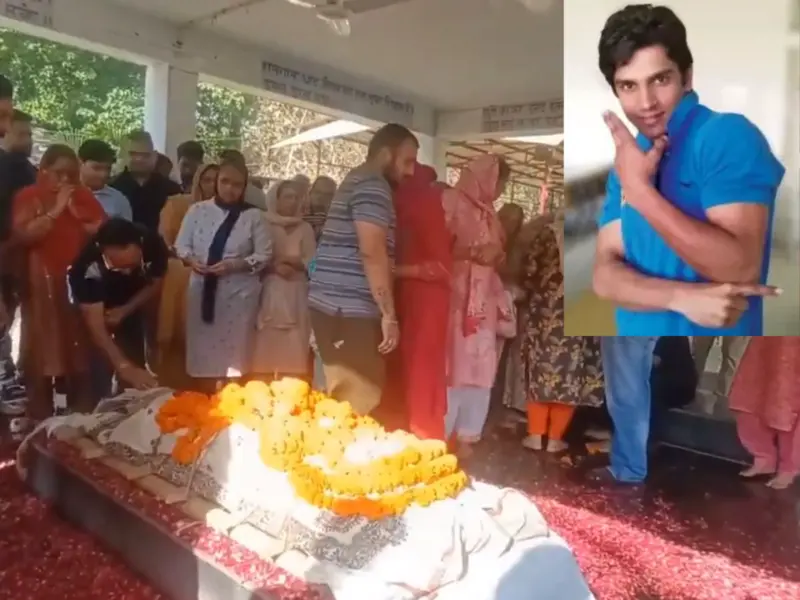

Harish Rana Funeral: A landmark legal and medical episode in India came to a solemn close on Wednesday as Harish Rana, the first person in the country ever granted permission for passive euthanasia by the Supreme Court of India, was cremated in South Delhi's Green Park Cremation Ground with close family and spiritual volunteers present.
Rana had been in an irreversible vegetative state for more than 13 years following a tragic fall from a fourth-floor balcony in 2013, while studying engineering. Doctors said there was no hope of recovery, and he remained entirely dependent on medical support.
Harish Rana Funeral: A Story of Legal and Emotional Journey Ends as Harish Rana is Cremated in Delhi
In early March, India's top court took the rare step of officially allowing the withdrawal of life-sustaining treatment for Rana under the legal framework of passive euthanasia, a process where doctors and caregivers stop medical interventions that keep a patient alive, letting nature take its course while ensuring comfort through palliative care.
The Supreme Court clarified that while feeding tubes or similar medical support could be stopped, palliative care must continue so that the dying process respects human dignity.
Just days before his death, Rana was shifted from his home in Ghaziabad, Uttar Pradesh, to the palliative care department of the All India Institute of Medical Sciences (AIIMS), New Delhi, for the final stages of this process.
Harish Rana Funeral: The Family Struggle to Keep Their Son Alive
For 13 long years, Rana's parents, Ashok Rana and Nirmala Devi, devoted every moment and resource to caring for their son at home. Neighbours recall how the family went to great lengths - even selling their home to pay for medical care - in the hope of seeing him improve.
"It is so sad. The family did everything they could for him all these years," one neighbour said, expressing collective grief in the community.
In the final days, members of the Brahma Kumaris and other spiritual volunteers visited to offer prayers, urging him to "sleep peacefully" in a video that circulated widely online.
Harish Rana Funeral: Family Chooses to Donate His Heart Valves and Corneas
According to news agency ANI, Harish Rana's family donated his heart valves and corneas following his death. The Association for Advancing Tissue and Biologics explains that heart valves can be donated posthumously and used in life-saving or life-enhancing transplants. The National Institutes of Health states that heart valves are typically harvested within 24 hours of death.
The NHS Organ Donation notes that corneas, which do not contain blood vessels, carry minimal risk of transmitting most diseases. Donated corneas can help patients with corneal blindness or eye damage regain their vision. Usually, corneas are removed in a brief 15-minute procedure within 6 to 8 hours after death.
Who is Dr Seema Mishra, HoD, Onco-Anaesthesia?
Harish Rana was under the care of a dedicated team of doctors and was admitted to the Palliative Oncology Unit (IRCH), led by Dr. (Prof.) Seema Mishra, HoD, Onco-Anaesthesia.
Harish Rana, who had remained in a permanent vegetative state for 13 years after a 2013 accident, was admitted to the palliative care ward at AIIMS Delhi on Saturday, March 14, 2026. He underwent passive euthanasia under a Supreme Court order, becoming the first person in India to have life support legally withdrawn, and he passed away on Tuesday, March 24, 2026.
Harish Rana Funeral: What is Passive Euthanasia? First Ever Case in India of Harish Rana
India allows passive euthanasia - legally distinct from active euthanasia - in limited situations under Supreme Court guidelines established over the past decade. These landmark rulings clarified that withdrawing certain medical treatments is permissible for terminally ill patients or those in a permanent vegetative state, provided strict safeguards and court permissions are met.
Although the law recognised the right to die with dignity years ago, Rana's case marked the first practical implementation of this provision in India, moving beyond theory to real-life legal and ethical application.
Harish Rana Funeral: End of a Chapter in India's Medical History
Rana's passing brings to a close a deeply personal story that also became national news, sparking widespread public and professional debate on ethical end-of-life decisions. Experts say his case could shape how future cases of long-term vegetative conditions and end-of-life care are handled in India.
The debate continues among medical ethicists, legal scholars and families facing similar situations about how best to balance the sanctity of life with dignity in suffering.
As Harish Rana's loved ones grieved his loss and laid him to rest, many in the country reflected on his journey - one of tragedy, resilience and ultimately, a legal milestone in Indian healthcare.