




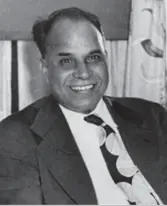

If modern medicine has an invisible architecture, vital load-bearing pillars bear Dr Subbarow's fingerprints.
It is a frequent phenomenon that social media lights up with stories of unsung Indian scientific heroes.
For a fleeting moment, a forgotten name captures our collective imagination. We see these individuals' stories and achievements shared everywhere for a day or two. People express genuine dismay at their lack of representation, questioning the historical biases that left them out of textbooks. However, as the digital news cycle moves on rapidly, the conversation inevitably fades, and these individuals, with all their achievements, quietly fade into obscurity. Dr Yellapragada Subbarow is frequently at the centre of these passing tributes.
However, his legacy deserves far more than a brief moment of retrospective grievance. If modern medicine has an invisible architecture, vital load-bearing pillars bear his fingerprints. His laboratory work did not just yield a single lucky breakthrough. Instead, it fundamentally altered how we understand human biology. Alongside Cyrus Fiske at Harvard in the 1920s, he co-discovered the ATP molecule itself, which we now know serves as the universal energy currency of living cells. Many of the works were so foundational that they remain cornerstones of global biochemistry even today.
Later on, moving away from academia, Dr Subbarow expanded his work. As director of research at Lederle Laboratories, he and his team synthesized folic acid. They developed aminopterin and methotrexate, the antifolate drugs that Dr Sidney Farber famously used to achieve the world's first remissions in childhood leukaemia. Subbarow also oversaw Benjamin Duggar's research that yielded Aureomycin, the first broad-spectrum tetracycline antibiotic. He also spearheaded the development of Hetrazan (diethylcarbamazine), which remains the World Health Organization's frontline defence against filariasis (elephantiasis).
Despite all these fundamental achievements, Subbarow remains merely a footnote or passing reference. As Indians, upon reading about him and his scientific breakthroughs, we ask why he never won a Nobel Prize. This leads to a broader discussion of why societies in the Global South repeatedly produce brilliant individuals while routinely failing to build the institutions necessary to sustain them. The reflection and criticism towards a West-led scientific hierarchy and system is genuine, even obvious. But one also needs to ask, do we in the Global South accord that overdue acknowledgment to such voices and works of individuals like Dr Subbarow?
Science is usually narrated as a sequence of lone geniuses. Newton under the fallen apple and others like Raman and his spectrometer. They create an attractive fiction because it makes history easier to digest. But reality is different, as one sees functionality behind discoveries. Such discoveries survive because laboratories, tenure committees, risk-tolerant funding agencies, clinical networks, and industrial supply chains drag them across the finish line.
Dr Subbarow's life captures this friction perfectly. Born in the Madras Presidency, he was an early detractor of colonial norms by supporting the freedom struggle. Notably, he wore khadi surgical gowns in response to Mahatma Gandhi's swadeshi call, which earned him the ire of his British professors. He was denied a full MBBS degree and had to settle for a lesser licentiate instead. He then went to America to continue his education, where he quickly found that Western meritocracy had its own brutal ceilings. Despite his monumental work on ATP, Harvard University refused to grant him a permanent faculty position, leaving him to languish in junior, poorly compensated roles.
After facing the rigid academic hierarchy, he finally turned to private industry at Lederle, where he found the institutional backing to match his intellect. Here is something we miss in stories like his, where success is achieved not merely through an individual's efforts but also through the necessity of an ecosystem that enables it. At Lederle, he finally built an ecosystem by facilitating other scientists and scholars. This, in all, tells us that scientific leadership is about directing collective effort, managing talent, and marshalling resources.
India today sits at an incredibly promising historical juncture. The language of innovation is everywhere, driven by a government that is inaugurating new research campuses at a breakneck pace and investing significant political will to make India a global hub for semiconductor manufacturing, biotechnology, and artificial intelligence. But transforming from a developing nation into a scientific superpower requires more than state-of-the-art infrastructure; it requires an evolving ecosystem.
The government is undeniably doing the heavy lifting by laying the physical and financial groundwork, but the academia and the broader scientific community must now actively cultivate the institutional habits that sustain world-class research. Cultivating and encouraging the scientific temperament longterm will ultimately require marrying this strong state backing with a more agile institutional culture. Leaning into the private sector to support R&D and even diverse projects is something that India has to be comfortable with. Hyderabad-based startup Skyroot Aerospace's recent success with Vikram-1 demonstrates that the private space industry can make significant contributions. We must have the vision to ensure that the private sector complements government efforts.
We crave the prestige of a Subbarow, which means we must continue building environments that tolerate the messy, unquantifiable nature of discovery. True scientific culture thrives when funding agencies complement the government's vision by prioritizing long-term, high-risk curiosity-driven research. It demands university departments in which a junior researcher questioning the department head is viewed as intellectual progress, not a matter of personal vengeance. It would require making an ecosystem that treats a failed hypothesis as a vital stepping stone rather than a setback.
This also means focus on interdisciplinarity. Subbarow moved fluidly across biochemistry, pharmacology, microbiology, and oncology. He followed the problem, not the publication metric. Today, as India's academic structures modernize, encouraging this kind of intellectual mobility and interdisciplinary freedom will be the key to unlocking the full potential of our researchers. When we reflect on Subbarow's legacy, it should not be to complain about historical slights, but to recognize that global recognition is the natural byproduct of a mature, wellsupported scientific ecosystem.
The enduring strength of any scientific superpower lies in the steady, well-funded machinery of thousands of unnamed researchers quietly producing reliable knowledge, backed by institutions that evolve alongside them.
Dr Subbarow operated with a severe intellectual humility, seemingly indifferent to his own fame. Millions of people who survived leukaemia, bacterial infections, and tropical diseases will never know how to pronounce his name. Their survival is his actual legacy, a testament to patient, cumulative, and collaborative work. And if we are serious in our resolve to honour our historical pioneers, we must actively support the ongoing transition of our research institutions.
As the government continues to increase R&D investments and streamlines procurement processes for laboratory equipment, the broader scientific ecosystem must rise to the occasion. These foundational reforms, coupled with progressive laboratory management, are exactly what will keep our brightest post-docs thriving in domestic labs rather than seeking opportunities abroad. Today, India is a confident scientific nation, looking firmly toward the future. The collective goal, shared by the state, academic institutions, and citizens alike, is to ensure that the next generation has the capital, the operational freedom, and the institutional confidence to change the world, but this time around, we ensure that the names of our scientists and scholars are not footnotes but titles.
*Prof Santishree Dhulipudi Pandit is the Vice Chancellor of JNU.