

In an active war, communication becomes as important as combat itself. The current U.S.-Iran conflict has made this visible again in a new visual vocabulary.
While the United States is pushing video game-style edits that echo Call of Duty and films like Top Gun, Iran is turning to rap music and Lego-style animation for its messaging. The styles may differ, but the objective is the same: to win not only on the battlefield, but also in the battle over narrative. This is the essence of psychological warfare: the weaponisation and manipulation of information to shape public opinion, influence morale, and generate fear, consent, or hostility.
Some scholars have begun calling this new information environment "slopaganda", a portmanteau of 'AI slop' and 'propaganda', to describe AI-generated content used to shape emotion and attention for political ends. Slopaganda is faster, cheaper, and more personalised than earlier forms of influence work. Yet the logic itself is not new. Long before social media, war was fought through posters, rumours, leaflets, films, and carefully managed narratives. To see how little the underlying strategy has changed, it helps to look at a case where the propaganda theatre was unusually intense and well-documented: India during the Second World War, when the subcontinent became a propaganda battleground shaped by competing British and Japanese messaging.
A Colony Drawn Into a War It Did Not Choose
In September 1939, Viceroy Lord Linlithgow declared, on the imperial government's behalf, that the subcontinent was at war with Germany. He did so without consulting the Legislative Assembly or any Indian political leader. The Indian National Congress, the largest political party in the country, resigned from provincial governments in protest. And yet, by August 1945, more than 2.5 million Indians had enlisted under the British flag. The Indian Army had become the largest volunteer force in history. That paradox, a colonised nation sending the largest volunteer army the world had ever seen to fight for its coloniser, was not an accident of sentiment. It was built through planning and propaganda.
When the war began, the British Indian Army numbered just over 200,000 men. After the fall of France in June 1940, London abandoned earlier assumptions that India would contribute only modestly to a European war. Recruitment expanded rapidly: 456,000 by the end of 1940, over 900,000 by the end of 1941, and more than 1.5 million by the end of 1942. India also supplied raw materials such as food, cotton, and jute, and industrial production ranging from ammunition to military textiles. War loans, taxation, and rationing financed the British war effort. All of this required consent, or at least acquiescence, from a population in which the nationalist movement was stronger and more organised than it had been in 1914.
The British Machinery of Persuasion
British authorities tried to present the war not as an imperial order imposed on Indians but as a shared cause in which Indian dignity, family, and national honour were themselves at stake. Combined with the coercive authority of the colonial state and the use of existing administrative structures, this strategy of enabled the mobilisation of Indian manpower and resources.
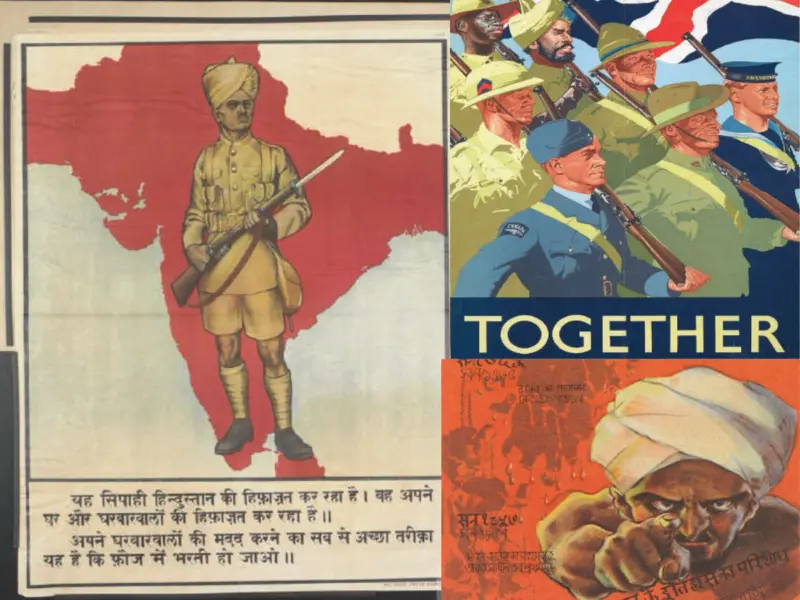
To recruit soldiers, posters were one of the primary tools. One such poster depicts an Indian soldier standing before a map of the subcontinent. The Hindi text reads: "This soldier is protecting Hindustan. He is protecting his home and his family. The best way to help your family is to enlist in the army." Posters such as these were produced in multiple Indian languages, presenting military service as both a respectable profession and a patriotic duty. The British effort to present the war as a joint cause is evident in posters depicting soldiers from across the Commonwealth marching side by side under the Union Jack, accompanied by slogans such as "Together."
After the Quit India Movement of August 1942, in which Congress leaders were arrested and protests disrupted communications and supply lines, the propaganda effort became more urgent and more coordinated. Protests spread across the country, and demonstrators disrupted communication networks and military supply routes. The colonial state responded with force, arrests, censorship, and a wider publicity campaign. The colonial government established the National War Front (NWF) under the Director of War Publicity, which focused on grassroots outreach. Its pledge, recovered by historian Debashree Mukherjee, captures the tone: "I solemnly pledge myself to stamp out defeatism and suppress alarmist rumour, to face and defy every peril threatening India's national honour and security." Morale was treated, explicitly, as a weapon of war.
The NWF and related bodies produced Pamphlets and posters, along with static and mobile information kiosks, exhibition displays, radio broadcasts, and theatre advertisements, were widely used. Pocket-sized booklets portrayed military life attractively, while publications recounted stories of soldiers and training experiences. Recruitment films screened by travelling cinema units carried persuasive titles such as Taraqqi (Progress), Future Leaders of India, Soldiers of the South, and Johnny Gurkha among others. In 1941-42, a defence services exhibition train travelled 1,500 miles through central and southern India, bringing military equipment displays to rural populations.
The Japanese Counter- Narrative
As Japanese forces advanced through Southeast Asia, India became the site of a parallel propaganda battle. The fall of Burma in 1942 brought the war to India's doorstep, and with it, a rival vision of Asia's future. If British posters urged enlistment in the name of duty, defence and family, Japanese propaganda sought to turn anti-colonial anger into political opportunity. It positioned Japan as the liberator of Asia and Britain as the brutal oppressor whose rule had brought India famine, massacre and humiliation.
These leaflets and posters were aimed at both civilians and soldiers, especially those stationed near the eastern front along the Burmese border. These posters and leaflets were striking and often produced in multiple languages. Their imagery was designed to be immediate and emotive, so that even those with limited literacy could grasp the message. Many relied on caricature, exaggeration and symbolic contrast. One recurring figure was a hybrid imperial villain, drawn on the visual template of John Bull (popular national personification of England), and made to resemble Winston Churchill, shown chaining Indians, or feasting while Indians starved.
The strategy was clear: show the range of historical grievances and oppression to provoke the viewer. Colonial rule and its administrators were show to promote violence, hunger and theft of resources from the country. Japanese propaganda drew heavily on episodes already charged with emotional power in Indian memory. A image linked multiple moments of violence across Indian history, urging the viewer to see the pattern of colonial injustice. The Jallianwala Bagh massacre of 1919, the uprising of 1857, the Bengal famine, the Battle of Plassey of 1757, and the sacrifices of Indian soldiers in earlier wars were all used to argue that British rule had always depended on bloodshed and betrayal. One leaflet invoked Amritsar directly, telling viewers that anyone unmoved by its memory could not call themselves Indian.
At the same time, Japanese posters offered an alternative vision. Some depicted Asian solidarity through images of Indian and Japanese soldiers standing together, or groups of Asian men raising a toast to a shared future. Others imagined an independent India freed from British rule, contrasting an idyllic life of dignity and abundance with the suffering of colonial subjection. This was the visual politics of "Asia for Asiatics": a promise that Japan and India were partners in a larger anti-Western struggle. Whether sincere or strategic, the appeal was carefully calibrated to Indian anti-colonial sentiment.
Yet these posters also carried a contradiction. They spoke the language of liberation while serving the ambitions of another imperial power. Japan presented itself as the emancipator of Asia, but its rhetoric of Asian solidarity was repeatedly undermined by the coercive and exploitative rule it imposed across occupied territories. Their brutality was also seen on Tamil labourers conscripted for the Burma-Thailand railway, also called the "Death Railway" (1942-1945). The propaganda was hard hitting because it was based on truth of the British rule, and that camouflaged Japans's true intentions.
Psychological Warfare on the Battlefield
When Japanese forces moved through Malaya and Burma, and as the INA emerged under Subhas Chandra Bose in 1943, propaganda became closely tied to recruitment, morale and defection. Leaflets were dropped from aircraft near battlegrounds and border regions, urging Indian soldiers to abandon the British and join the anti-colonial fight. British officials themselves worried about the sophistication of these materials and the way they could deepen political consciousness among Indian troops. The power of such propaganda lay precisely in the fact that it did not always appear foreign; it spoke in the idiom of Indian nationalism. Evidence also suggests that INA personnel helped shape or draft parts of this messaging.
By 1944, the British had mounted a vast counterleaflet campaign, dropping an estimated 1.5 million leaflets per month on INA positions. One Anti-Japanese leaflet portraying Subhas Chandra Bose labelled him the "quisling son of India", a reference to the Norwegian collaborator Vidkun Quisling. The phrase meant to cast him as a one who had betrayed his own motherland. On the front, Bose was shown handing a chained Bharat Mata to a Japanese soldier with a bloody sword. On the reverse, a statement attributed to Mahatma Gandhi urged "Indian patriots" to oppose Japan, effectively pitting Bose against Gandhi. Another leaflet showed Bose riding a Japanese bomb about to fall on an Indian family, reinforcing the image of a traitor. Such images were part of British attempt to discredit Bose and the INA, and to blunt his popularity within India.
British leaflets were specifically targeted at soldiers of the Indian National Army (INA) and Indian prisoners of war (POWs), urging them to desert Japanese forces and surrender. Many of these leaflets carried stories of prisoners of war, emphasising Japanese ill-treatment and atrocities; recurring themes in anti-Japanese propaganda. These leaflets were part of a coordinated system: radio broadcasts, loudspeaker operations, news sheets such as the Urdu weekly Hamara Hindustan, and safe-conduct passes on durable paper stock. The campaign was designed to undermine morale and loyalty within the INA ranks. After the collapse of the Japanese offensive at Imphal and Kohima in 1944, and the disintegration of the INA during the 1945 Burma campaign, many INA soldiers surrendered in the field, some carrying the very leaflets that had invited them to do so. According to a British internal report, three out of four INA soldiers in Burma in 1944 who surrendered attributed their decision to these leaflets.
The Paradox Resolved
Despite nationalist resistance, despite the Quit India arrests, despite Japanese appeals that spoke fluently to anti-colonial grievance, the numbers held. Indians enlisted in unprecedented volume. They served in North Africa, Italy, Burma, Malaya, Iraq, Iran, Syria, Greece, and East Africa. How? Partly because recruitment appealed to material realities, a steady wage, land grants, irrigation rights, that were particularly powerful in regions like Punjab with deep traditions of military service. And Partly because propaganda worked: not by converting nationalists into loyalists, but by offering a frame in which military service and Indian dignity could coexist.
From Lithographic Posters to AI Memes
History does not repeat itself neatly, but it does reveal patterns. The technologies have changed. From lithographic posters to AI-generated videos and algorithmically amplified memes, yet the basic logic remains familiar. Wartime media is rarely neutral. It is designed to simplify, polarise and persuade. . It mobilises historical memory selectively. It mixes real grievances with self-serving silences. What the Second World War material reveals is emotional resonance, strategic simplification, distribution at scale, the blurring of satire and sincerity, were already present in the lithographed leaflet fluttering into an Assam paddy field in 1944. Generative AI has not invented a new species of information warfare. It has industrialised an old one.
It is the scale and speed of the operation that matters. USA's entertainment style videos and Iran's Lego animations can be generated in minutes and distributed to segmented audiences automatically. What once required a print run in Bombay or a transmitter in Zeesen can now be produced by a teenager with a prompt.
The Lesson of the Colonial Past
In the 1940s, India was dragged into a war not of its choosing because it was still a colony. Today, as an independent nation and a major Asian power, India is in a very different position. Its has the option to refuse the emotional theatre of other people's wars. The challenge is not whether to be persuaded by slopaganda, of course it is designed to persuade, but whether to participate in spectacle as strategy. Times like these call for strategic clarity: to protect its citizens, secure its energy and regional interests, resist disinformation, and continue urging de-escalation and dialogue. Supriya Lahoti is a museum professional and art consultant .