





Indian diplomats repeatedly fail to frame the parameters of the debate. To change this, Indian diplomats must change their basic strategy.
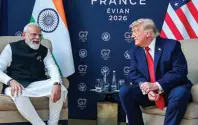
President Donald Trump briefly met Indian Prime Minister Narendra Modi on June 16, 2026, at the plenary session for the G7 Summit at Evian-les-Bains, France. It was the first meeting in 16 months after Trump, at the behest of Pakistani lobbyists, tilted U.S. policy sharply toward Islamabad.
Trump's turn toward Pakistan exposed the corruption of American policy at its worst. George Sorial, the chief compliance officer for the Trump Organization founded Javelin Partners. He hired Trump's former bodyguard Keith Schiller. Together with Stephen Payne, head of the Texas-based Linden Strategies, they lobbied Trump to embrace Pakistan and its narrative, false as it may be. The Washington Post identified Zachary Witkoff, son of Trump business partner and now Special Envoy Steve Witkoff, partners with World Liberty Financial, a Trump backed cryptocurrency firm that cultivates business in Pakistan. What Indians understand as bribery, Americans simply call lobbying. While many presidents stand on principle, Trump views relations more transactionally. Put another way: While Bin Laden perished more than five years before Trump became president, hypothetically, if Osama Bin Laden had lived, hired the right lobby firm, and declared in a cave-videos that Trump deserved the Nobel Prize, Trump might very well have delisted and partnered with him.
During his recent visit to New Delhi, Secretary of State Marco Rubio, meanwhile, delivered an invitation for Modi to visit the White House. Rubio is a presumptive Republican candidate for the presidency and likely recognizes the error of Trump's Pakistan tilt, even if he lacks the power in Trump's "money talks" policy process to right policy.
This does not mean that India should not try. While Pakistan purchases the president, India has facts and historical truth on its side. Its failure to date rests on two mistakes: First, is the failure to fully recognize American historical inexperience. U.S. diplomats, Pentagon officials, and intelligence analysts may know their history, but those in Congress and the White House often do not. Increasingly, Americans take pride in their ignorance. Basic facts that all Indians and Pakistanis know, for example, that the dispute between the two countries is not 1,500 years old, are lost on some very senior interlocutors. Second, Indian diplomats repeatedly fail to frame the parameters of the debate.
To change this, Indian diplomats must change their basic strategy. They should stop discussing Pakistan as a legitimate country and start describing it as both an artificial state and an imperial monster. Few Americans know that even the name Pakistan is artificial, an anagram created by Muslim nationalist Choudhry Rahmat Ali while at Cambridge University. The Punjabis who dominate Pakistan's military and intelligence, up to and including Field Marshal Asim Munir, essentially colonize each of the peoples represented by the other letters in the anagram. Bangladesh won its freedom in 1971, but Pakistan continues to occupy Kashmir as well as, under the name Khyber Pakhtunkhwa, parts of Afghanistan. The Durand Line is an artificial construct that no longer has legal validity. The Baluch and Sindh, meanwhile, are essentially captive nations. Pakistan illicitly gobbled up the Khanate of Kelat (Balochistan).
Rather than designate the Balochistan Liberation Army as a foreign terrorist organization, the United States should instead view it as an insurgency seeking to restore independence its people were unfairly denied.
There is precedent. The United States views Tibet as part of China but considers the conquered nation's final status to "undetermined." And while every president since Richard Nixon has embraced a "One China" policy, the United States still maintains separate diplomatic relations with Taiwan through the American Institute on the island. Today, Americans from Hollywood entertainers to members of Congress to diplomats, realize that they cannot accept Beijing's narrative at face value.
If India starts describing Balochistan and Sindh as captured nations, eventually core assumptions in Washington about the legitimacy and final disposition of Pakistan will shatter. Diplomats accustomed to short-term amelioration may complain but the long game matters, especially if the goal becomes, in Trump's words, ending a "1,500-year-old conflict."
Michael Rubin is director of policy analysis at the Middle East Forum and a distinguished fellow at India's Usanas Foundation.