





A weakened alliance with Nepal may impact India's security interests, trade routes, and influence in the Himalayan region. For Nepal, it could be detrimental in multiple spheres as the world turns increasingly transactional.
1,751 km long border across the five Indian states of Sikkim, West Bengal, Bihar, Uttar Pradesh and Uttarakhand. Bilateral relations are defined by deep-rooted cultural links as well as commonalities in religion, language and culture.
There have been 14 Prime Ministers after the end of the monarchy in Nepal in 2008, which signifies a rather turbulent political landscape. The incumbent, Balendra Shah was sworn in as Prime Minister on March 27, 2026, after an uprising, which somehow, does not seem entirely organic in origin.
Nestled strategically in the ecologically fragile Himalayan region between China and India, Nepal is an important buffer state. In terms of national strength, Nepal's relations with China and India are asymmetrical. The primary interest of China's intervention is to apparently prevent Tibetans from using Nepal's territory as a base for their movement for autonomy. There are seven provinces and 77 districts in Nepal. 26 districts of Nepal share borders with India, and two districts, Taplejung and Dharchula, are adjacent to both India and China.
The landmark 1950 India-Nepal Treaty of Peace and Friendship forges close ties based on culture and demography. This is a foundational document which envisages respecting the sovereignty, territorial integrity and independence of both nations. The enabling Articles 6 and 7 empower both sides to grant various provisions to the nationals of one country in the territories of the other, the same privileges in the matter of residence, ownership of property which requires RBI permission, participation in trade and commerce and movement on a reciprocal basis. This is a unique treaty which has stood the test of time through several upheavals.
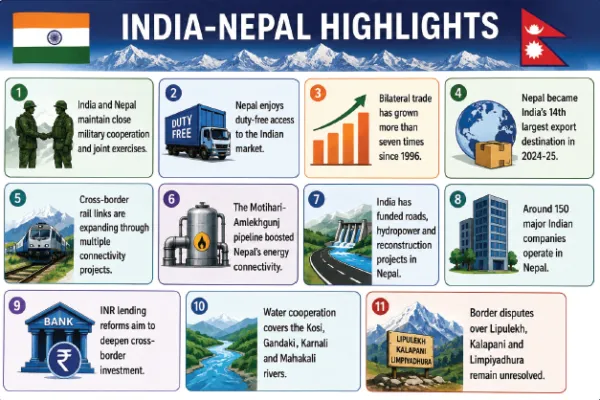
Both countries have long-standing military ties and have an endearing custom to confer the honorary rank of General to each other's Army Chiefs. India has been deeply involved in training and providing equipment to aid the Nepal Army in modernisation. India's cooperation with Nepal also includes assistance during disasters, joint military exercises, adventure activities, climate change aspects, tourism and education.
The bilateral framework for trade is anchored in the 2009 India-Nepal Treaty of Trade and Agreement of Co-operation. The Treaty allows Nepal unilateral duty-free access to the Indian market. India and Nepal also have a Treaty of Transit, which confers transit rights through each other's territory through mutually agreed routes and modalities. Its revised version was signed in June 2023 for a period of 7 years. It will be auto renewed for a period of 7 years, thereafter.
Nepal is a landlocked nation and there is a huge impetus on rail connectivity. India-Nepal Rail Services Agreement, signed in 2004 governs the rail-freight transport between the two countries. A letter of exchange was signed in 2021 to liberalise India-Nepal rail freight traffic and bring it in line with the latest operational and infrastructure metrics. The cross-border section of the first railway link, connecting Jaynagar in India, to Kurtha in Nepal, became operational in April 2022 and has been further extended to Bijalpura. The work on the final segment of the railway link, from Bijalpura to Bardibas, is ongoing. Building of Jogbani-Biratnagar rail link is in progress, and the new Raxaul-Kathmandu railway link is also being finalised by both countries.
There are numerous power and transmission projects underway with Indian assistance, which includes grid transmission lines. All these projects are aimed at strengthening regional energy security, improving grid resilience, and contributing to sustained economic growth in both nations. This cooperation has been expanded with the commissioning of the Motihari-Amlekhgunj Petroleum Pipeline (MAPL) in 2019. MAPL became the first cross-border petroleum product pipeline in the region and has yielded immense economic benefits to the people of Nepal. Hulaki/Terai Roads project and the East-West fibre optics project are two other important projects undertaken in the realm of connectivity.
The bulk of Nepal's exports are from Indian ports due to geographical aspects, proximity and logistical costs. Nepal's trade with Bhutan and Bangladesh also transits through India. Operationalisation of Vishakhapatnam Port (Amendment in the Treaty of Transit) for traffic-in-transit between Vishakhapatnam Port and Nepal was signed in February 2016. Four Indian Lines of Credit by India are dedicated towards infrastructure development as prioritised by Nepal. These enabling lines of credit have financed more than 40 road projects, 6 hydropower projects and several others in housing and reconstruction.
Since 1996, Nepal's exports to India have grown more than eleven times and bilateral trade more than seven times. 150 large Indian ventures have a footprint in Nepal and are engaged in manufacturing, services (banking, insurance, dry port, education and telecom), power sector and tourism industries. Indian companies and investments have played a key role in Nepal's national economic journey by contributing to industrialisation, employment generation, government revenue and export earnings. Nepal is India's 14th largest export destination in 2024-25, up from 28th position in 2014.
There have been significant fiscal reforms in the recent past. RBI's permission to Indian banks to lend in INR to Nepalese entities in 2025 aims to enhance cross-border investment and reduce currency volatility, strengthening Nepal's financial stability. However, political instability, trade imbalances, infrastructure gaps, and geopolitical competition continue to challenge bilateral growth.
Several water sharing agreements have also taken place through the years. Water cooperation between Nepal and India has resulted in agreements signed on major rivers like the Kosi, signed in 1954 and Gandaki, signed in 1959 with amendments in 1964. Karnali and Mahakali agreements were signed in 1996 and came into force in 1997. These agreements are essentially for large hydroelectric and irrigation projects by building dams or barrages. Post the Kosi Agreement and building of the barrage, talks between the two governments reached an impasse, and water issues have not been resolved in entirety.
In 2020, Nepal had also released a new political map incorporating Lipulekh, Kalapani, and Limpiyadhura, later reflected on its currency note. There are some areas of concern on border sharing aspects. Nepal claims that the territories of Limpiyadhura, Lipulekh, and Kalapani, located east of the Mahakali River, have been integral parts of Nepal since the Treaty of Sugauli in 1816. It cites the 1816 Treaty of Sugauli, arguing the Kali River originates at Limpiyadhura, while India claims it starts further east. Nepal has recently expressed "concerns" to both India and China regarding the upcoming Kailash Mansarovar Yatra being routed through the Lipulekh Pass. In terms of staying arrangements for Indian nationals, Nepal has now confirmed that no changes in open border movement are either warranted or modified. There have been reports in the media that Balen Shah reportedly refused to meet Indian Foreign Secretary, instead requesting to meet a representative of equal rank for discussions.
India and Nepal are a part of identical cultural fabric and faith. With a new government in place, a lot needs to be done besides many engagements at myriad levels to include economic interdependence, infrastructure, transit routes and cooperation.
A weakened alliance with Nepal may impact India's security interests, trade routes, and influence in the Himalayan region. For Nepal, it could be detrimental in multiple spheres as the world turns increasingly transactional. India seems to be more willing than ever to abandon its old hesitancies and not view Nepal through a prism of China, while also demonstrating a clear political legitimacy for a regional balance of power. Building trust, while deftly balancing trade with geographic power dynamics could carve a great path for both nations.
"Rifts to Resets" throughout history have been a norm and it is a well-known fact that closeness, if not handled with sensitivity can cause trouble in both personal relationships and geopolitics. Shakespeare's endearing lines from "King Lear" have a new meaning in international relations, especially for the politically inexperienced entities "Have more than thou showest, speak less than thou knowest".