





Key to RSS' future success will be continued openness to establishing new affiliates that address new challenges. Perhaps the most significant over the next few decades will be addressing poverty at the rural level.
This article will address the evolution of the Rashtriya Swayamsevak Sangh (RSS) since its formation one hundred years ago into an organization that has become India's most influential non-government organization. It now plays an influential role not only in the politics of India, but also within major sectors of Indian life through the dozens of affiliated organizations that have sprung up around it. Unusual for such large organizations in a democratic India, the RSS has avoided any significant splintering since its formation. It is this cohesiveness that fascinated my advisors at the University of Chicago, Professors Lloyd and Suzanne Rudolph. They in turn convinced me to make the issue of its cohesiveness an issue to address in my doctoral dissertation at the University of Chicago. I am glad I followed their advice. As with the Rudolphs, I am equally fascinated by the ability of the RSS to adjust to a changing India. At that time, I had concluded that the fundamental explanation for both its rapid growth and cohesiveness was due to two factors: (1) adherence to a core belief that provides a meaning of life beyond one's self (and in this case the notion of an India unified both politically, socially and culturally; (2) providing opportunities to demonstrate that loyalty in ways that strengthen both a personal commitment to the RSS and to its core belief system (a kind of secular political religion). This remains the case.
On October 8, 1925, on the occasion of the Hindu festival of Vijayadashami and drawing on its symbolism of good over evil, a small group of young men in the central Indian city of Nagpur and led by a recently graduated medical doctor, Dr Keshav Baliram Hedgewar, formed the first unit (shakha) of the RSS. His central thesis was that the peoples of India constitute a nation; that they are the indigenous people of the subcontinent, and they deserve their own independent country. He wanted something like the nationalist movements in the late 19th century Europe to create a united Turkey, Germany, and Italy. He was convinced that the most effective way to achieve the goal of an independent and self-confident India was to organize a cadre of patriotic young men and women (represented in a parallel female group) who would work to strengthen the notion of a common brotherhood (for the RSS) and sisterhood (for its female counterpart) among themselves, and their project would be to enhance Indian self-confidence in themselves as well as loyalty to the notion of a single unified Indian state.
These were prerequisites, Hedgewar felt, for a successful movement to bring about an independent state of India. Hence the decision to form the daily shakha as a training ground for this cadre. However, he (and his successors) did not look on the RSS as a political party, or as another Hindu religious cult. It was something much greater; it was like the nationalist movements that had led to the formation of a united Turkey, Germany and Italy.
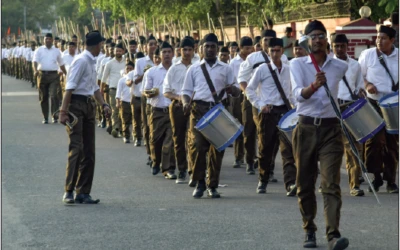
That first RSS shakha in 1925 was the seed of what was to blossom into what is today one of the world's largest and most influential non-government organizations. It now has some 83,000 shakhas in every Indian state and union territory, and some even outside of India, including in the US, UK, and other countries. Around it is some three dozen formal affiliates that address major aspects of Indian life. They include Muslims and Christians as well as the majority Hindu population. Among the most influential are:
The Vidyarthi Parishad, India's largest college student group-and from which many of India's politicians belonging to the RSS' political affiliate, the Bharatiya Janata Party (BJP), have emerged;
The Bharatiya Mazdoor Sangh, India's largest trade union organization and its affiliated farmer's group, the Bharatiya Kisan Sangh;
And perhaps its most prominent affiliate, India's ruling party, the Bharatiya Janata Party (BJP), which along with allied parties has ruled India continuously since 2014 and controls twenty of India's twenty-eight (including its May 2026 victory for the first time in the Assembly elections in the populous state of West Bengal). Most of the BJP's parliamentarians and cabinet members at the level are participants in the RSS or one of its affiliates-or both.
Besides this, there are dozens of other affiliated groups that work in specific areas, such as a group focused on education and which runs some 12,000 primary and secondary schools (India's largest private school system by far) and another that last year managed some 130,000 social welfare projects both in India and outside, some working recently for example on flood relief in the US. These service activities provide major opportunities to commit oneself to the goals of the RSS. The glue that holds this together is the 3,000-4000 or so full-time RSS workers (pracharaks) who, after specialized training and as an apprentice, are assigned to the affiliates or to the RSS itself. Prime Minister Narendra Modi, before he went into politics full time, was a pracharak. These autonomous affiliates are the public face of the RSS and represent the interests of the membership of the group to which the pracharaks are assigned. Because of the broad range of interests, sometimes conflicting, the leadership has learned to work out compromises without shattering the larger RSS organizational structure. This arrangement has worked remarkably well over the past one hundred years both within and between the many parts of the RSS since its founding in 1925.
How to explain its cohesiveness and rapid growth rate-and how will the RSS family of groups likely develop in the future? There are five basic reasons in my view that explain both its cohesiveness and rapid growth:
An adherence to a common ideology of a unified Indian state that has a popular appeal (a word often used to describe this by RSS members is patriotism).
A sensitivity to India's evolving social and economic complexity by the RSS leadership as reflected in its openness to the establishment of affiliates that address those new interests, which has the added advantage of providing opportunities for service.
A tight hierarchical organization built around neighbourhood shakhas (83,000) with a daily program aimed at building a pan-Hindu identity among India's diverse social and linguistic groups.
A command structure headed by full time trained workers now numbering between 3,000-4,000 men, most of whom are bachelors and college graduates, and who occupy the key leadership positions throughout the RSS family.
Autonomy of the affiliated units which ensures that they represent the views of the membership and reduces the chances of internal splintering.
FUTURE CHALLENGES
The future will present challenges brought on by a rapidly changing India. Key to its future success in my view will be continued openness to establishing new affiliates that address new challenges. Perhaps the most significant over the next few decades will be addressing poverty at the rural level, home to some two-thirds of India's 1.4 billion people. The RSS has identified alleviating rural poverty as a major goal in this second century. This approach provides a model for future challenges in other areas:
a. Increase the number of shakhas and participants in rural India both to get a better knowledge of the problem and to build political pressure on policymakers to enhance the lives of rural Indians.
b. Strengthen the voice of the Bharatiya Kisan Sangh, the farm affiliate, as well as other affiliates that address rural issues.
Other areas that present significant future challenges:
Issues related to caste such as to who qualifies for caste specific benefits.
Relevant education to create better job opportunities and enhance upward social mobility.
Adjusting regional political representation to avoid regional dissidence flowing from sense on being deliberately overlooked-an issue now as India prepares new parliamentary boundaries.
The persistent issue of foreign investment.
Persistent Hindu-Muslim animosity-and the present head of the RSS has made a special outreach to Muslims.
The RSS tends to trend centre-left on economic issues and centre-right on cultural issues. The bottom line is that it is likely to take a moderate line on change, as it has done in the last hundred years.