
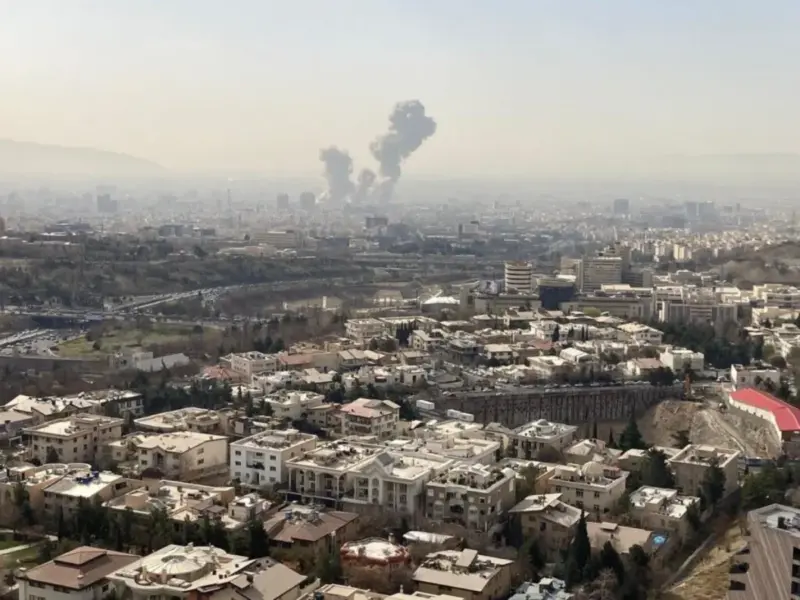

The ongoing US-Israeli war with Iran is not merely a limited military operation or another round in the cycle of mutual deterrence. Rather, it presents a revelatory moment for the entire structure of the international order.
This confrontation is redrawing geopolitical divisions in an unprecedented way.
Militarily, Iran has done what no US adversary has managed in decades: not merely survive American firepower, but match it, striking the most protected targets on the planet, damaging America's most advanced aircraft, and destroying the very missile defence systems designed to stop it. Economically, it has triggered the worst energy shock in modern history and taken control of the world's most strategic chokepoint; while the US is unable to reopen the Strait in spite of its naval power differential. The Strait has turned out to be Iran's most effective leverage and deterrent.
There has also been a doctrinal shift for Iran. The Iranian regime's modus has been to push the envelope with adversaries, while maintaining plausible deniability. This resulted in the use of proxies and other hybrid capabilities. But in the current war, this has changed as Iran has targeted critical civilian infrastructure in the Gulf. In view of the degradation of its proxies, Iran will probably focus more on its own kinetic capabilities.
The course of the war has demonstrated that the concept of "neutrality" is no longer viable in contemporary regional contexts, particularly in the Middle East. When the instruments of conflict extend through armed proxies, the closure of vital maritime corridors and threats to global energy supplies, any state, regardless of its position, finds itself drawn into the trajectory of the crisis in one form or another.
Iranian strikes on energy infrastructure across Gulf states forced several producers to declare force majeure and suspend their operations. The effects were felt almost immediately in Europe through a surge in gas prices of almost 80%, and in Asia by a shortage. A grim reminder that the global economy, energy security and supply chains are now directly tied to the stability of this region.
The UAE spent decades fostering Dubai's global reputation as an oasis of stability, and most of the UAE's GDP comes from non-oil sectors which are the primary source of its economic growth. But today its geographical proximity to Iran has proved to be its vulnerability.
The war has also changed the strategic equation in the Middle East. Trust in the US security umbrella has been shaken as GCC countries have seen that in a crisis Washington is unable or unwilling to protect them and Israel's security interests have primacy over theirs.
While they will continue maintaining reliance on the US, but simultaneously will concentrate on military self-reliance for their defence, while diversifying regional and international partnerships and attempting to reduce tensions with Iran.
The once-solid US-Europe alliance is also showing signs of strain, reflecting deeper divisions within what were once shared norms. Those fractures may prove more consequential.
Military interventions, such as those in Iraq and Libya, for example, have demonstrated that toppling regimes by force do not necessarily lead to the construction of stable systems; more often, it opens the door to chaos and institutional collapse. In both Iraq and Libya, external military interventions contributed to prolonged conflict, fragmentation and institutional collapse, from which both countries are still recovering.
War is a difficult cross to bear and that the priority must therefore be to halt the humanitarian and economic toll and return to the diplomatic track, even if that means coexisting with Iran. Relative stability is preferable to chaos with uncertainty.
However, this argument faces a central dilemma, it assumes that the Iranian regime is amenable to containment within the rules of conventional diplomacy, an assumption that Iran's own actions are now being questioned. For example, Iran struck several Gulf states, including Qatar and Saudi Arabia, which had given explicit assurances that their territories would not be used to launch any offensive operations against Iran.
The regime change camp in turn argues that the war did not create the crisis but rather revealed its true nature. It contends that Iranian behaviour, whether through targeting maritime corridors or expanding proxy wars, has proven that the regime cannot be contained or tamed through traditional instruments. Decades of diplomacy and sanctions did not prevent the closure of the Strait of Hormuz.
They feel that diplomacy, including the nuclear agreement and regional mediation, have helped strengthen Iran's capabilities and expand its influence rather than contain them. For them, the solution lies in changing the very structure of the regime itself.
Nevertheless, this raises a complex question, what comes after regime change? The opening strike of this war, the assassination of Iran's Supreme Leader Ayatollah Khamenei, was itself premised on the assumption that removing the head of state would precipitate collapse. Instead, a successor was selected shortly after the initial strike, and state institutions continued to function.
Indeed, this war reveals a deeper transformation in the nature of the threats confronting the international order. Threats are no longer conventional or confined within state borders; they have become networked and able to spread across military, economic and digital fronts simultaneously. They originate not only from regular armies but from the convergence of multiple instruments: militias, cyberattacks, economic targeting and the closure of maritime passages. This complexity makes it exceedingly difficult to rely on traditional tools, whether diplomatic or military, to address crises effectively.
Calling for a cessation of hostilities without addressing the root causes of the crisis may amount to nothing more than postponing the inevitable explosion, while pursuing radical change without a clear vision for the day after may open the door to even wider chaos.
But the truth is that hostility between countries cannot justify a broader escalation that places the entire international system at risk.
The disappearance of shared principles and common purpose has left global standards fragmented. More troubling, the future of the international order seems to have lost a broadly accepted direction, raising questions about whether the current moment represents a transition or a descent into deeper disorder.
Whichever way the Iran war ends, its consequences will be felt for a long time to come as its security, economic and diplomatic fallout have accelerated certain trends that were already in play. This will lead to nations reshaping their policies in the face of changing realities.
Maj Gen Jagatbir Singh, VSM, retired from the Indian Army.