
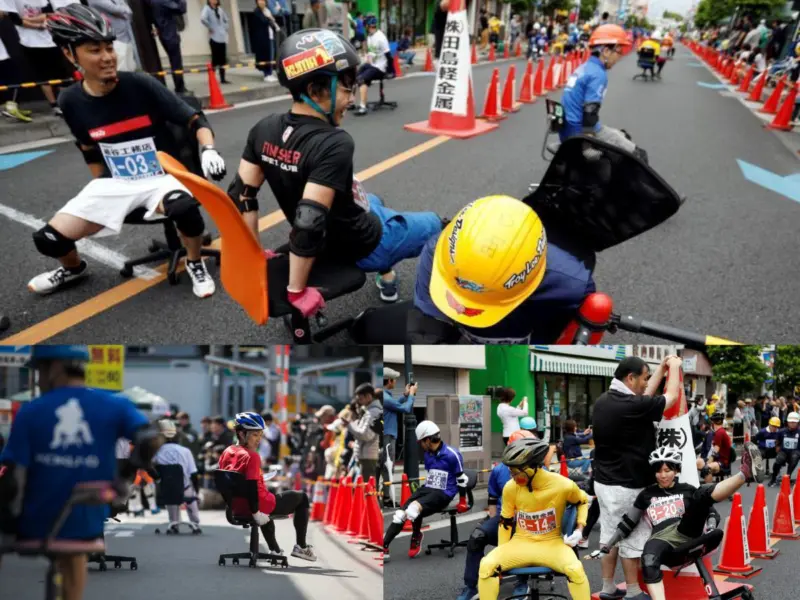

Isu-1 Grand Prix: It started as a way to bring life back to a quiet shopping street. Seventeen years later, it is a national championship spread across more than 20 Japanese cities-where teams of three race standard office chairs around a circuit for two hours straight, cover over 20 kilometres on their legs alone, and compete for prizes measured in kilograms of rice.
The Isu-1 Grand Prix is entirely real, entirely serious, and just held its latest race in Kyotanabe on March 29.
What Is the Isu-1 Grand Prix and Where Did It Come From?
Tsuyoshi Tahara founded the sport in 2009 in Kyotanabe, a small city in Kyoto Prefecture, with the modest goal of revitalizing a local shopping arcade. The concept was simple: grab an office chair, sit down, and race. What nobody expected was that it would spread. The Isu-1 GP-Isu meaning 'chair' in Japanese-has since grown into a structured, multi-city national series with qualifying rounds, pit crews, safety regulations, and a growing international following. Teams from Taiwan have competed alongside Japanese participants. CNN and multiple international outlets have covered the sport, and its social media presence continues to pull in curious viewers worldwide.
How Does Office Chair Racing Actually Work?
The format mirrors professional motorsports more closely than most people expect.Teams of three riders take turns throughout a two-hour endurance race on a closed circuit measuring approximately 200 metres. Think of it as the Le Mans of office furniture - teammates rotate in and out to manage fatigue, just as drivers do in long-distance car racing. Before the main event, teams complete a 30-metre qualifying sprint or a single timed lap to determine their starting positions. Riders must remain seated at all times and propel themselves using only their legs-most push backward to maximize leverage from their leg muscles. The chair must be a standard, off-the-shelf wheeled office chair. No modifications of any kind are allowed.Altered chairs result in immediate disqualification. Each team may use up to two chairs during the event.
Is It Actually Physically Demanding?
Far more than the premise suggests. Top teams complete over 100 laps during the two-hour race-covering more than 20 kilometres entirely under leg power while seated. That is the rough equivalent of running a half-marathon, except every metre is generated by thrusting against a hard surface from a sitting position. Safety gear is mandatory for all participants: helmets, gloves, elbow pads, and knee pads are required before anyone takes the starting line. The sport combines raw endurance with team strategy, as knowing when to rotate riders and how to pace across two hours is as important as raw speed.
What Do Winners Actually Win?
This is where the Isu-1 GP parts ways entirely from conventional sport. There are no cash prizes and no trophies in the traditional sense. High-quality Japanese rice that is sourced locally is awarded to the winners: 90 kg for first place, 60 kg for second, and 30 kg for third. The award is a reflection of the event's strong ties to local agriculture and culture as well as its community-driven origins. It is impractical, generous, and completely on-brand for a sport built around office furniture.
What Is the 2026 Season Schedule?
The current season has been active across multiple cities. The Kumamoto Nankan GP was held on February 8, 2026, followed by a second Kumamoto event on February 23. The most recent race - the Kyoto Kyotanabe GP, held in the sport's founding city - was scheduled for March 29, 2026. Further dates for the 2026 season have not been publicly confirmed at the time of publication.
FAQs: Japan Office Chair Racing
Q: What is the Isu-1 Grand Prix?
A: It is Japan's national office chair racing championship, founded in 2009, where teams of three race standard wheeled desk chairs around a 200-metre circuit for two hours.
Q: Who founded office chair racing in Japan?
A: Tsuyoshi Tahara founded the Isu-1 GP in 2009 in Kyotanabe, Kyoto, originally to revitalize a local shopping arcade.
Q: How far do teams race in the Isu-1 GP?
A: Top teams complete over 100 laps, covering more than 20 kilometres in a single two-hour session.
Q: Are chair modifications allowed in Isu-1 racing?
A: No. Any modification to the office chair results in immediate disqualification. Only standard, unaltered wheeled chairs are permitted.
Q: What is the prize for winning the Isu-1 Grand Prix?
A: First place receives 90 kilograms of high-quality local rice. Second place receives 60 kg and third place 30 kg.
Q: Has the sport spread outside Japan?
A: Yes. International teams including those from Taiwan have participated, and the sport has attracted global media coverage.
Disclaimer: This information is based on inputs from news agency reports. TSG does not independently confirm the information provided by the relevant sources.