
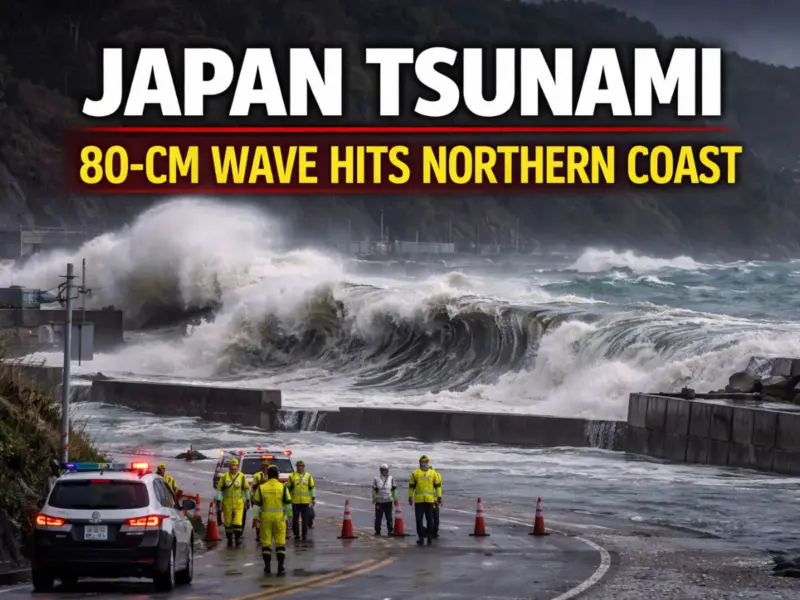

Japan Tsunami Warning: Authorities in northern Japan recorded a tsunami wave measuring about 80 centimetres at a coastal port on Monday after a 7.5 magnitude earthquake on the northern Japanese coast, prompting heightened safety monitoring along parts of the country's shoreline.
The location of the powerful earthquake was Sanriku in northern Japan at around 4:53 PM, and the depth of the earthquake was about 10 kilometres below the sea surface, according to the agency.
Japan Tsunami Warning: Japan Records 80-cm Tsunami Wave
Officials had earlier issued warnings that waves could reach significantly higher levels, urging residents in vulnerable coastal areas to remain alert and follow safety guidance. Emergency teams continued to monitor coastal conditions as authorities assessed the situation and tracked additional wave activity.
The wave was observed at Kuji port in Iwate prefecture during the evening hours, according to official updates from Japan's meteorological authorities. The development led to precautionary actions across several northern coastal regions.
Japan Tsunami Warning: Tsunami Waves Detected at Multiple Coastal Locations in Japan
Monitoring systems detected the largest wave of approximately 80 centimetres at Kuji port in Iwate prefecture. Officials recorded the wave during routine coastal observation, confirming earlier alerts issued for the region.
The Japan Meteorological Agency (JMA) reported that the wave was observed at 5:34 pm local time at Kuji port. The agency also confirmed earlier readings at nearby locations.
"JMA earlier said a 70-centimetre wave had struck at 5:32 pm," AFP reported.
Authorities also recorded a smaller tsunami of around 40 centimetres at another port within the same prefecture, indicating continued coastal movement following the initial wave activity.
Officials maintained surveillance along the affected shoreline to ensure public safety and provide timely updates.
Japan Tsunami Warning: Coastal Alerts Issued Across Northern and Northeastern Regions
Authorities issued tsunami warnings for several coastal areas, including parts of Iwate, Aomori, and southeastern Hokkaido. Officials advised residents in these areas to remain cautious and avoid coastal zones until further notice.
Emergency alerts were also extended to the coasts of Miyagi and Fukushima, where authorities issued milder advisories as a precaution.
Local disaster response teams coordinated with regional agencies to share real-time updates and provide instructions to communities living near the coastline.
Officials emphasised that precautionary advisories remain essential even when wave heights appear moderate, as changing sea conditions can pose sudden risks.
Japan Tsunami Warning: Transport Services Temporarily Disrupted Amid Safety Measures
Authorities temporarily halted certain high-speed rail services in northern Japan as part of precautionary safety steps. Transport officials suspended operations briefly to ensure passenger safety and inspect infrastructure.
Bullet train services in Aomori experienced interruptions during the period of heightened alerts. Officials later resumed services after confirming operational safety.
Transport agencies also reviewed safety systems and monitored track conditions before restoring full service, ensuring minimal disruption to commuters and travellers.
Japan Tsunami Warning: Why Tsunami Preparedness Remains Critical in Japan?
Japan maintains one of the world's most advanced coastal monitoring systems due to its long history of tsunami activity. Authorities continue investing in warning networks, coastal barriers, and public awareness programs to reduce risks to communities.
Experts note that regular preparedness drills and early-warning systems help residents respond quickly during emergencies. Officials also encourage citizens to remain familiar with evacuation routes and safety protocols.
Authorities continue to monitor coastal waters and maintain readiness as precautionary alerts remain active in several regions.