




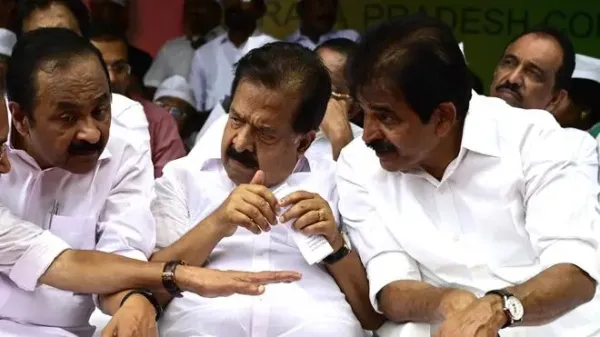

Expectations were that K.C. Venugopal would assume the Chief Minister's office; preparations were reportedly underway.
Developments in Kerala have once again intensified internal turbulence within the Congress party.
A significant section of the leadership is both surprised and unsettled. The surprise stems from the High Command's decision to appoint V.D. Satheesan as Chief Minister, a move many believe inadvertently reinforces the BJP's long-standing allegation of "Muslim appeasement." The unease arises from the political messaging and internal fallout that followed the announcement, which appear to have compounded the party's strategic vulnerabilities.
The decision has also reignited the subtle but persistent power struggle between the 'brother-sister' leadership axis-Rahul Gandhi and Priyanka Gandhi.
Within party circles, Satheesan's elevation is widely interpreted as the outcome of deft political maneuvering by Priyanka Gandhi, who oversees the party's equation with the Muslim League. The League's influence in Wayanad-Priyanka's parliamentary constituency-adds a further dimension to the calculus.
According to insiders, Priyanka achieved a dual objective: securing the appointment of a Chief Minister aligned with her preferences while simultaneously signaling her authority to the party's General Secretary (Organization), K.C. Venugopal. Venugopal is broadly regarded as Rahul Gandhi's most trusted lieutenant and the informal leader of his inner circle. Until the final hours, expectations were that Venugopal would assume the Chief Minister's office; preparations were reportedly underway. Priyanka's late intervention, however, altered the trajectory.
Many within the organization believe that leaders close to Rahul Gandhi have systematically constrained Priyanka's institutional authority despite her formal designation as General Secretary. Her assignment to head the Screening Committee in Assam was perceived by some as a symbolic rather than substantive responsibility. The Kerala decision, therefore, is seen as a reminder that the internal hierarchy remains fluid and contested.
A comparable episode unfolded during the 2022 Congress presidential election. Sonia Gandhi and Rahul Gandhi encouraged then Rajasthan Chief Minister Ashok Gehlot to contest for the national presidency. Gehlot agreed, and it was widely assumed he would be elected unopposed. The plan envisaged his presenting a populist Rajasthan budget before stepping down at a strategically chosen time-consistent with the party's tradition permitting dual office-holding.
However, the scenario shifted dramatically. Digvijaya Singh announced his candidacy, complicating the process. Gehlot was asked to resign preemptively, and there were moves to elevate Sachin Pilot-who had earlier challenged the state government-as Chief Minister. The resulting turbulence inflicted lasting damage. Rajasthan eventually slipped from Congress control, and critics argued that internal miscalculations had aligned inadvertently with BJP objectives.
During that presidential contest, Priyanka Gandhi reportedly considered staking her own claim but was dissuaded by Sonia Gandhi. By then, fissures had widened. Even Rahul Gandhi's 'Bharat Jodo Yatra' felt the tremors of organizational discord.
The Kerala episode now risks similar repercussions. Venugopal's standing may diminish, factional rivalries could sharpen, and the BJP stands to capitalize politically. With elections approaching in Uttar Pradesh, Uttarakhand, Punjab, Goa and Manipur, the Congress confronts a narrative challenge. The BJP is likely to foreground themes of "infiltration" and alleged "appeasement," reinforcing its consolidation of the Hindu vote base.
The Muslim League's post-election messaging in Kerala-particularly its overt opposition to Venugopal-signaled that recalibrations were underway. Subsequent remarks by League leaders, including criticism of Hindu religious practices, have been weaponized by the BJP to sharpen its ideological attack.
Nationally, the Congress faces a perception battle. Of its legislators across states, 80 are Muslims. In Assam, 18 of the 19 seats it recently secured were won by Muslim candidates; in Bengal, both victorious candidates were Muslims. Critics argue that the party risks acquiring a limiting political label in North India.
After the 2014 defeat, senior leader A. K. Antony advised distancing the party from overt identity politics in his post-mortem report. Whether that counsel is heeded now remains uncertain. What is clear is that the Kerala decision has once again altered the Congress's internal equilibrium-at a moment when strategic coherence is most urgently required.