




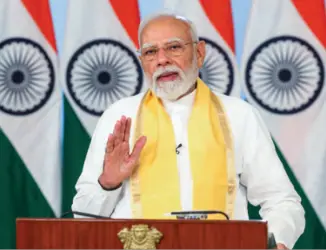

His conviction has remained consistent: technology must be harnessed at scale, and it must expand opportunity.
Twenty-five years ago, when Narendra Modi assumed office as Chief Minister of Gujarat, India was at a very different point in its technological journey.
The internet was still a privilege for a small section of society, mobile telephony was only beginning to expand, digital payments were unimaginable for most citizens, and the idea that technology could become an instrument of mass governance had barely entered the political vocabulary. Yet even before he entered government, Modi had acquired a reputation within the organization for being unusually comfortable with technology, communication systems and data. As an organizational general secretary, he understood early that technology was not merely about machines. It was about information, speed, coordination and the ability to reach people directly. That instinct has remained a constant through his twenty-five years in public office.
In Gujarat, this translated into an emphasis on technology enabled governance. The use of video conferencing to connect the state leadership with district administrations, the SWAGAT grievance redressal system, digitization of government processes and the widening use of data in administration were all part of a larger effort to make government more responsive. Technology was treated not as a fashionable add on but as a tool to compress distance between the citizen and the state. The central idea was simple: scale cannot be managed through old systems alone.
By 2014, that approach had acquired a national political dimension. Modi's campaign understood the possibilities of social media, digital outreach and direct communication much earlier than most traditional political formations. Social platforms were used to bypass conventional gatekeepers, engage young voters and create a two-way political conversation. Technology did not replace the public meeting or the karyakarta. It multiplied their reach. The 2014 election therefore marked not only a political transition but also a transformation in the way Indian democracy communicated with its citizens.
The more consequential transformation came after Modi became Prime Minister. Digital India gave the technological project a national architecture. The combination of Aadhaar, Jan Dhan accounts and mobile connectivity created the foundation for direct benefit transfers on an unprecedented scale. UPI turned the mobile phone into a payment instrument for hundreds of millions of Indians. DigiLocker, CoWIN and other digital public platforms demonstrated that India could build technology not only for commercial profit but for public purpose. Where much of the technology world built first for the top of the pyramid, India increasingly built digital infrastructure for the base.
The effect has gone far beyond convenience. Technology has reduced leakages in welfare, brought millions into the formal financial system, widened access to services and made transactions cheaper and faster. It has also produced something less easily measured but equally important: confidence. A small entrepreneur in a tier three town can receive a digital payment instantly. A student can access learning resources from anywhere. A young founder can build on digital rails that would once have required enormous private capital. Rural India is increasingly connected to markets, information and opportunity in ways that were impossible a generation ago.
This is why the technology story of the Modi years cannot be reduced to apps and platforms. The next phase is about national capacity in critical and emerging technologies. Semiconductors, artificial intelligence, quantum computing, space, defence technology, advanced communications and clean energy are now foundations of economic power, national security and geopolitical influence. The India Semiconductor Mission, IndiaAI Mission, National Quantum Mission, reforms in the space sector and the widening ecosystem of Indian defence and strategic technology companies are all parts of an attempt to build capability across this new technological stack.
The semiconductor push is especially significant. For decades, India contributed world class engineering talent to the global chip industry but remained weak in fabrication and manufacturing. That is beginning to change. New semiconductor and assembly projects, alongside India's deep design talent, are creating the possibility of a more complete domestic ecosystem. In artificial intelligence too, the challenge is not simply to consume models developed elsewhere. India must build compute capacity, develop models suited to its linguistic and social diversity, create trusted data systems and ensure that the benefits of AI reach a population of continental scale. The same principle applies to space and defence. India in these sectors is moving steadily from buyer to builder, and from adopter to shaper.
For India's young people, this shift may be the most consequential legacy of the past decade. Earlier generations of talented Indians often had to leave the country to work at the frontiers of technology because that was where the ecosystems, capital and opportunities existed. Today, for the first time since Independence, a young Indian increasingly has the opportunity to compete with the world from India itself. The geography of aspiration is changing. Startups can serve international markets from their first day. Indian engineers are contributing not only to software but to chips, drones, satellites, defence systems, electric mobility, artificial intelligence and frontier research.
This is also where Startup India and the broader innovation ecosystem matter. A country in which young people once overwhelmingly sought secure employment is becoming a country where millions aspire to create enterprises. The significance is cultural as much as economic. Risk taking has acquired legitimacy. Innovation is increasingly seen as a form of national contribution. Government cannot create entrepreneurs, but it can create the conditions in which entrepreneurship flourishes. Digital public infrastructure, connectivity, easier access to markets and a growing domestic technology base have widened that space.
There are major challenges ahead. India must deepen research and development, improve technical education, build more patient capital, secure supply chains and ensure that regulation encourages innovation while protecting citizens. Technological sovereignty cannot mean isolation. India will continue to collaborate with major partners, but collaboration is strongest when it rests on domestic capability. In a world where access to chips, data, AI models and strategic technologies is increasingly shaped by geopolitics, self-reliance in critical technologies is not protectionism. It is strategic resilience.
Twenty-five years of Narendra Modi's public service can therefore be read through many lenses, but technology provides one of the clearest continuities. From the early embrace of digital tools in organization and governance, to the use of social media to transform political communication, to the building of digital public infrastructure and now the push into critical technologies, the conviction has remained consistent: technology must be harnessed at scale, and it must expand opportunity. The next stage of India's rise will be shaped not by whether we participate in the technologies of the future, but by whether we help define them. The most powerful measure of success will be a generation of young Indians who no longer look at the frontiers of innovation from a distance, but stand at those frontiers with the confidence, capability and opportunity to lead.
*Anil K. Antony is National Secretary and National Spokesperson of Bharatiya Janata Party, and author of "Advantage India: Reshaping the Future for an Equitable World Order".