
Astronomy has a way of humbling us while sparking endless curiosity. From the birth of stars to the mysteries of black holes, the universe is both vast and deeply personal in its impact on how we see our place in it.
10 Best Astronomy Books
If you're looking to dive into the cosmos, these timeless astronomy books combine science, storytelling, and wonder-perfect for beginners and seasoned space enthusiasts alike.
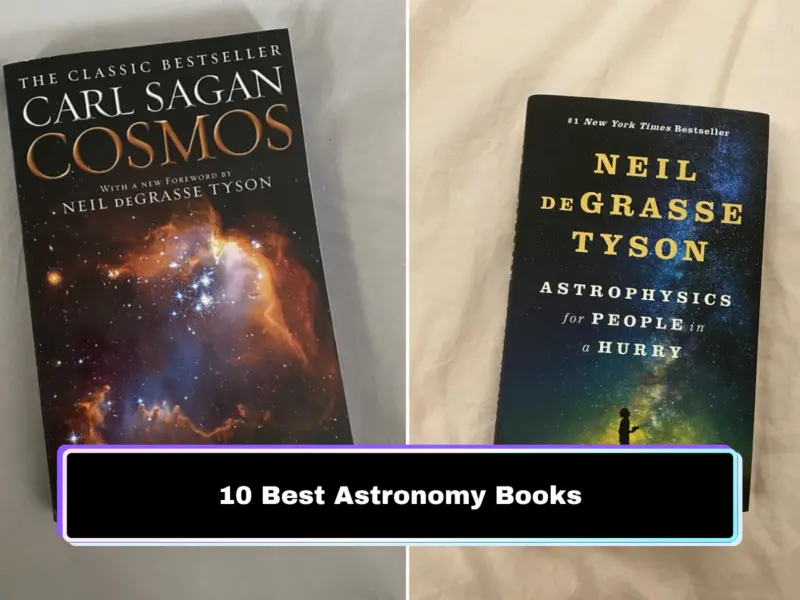
1. Cosmos by Carl Sagan
A true classic, Cosmos is often the first recommendation for anyone curious about space. Carl Sagan's poetic writing makes complex scientific ideas feel deeply human. Covering everything from the origins of the universe to the possibility of extraterrestrial life, this book doesn't just inform-it inspires a lifelong fascination with the cosmos.
2. A Brief History of Time by Stephen Hawking
This groundbreaking book explores big questions: How did the universe begin? What is time? Are black holes real? Hawking simplifies highly complex theories like relativity and quantum mechanics, making them accessible without losing depth.
3. Astrophysics for People in a Hurry by Neil deGrasse Tyson
Short on time but big on curiosity? This book breaks down the universe into bite-sized chapters. Tyson's conversational tone makes astrophysics engaging, humorous, and surprisingly easy to grasp.
4. The Universe in a Nutshell by Stephen Hawking
A visually rich follow-up to A Brief History of Time, this book dives deeper into string theory, black holes, and the nature of reality. It's perfect for readers ready to go beyond the basics.
5. Pale Blue Dot by Carl Sagan
Inspired by the famous photograph of Earth taken from space, this book reflects on humanity's place in the universe. Sagan blends science with philosophy, making it both intellectually and emotionally powerful.
6. The Elegant Universe by Brian Greene
This book explores string theory and the quest for a unified theory of everything. Greene's storytelling turns abstract physics into a compelling narrative about the nature of reality itself.
7. Black Holes and Time Warps by Kip Thorne
Written by one of the leading experts in gravitational physics, this book takes readers on a journey through black holes, wormholes, and the fabric of spacetime. It's both scientific and deeply imaginative.
8. The Fabric of the Cosmos by Brian Greene
Time, space, and reality-this book explores them all in an engaging and understandable way. Greene explains mind-bending concepts like parallel universes and quantum mechanics with clarity.
9. NightWatch by Terence Dickinson
A perfect guide for amateur astronomers, NightWatch helps you understand the night sky. With star maps and practical tips, it bridges the gap between reading about space and observing it yourself.
10. The End of Everything (Astrophysically Speaking) by Katie Mack
This modern favorite explores how the universe might end-from the Big Crunch to heat death. Mack's witty and approachable style makes even cosmic doom feel fascinating.
Why These Astronomy Books Matter
These books do more than explain scientific theories-they reshape how you think about existence. Whether it's Sagan's philosophical reflections or Hawking's groundbreaking insights, each title opens a new window into the universe.
They remind us that astronomy isn't just about stars and galaxies-it's about curiosity, perspective, and the endless human desire to understand what lies beyond.
FAQs: Top Astronomy Books
Q1. Which astronomy book is best for beginners?
A: Cosmos and Astrophysics for People in a Hurry are great starting points due to their simple and engaging explanations.
Q2. Are these books scientifically accurate?
A: Yes, all the listed books are written by renowned scientists and are based on well-established scientific research.
Q3. Can I read these books without a science background?
A: Absolutely. Many of these books are specifically written for general readers with no prior knowledge of physics or astronomy.
Q4. Which book goes deepest into theoretical physics?
A: The Elegant Universe and The Universe in a Nutshell explore advanced concepts like string theory and quantum mechanics.
Q5. Are there any practical astronomy guides in this list?
A: Yes, NightWatch is ideal for learning how to observe the night sky.
Disclaimer: This article is based on curated recommendations and reading trends. Readers are encouraged to explore books based on personal preferences.