




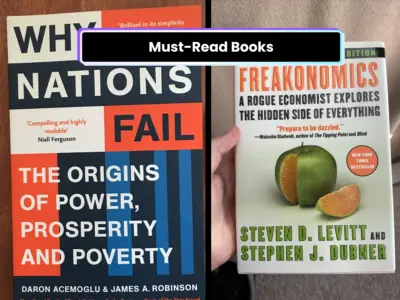

Must-Read Books: Understanding how the global economy works is essential in today's interconnected world. From inflation and trade wars to inequality and financial crises, a strong reading base helps decode real-world systems.
5 Powerful Reads to Understand the Global Economy
The following list brings together five foundational works that are widely studied and often grouped under books on economics and global finance for deeper understanding. Tale a look
The Wealth of Nations
This classic by Adam Smith lays the foundation of modern economics by explaining how free markets, specialization, and self-interest contribute to economic growth. It introduces the idea of the "invisible hand," which still influences global economic thinking today.
Under books on economics, this work is considered essential reading because it explains how trade, productivity, and competition naturally shape wealth creation in societies.
Capital in the Twenty-First Century
Thomas Piketty's landmark research focuses on long-term inequality trends and how wealth becomes concentrated over generations. It provides deep data-driven insights into how capital accumulation impacts societies differently across time and regions.
Under books dealing with modern economic inequality, this book stands out for explaining how wealth gaps expand when returns on capital exceed economic growth.
Freakonomics
This unconventional economics book explores hidden patterns in human behavior using data, incentives, and real-world case studies. It connects everyday decisions with larger economic outcomes in surprising ways.
Among books focused on behavioral economics, this title is widely appreciated for making complex economic logic simple, engaging, and highly relatable.
The Ascent of Money
Niall Ferguson traces the evolution of money, credit, banking, and financial systems from ancient civilizations to modern global markets. The book shows how financial innovation has repeatedly shaped world history.
Under books on financial history, it is a key read for understanding how money systems influence economic stability and crises.
Why Nations Fail
This influential book explains why some countries grow wealthy while others remain poor, focusing on political and economic institutions rather than geography or culture. It highlights the importance of inclusive systems for long-term prosperity.
Under books that study global development, this work is crucial for understanding how institutions determine national economic success.
These five influential works, often grouped under books on economics, finance, and global systems, provide a strong foundation for understanding how the world economy operates. Together, they explain everything from markets and inequality to institutions and financial evolution.
Disclaimer: This article is based on recommendations. Readers are encouraged to explore books based on personal preferences.