
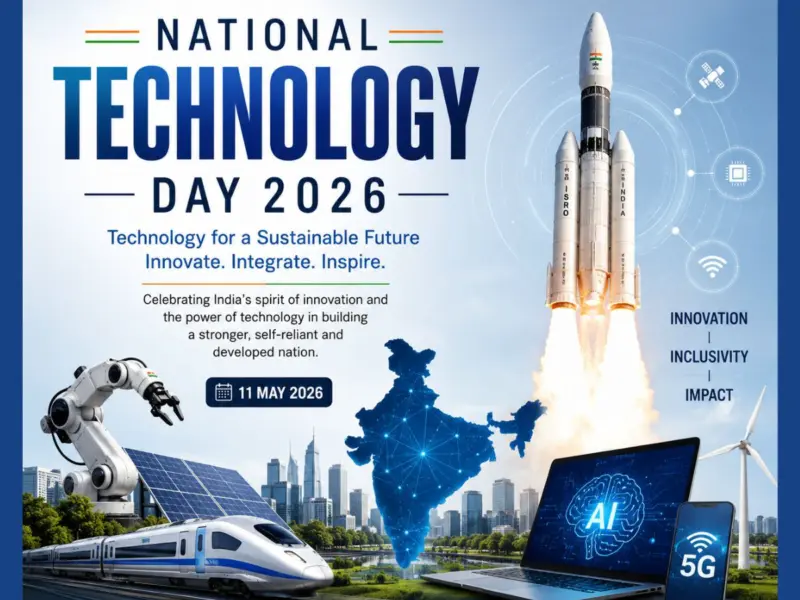

National Technology Day is celebrated in India annually on May 11 to commemorate the successful Pokhran-II nuclear tests (Operation Shakti) conducted on May 11, 1998 to honour the history of India's technological inventions and transition period which provided India a wide opportunity to make recognition across the world.
What is National Technology Day?
India celebrates National Technology Day every year on May 11 to recognise the country's achievements in science, innovation and indigenous technology. The day mainly reminds the nation about the successful Pokhran-II nuclear tests conducted in 1998, which established India as a nuclear-capable nation. The occasion highlights the importance of self-reliance, scientific progress and technological innovation in strengthening the country's global position.
National Technology Day is observed to mark the success of the Pokhran-II nuclear tests carried out in Rajasthan on May 11, 1998. The operation demonstrated India's scientific capability and technological strength under difficult international and geopolitical conditions. The tests showcased the country's ability to develop advanced defence technology using indigenous expertise. Apart from the nuclear tests, May 11, 1998, also became historic because India successfully test-fired the Trishul missile and conducted the first flight of the indigenous Hansa-3 aircraft on the same day.
How National Technology Day Began?
The Government of India officially declared May 11 as National Technology Day in 1999, one year after the Pokhran-II tests. The initiative was introduced under the leadership of former & late Prime Minister Atal Bihari Vajpayee to honour scientists, engineers and researchers who contributed to India's technological growth.
Led by Prime Minister Atal Bihari Vajpayee, these tests in Rajasthan established India as a nuclear-weapon state, demonstrating significant scientific, technological, and strategic capability.
The day was created not only to celebrate a strategic milestone but also to encourage innovation and scientific excellence across the country. Since then, the Ministry of Science and Technology has been organising events, award ceremonies and awareness programmes every year.
A.P.J. Abdul Kalam's Role in Pokhran-II
Whenever National Technology Day is discussed, one name stands out prominently - A. P. J. Abdul Kalam. Known as the "Missile Man of India," Abdul Kalam played a key role in the Pokhran-II nuclear tests. His leadership and scientific vision inspired millions of students and young innovators across the country. For many Indians, National Technology Day is also seen as a tribute to Abdul Kalam's dream of building a technologically advanced and self-reliant India.
How India Observes National Technology Day
Every year, schools, universities, research organisations and technology institutions across India celebrate National Technology Day through exhibitions, seminars and innovation showcases. The day also features award ceremonies recognising outstanding contributions in science and technology. Start-ups, scientists and innovators present developments in fields such as artificial intelligence, biotechnology, clean energy, semiconductor manufacturing and space technology.
National Technology Day 2026 Theme and Focus
In 2026, National Technology Day carries even greater significance as India continues expanding rapidly in sectors like AI, quantum computing, green energy and semiconductor manufacturing. The focus this year is on responsible innovation, indigenous technology and inclusive growth through scientific advancement.
The 2026 theme highlights deep-tech innovation, precision engineering and India's ambition to become a global technology leader. Government initiatives such as "Make in India" and support for deep-tech start-ups are also playing a major role in strengthening India's global competitiveness.
Technology Development Board Awards
As part of the celebrations, the Technology Development Board (TDB) presents national awards to innovators, entrepreneurs and organisations for major contributions in science and technology. These awards recognise excellence in research, product development and technological innovation that support India's growth and self-reliance.
Pokhran-II: The Event That Changed India's Technological History
The Pokhran-II nuclear tests, also known as Operation Shakti, were conducted at the Indian Army's Pokhran Test Range in Rajasthan. The first successful nuclear device test, named Shakti-1, was carried out in May 1998. Later, India conducted five nuclear explosions on May 11 and May 13 at the Pokhran site.
These tests made India a declared nuclear weapons state and marked a major turning point in the country's defence and technology sectors.
The operation included one fusion bomb and four fission bombs. The first detonation involved a fusion device, while the remaining tests involved fission-based nuclear devices. Earlier, India had conducted its first nuclear test in May 1974 under the code name "Smiling Buddha."
5 Important Facts About Pokhran-II
1. Pokhran-II Included Five Nuclear Tests
India conducted five nuclear bomb test explosions in May 1998 at the Pokhran Test Range in Rajasthan. These tests together became known as Pokhran-II.
2. India's First Nuclear Test Happened in 1974
Before Pokhran-II, India had carried out its first nuclear test in May 1974 under the code name "Smiling Buddha."
3. The Tests Included Fusion and Fission Bombs
Among the five explosions, one was a fusion bomb while the remaining four were fission bombs designed with advanced nuclear technology.
4. India Faced Global Criticism After the Tests
Following the nuclear tests, several countries including the United States and Japan imposed political and economic restrictions on India.
5. Operation Shakti Declared India a Nuclear State
On May 11, 1998, India detonated one fusion and two fission bombs under "Operation Shakti." Two more fission devices were tested on May 13.
After the successful operation, the government led by Atal Bihari Vajpayee officially declared India a full-fledged nuclear weapons state.
The five nuclear devices used during the tests were named Shakti-I, Shakti-II, Shakti-III, Shakti-IV and Shakti-