
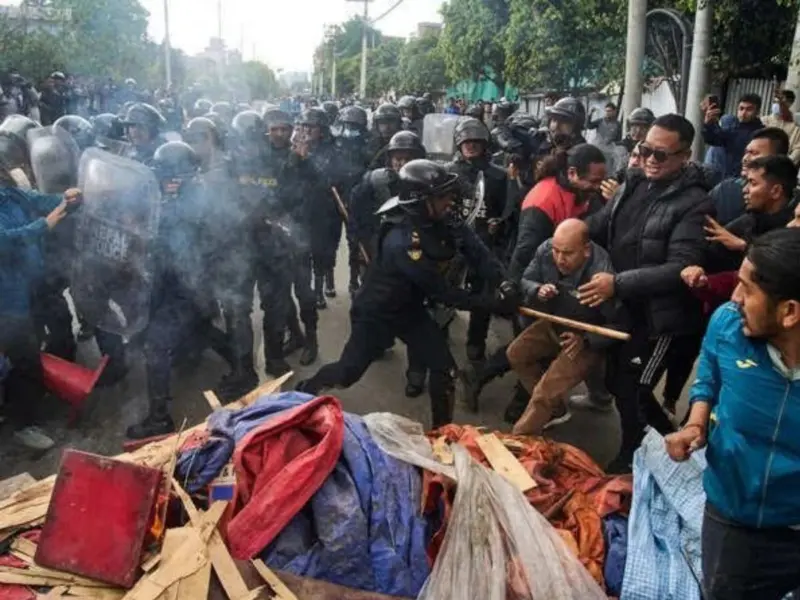

Nepal Protest 2026: Public anger is rising across Nepal as thousands of citizens, students and political workers take to the streets against the government led by Prime Minister Balendra Shah.
The protests, which began as small demonstrations, have quickly grown into widespread agitation across major cities, including Kathmandu.
The unrest comes just weeks after Shah assumed office, putting the young leader under pressure at the very start of his tenure. Demonstrators have gathered near the government's administrative headquarters at Singha Durbar, demanding policy changes and accountability from the leadership.
According to multiple reports, the protests are not driven by a single issue. Instead, a combination of economic decisions, governance concerns and corruption allegations has fueled widespread dissatisfaction across the Himalayan nation.
Nepal Protest 2026: Why Are Protests Happening in Nepal?
One of the biggest triggers behind the protests is the government's strict enforcement of customs duty rules on goods brought from India. The policy requires citizens to pay taxes on items worth more than NPR 100 brought across the open border between Nepal and India.
Many residents, especially those living in border districts, rely heavily on Indian markets to buy essential items such as groceries, medicines and clothing. Protesters say the rule increases daily expenses and creates financial hardship for families.
Officials, however, say the rule is not new. The government recently began enforcing it more strictly to reduce revenue losses and control illegal imports into the country. Authorities also increased monitoring at border checkpoints to ensure compliance with customs laws.
Nepal Protest 2026: How Student Union Issue Add Fuel to the Nepal Protest?
Another major reason behind the unrest is the government's alleged move to sideline or restrict student unions linked to political parties. This decision has triggered protests across universities and colleges, drawing thousands of young people into demonstrations.
Student leaders have accused the government of adopting a restrictive approach instead of engaging in dialogue. Many protesters carried placards and shouted slogans demanding that authorities reverse the decision and protect student representation in educational institutions.
Nepal Protest 2026: What is the New Customs Duty Rule in Nepal?
Nepal has started strictly enforcing a rule that requires citizens to pay mandatory customs duty, locally known as Bhansar, on any goods purchased from Indian markets if their value exceeds NPR 100 (around ₹63-₹65).
Under the revised enforcement, the tax rate varies widely depending on the type of product. Duties now range from 5% to as high as 80%, making several everyday purchases significantly more expensive.
The regulation covers essential daily-use items such as food products, clothing, medicines and other household supplies. Authorities have also made public announcements through loudspeakers in border regions, informing people that no exemptions will be allowed, including for civilians, government workers or non-governmental organisations.
Nepal Protest 2026: How Daily Shopping Costs Are Rising?
Shopping costs have risen sharply because earlier rules were less strict and allowed people to bring small quantities of goods from India without paying tax.
Previously, buyers could carry items worth NPR 200 to NPR 500 across the border without facing detailed checks. However, under the current enforcement, even small purchases, such as a packet of biscuits or a kilogram of tea, can attract customs duty.
Many shoppers now have to wait in long queues at border checkpoints to pay taxes, even for minor items. Officials have reportedly seized goods when buyers failed to pay duties within the specified time, sometimes within 24 hours of crossing the border.
The limited access to cheaper Indian products has also affected local markets. Retailers in Nepal have started increasing prices on goods already in stock due to reduced supply and rising demand.
Nepal Protest 2026: How this Bill will Impact on Border Residents and Local Markets?
The new enforcement has triggered strong reactions in border regions that share deep economic and cultural connections with India. Areas near the Indian states of Bihar and Uttarakhand rely heavily on cross-border trade and long-standing social ties often described as 'beti roti' relationships, symbolising close family and livelihood connections.
Markets located along the Indo-Nepal border, stretching from Dharchula to Darjeeling, including busy trade points such as Jogbani and Banbasa, have reported a noticeable decline in customer visits. Many Nepali buyers have stopped travelling to Indian markets due to the additional taxes and longer waiting times at checkpoints.
The policy has also led to demonstrations along the nearly 1,750-kilometre open border, highlighting the scale of public concern.
For thousands of low-income households, purchasing lower-cost goods from Indian markets had become an essential way to manage rising living costs in Nepal. This practice acted as a practical "survival strategy" for families facing inflation.
Although the government introduced stricter enforcement to increase domestic revenue and encourage the purchase of locally produced goods, critics argue that the NPR 100 threshold is extremely low. As a result, even routine grocery shopping has become costly and time-consuming for ordinary citizens.
Experts warn that unless authorities revise the limit or simplify procedures, daily life could become increasingly difficult for residents who depend on cross-border trade for necessities.
Nepal Protest 2026: Corruption Allegations Intensify Public Outrage
Public anger has also intensified due to allegations of corruption against Nepal's Home Minister, Sudan Gurung. Protesters claim he accumulated disproportionate assets and was involved in suspicious financial dealings.
These accusations have led to growing demands for his resignation. Opposition leaders and civil society groups have called for an independent investigation to ensure transparency and restore public confidence in the government.
Nepal Protest 2026: Political Pressure Mounts on New Prime Minister
Prime Minister Balendra Shah took office recently after the fall of the earlier government led by KP Sharma Oli. His rise to power followed widespread youth-led protests that reshaped Nepal's political landscape.
At 35 years old, Shah became one of the youngest leaders to hold the top office in Nepal. Many voters supported him because of his anti-corruption promises and reform-focused campaign. However, the ongoing protests now present one of the biggest early challenges to his leadership.
Political analysts warn that continued unrest could weaken the government's authority and delay key policy decisions if tensions remain unresolved.
Nepal Protest 2026: Economic Impact and Border Concerns
The strict customs enforcement has not only affected Nepalese citizens but also impacted cross-border trade with India. Border towns that depend on daily trade have reported fewer shoppers and reduced business activity.
Residents in several regions have complained about long queues and strict inspections at border checkpoints. Some reports also show that enforcement teams have increased patrols to monitor goods entering the country.
Experts say the open-border system between Nepal and India has played a crucial role in the region's economy for decades, and any disruption could affect livelihoods on both sides.
Nepal Protest 2026: What Could Happen Next in Nepal?
With protests continuing in several cities, pressure is mounting on the government to review controversial policies and address public concerns. Political parties, student groups and civil society organisations have demanded immediate dialogue with authorities.
If the government fails to respond quickly, analysts warn that the unrest could expand into a broader political crisis. However, if officials reconsider certain policies or announce reforms, tensions may ease in the coming weeks.
For now, Nepal remains on edge as citizens continue to demand changes, making the unfolding situation one of the most closely watched political developments in South Asia.