
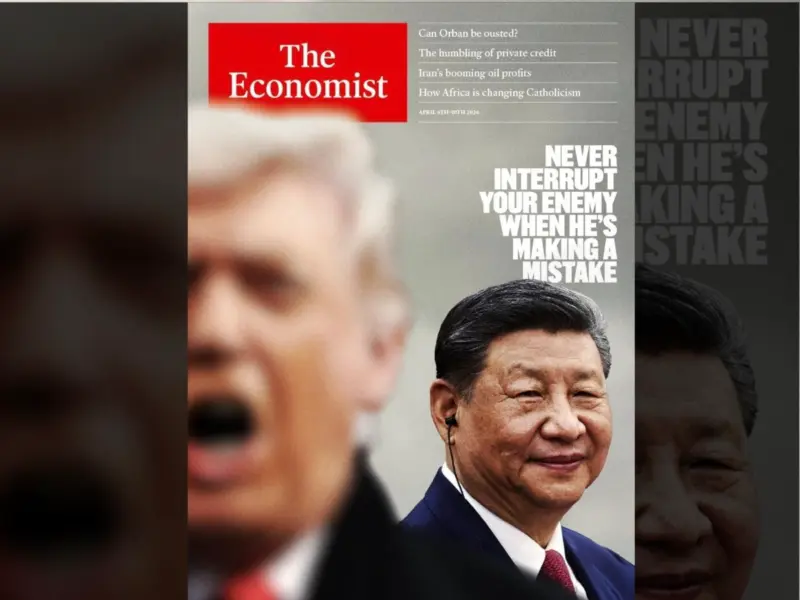
The latest cover of ‘The Economist’ has sparked global debate as the war between the United States and Iran continues to reshape geopolitical dynamics.
The cover prominently features Xi Jinping in sharp focus, while Donald Trump appears blurred in the background. The caption reads: "Never interrupt your enemy when he's making a mistake."
The visual message has drawn attention because it reflects a wider global perception that China may be quietly gaining an advantage while the United States remains deeply engaged in the Iran conflict. Analysts say the war is not only a military confrontation but also an economic and strategic test that could reshape global power balances. While Washington focuses on military pressure, Beijing appears to be watching carefully, strengthening its economic position and preparing for long-term gains.
What Does the Economist’s Cover Page Mean in the Context of the Iran War?
The cover page design itself carries a strong strategic message. By placing Xi Jinping clearly in focus and showing Donald Trump blurred in the background, the image suggests a shift in global attention and influence.
The quote on the cover, “Never interrupt your enemy when he's making a mistake,” is widely attributed to Napoleon Bonaparte. In military strategy, the phrase means that when an opponent makes a costly decision, it is often wiser to observe rather than intervene.
In the context of the Iran-US war, analysts believe the cover symbolises how China is choosing patience instead of confrontation. While the United States increases military involvement, China remains relatively silent, allowing geopolitical tensions to create opportunities that Beijing may later use to strengthen its global position.
Experts say the cover reflects the idea that wars are not only fought with missiles and troops but also through economic resilience, diplomacy, and long-term planning. The visual narrative suggests that while one nation acts aggressively, another may benefit simply by waiting and adapting.
How the War is Affecting the US While Creating Opportunities for China
The Iran conflict has placed significant economic and political pressure on the United States. Rising oil prices have increased transportation costs, which in turn contribute to inflation and economic uncertainty. Financial markets have also reacted to instability, creating challenges for policymakers.
Meanwhile, China appears to be using the situation to expand its economic partnerships. As Western nations focus on military operations and security concerns, Beijing has strengthened trade links across Asia, Africa, and parts of Europe.
Experts say the pattern is becoming increasingly clear:
US military escalation → global instability → rising costs → strategic openings for China.
Instead of confronting the United States directly, China is positioning itself as a stable economic alternative. This strategy allows Beijing to gain influence gradually without engaging in open conflict.
How the US-Iran War Is Benefiting China?
- Strategic Distraction From Indo-Pacific
The conflict with Iran has forced the United States to shift military focus and resources to the Middle East. This reduces Washington's attention on the Indo-Pacific region, which China considers strategically important. Analysts say this distraction could ease pressure on Taiwan, giving China more strategic flexibility.
- Opportunity to Study US Military Operations
China is closely observing the war to understand how US forces operate in real combat. Military planners are studying drone usage, missile defence systems, and aircraft carrier movements. This real-time battlefield data helps China improve its own defence strategies without directly entering the conflict.
- Economic Gains Through Oil and Trade
China continues to benefit economically as global oil supplies face disruption. With tensions rising near the Strait of Hormuz, fuel prices have increased worldwide. Meanwhile, China maintains access to Iranian oil and strengthens energy agreements, helping secure stable supplies and lower costs.
- Diplomatic Advantage and Global Influence
China has positioned itself as a supporter of diplomacy and stability during the conflict. By avoiding direct military involvement, Beijing is strengthening ties with developing nations and presenting itself as a balanced global power. This approach helps China expand its influence while the United States remains deeply engaged in war efforts.
Is China Getting Any Sort of Benefit From the War?
Several diplomats and analysts believe China is already gaining indirect benefits from the ongoing war. Rising oil prices and disruptions in energy routes have created uncertainty across Western economies. At the same time, China has strengthened trade relationships and secured long-term energy agreements with multiple partners.
Experts argue that Beijing has adopted a calm and patient approach while Western markets face rising inflation and supply disruptions. Countries in Europe and Asia that depend heavily on energy imports have experienced price shocks, while China has focused on stabilising its supply chains.
Some analysts say China is benefiting without engaging directly in the conflict. Instead of reacting publicly, the country continues to expand its economic ties and influence in regions affected by instability.
US-China Feud
The conflict has also highlighted the growing rivalry between the United States and China. Strategic competition between the two global powers has intensified in recent years, especially over technology, trade, and military influence.
Observers note that the United States expected the war to demonstrate its military strength and deter rivals. However, many experts now argue that the conflict may have produced unintended consequences.
China's leadership, under Xi Jinping, has prioritised national security and long-term planning. Analysts believe Beijing sees the current situation as proof that focusing on stability and patience can provide strategic advantages.
Meanwhile, tensions between the United States and European allies have also increased due to rising economic pressure linked to the conflict.
What Does the Quote on the Cover Mean?
The cover of The Economist featured a powerful quote that captured global attention.
“Never interrupt your enemy when he is making a mistake,” reads the inscription on the cover of the magazine.
The phrase is widely attributed to Napoleon Bonaparte, who reportedly used it to describe strategic patience during conflict.
Experts say the quote reflects China's approach to the current situation. Instead of confronting the United States directly, China appears to be allowing events to unfold while benefiting from the resulting economic and political shifts.
Analysts believe the quote symbolises a moment where one side continues aggressive action while the other quietly gains influence.
How is China hoping to win the War?
China has not entered the conflict militarily, but observers say it is using diplomacy and economic policy to strengthen its position. By expanding trade links and securing stable energy supplies, Beijing aims to reduce vulnerability to global disruptions.
Experts note that China is positioning itself as a reliable economic partner at a time when uncertainty affects Western economies. This approach allows Beijing to increase its influence without confrontation.
Analysts believe China's long-term strategy focuses on patience rather than speed. Instead of immediate gains, it aims to strengthen its global standing gradually.
What is Trump’s Mistake in Iran which Made It in the Hands of Beijing?
Critics argue that the decision to escalate military action against Iran may have created opportunities for China. Some believe that focusing heavily on military engagement has diverted resources and attention from economic competition.
Observers say that policies introduced by Donald Trump have increased global instability. Rising oil prices, disrupted trade routes, and strained diplomatic relationships have placed pressure on Western economies.
Experts suggest that such instability creates openings that rival nations can exploit. In this case, China has used the situation to strengthen its economic and strategic partnerships.
How Attack on Iran is Biggest Mistake of the US?
Some scholars believe the attack on Iran may prove to be one of the most significant strategic miscalculations by the United States. Instead of weakening rivals, it may have strengthened them indirectly.
Many analysts argue that wars often create unintended consequences, including economic stress and geopolitical shifts. In this case, rising energy costs and global market instability have affected multiple nations.
Experts warn that prolonged conflict could increase the risk of economic downturns and weaken alliances, making it harder for the United States to maintain global dominance.
US-Iran Latest Update: What’s Going On?
The war between the United States and Iran continues to shape global security and economic trends. Military operations remain active, and tensions show no clear sign of easing.
While leaders continue to defend their actions, analysts believe the long-term effects of the conflict will depend on how quickly stability returns to the region.
For now, the war has created a complex geopolitical environment where military decisions, economic shifts, and diplomatic strategies are closely linked. Observers say the coming months will determine whether the conflict strengthens American influence or accelerates a shift in global power toward China.
What Does the Economist Cover Page Mean - Has Trump Got It Wrong?
The cover of The Economist ultimately delivers a strategic warning rather than a direct judgment. By placing Xi Jinping in focus and showing Donald Trump blurred in the background, the image suggests that the United States risks creating opportunities for its rivals if the conflict continues to stretch resources and attention.
The quote, "Never interrupt your enemy when he's making a mistake," signals that China may choose patience while the United States remains deeply engaged in war.
In this context, the cover does not openly declare that Trump got it wrong, but it clearly raises the possibility that prolonged military action against Iran could unintentionally strengthen China's position in the global power balance.