




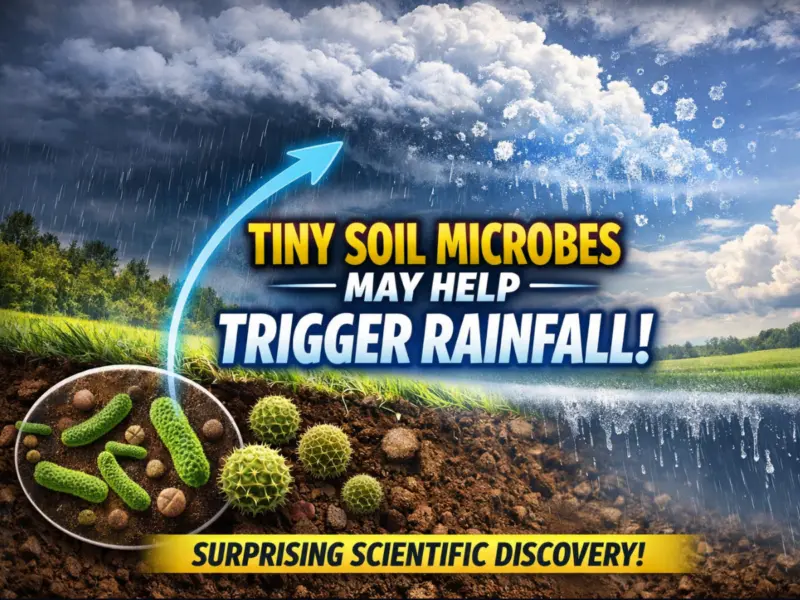

A fascinating new scientific study suggests that tiny organisms living in soil may play an unexpected role in shaping rainfall patterns.
Researchers say that microscopic life, such as bacteria and fungal spores, could help trigger one of the most important steps in rain formation - the freezing of water inside clouds, according to research highlighted in a recent ScienceAlert report.
The findings are reshaping how scientists understand the connection between Earth's surface and the atmosphere, revealing that the story of rain may begin much closer to the ground than previously believed.
The Hidden Role of Soil Microbes
According to research highlighted in a recent ScienceAlert report, certain bacteria and fungal spores found in soil can act as ice-nucleating particles. These biological particles have a special ability: they help water freeze at higher temperatures than many non-living particles, such as dust or soot.
This means they can make it easier for ice crystals to form inside clouds - an essential step in the process that leads to rain or snow.
From Soil to Sky: How Microbes Enter Clouds
These microbes do not stay in the ground forever. Wind and natural air currents can lift them from soil surfaces into the atmosphere, where they become part of airborne particles inside clouds.
Once inside clouds, they interact with supercooled water droplets, which are liquid droplets that exist at temperatures below freezing. The microbes help these droplets crystallize into ice, effectively supporting the formation of precipitation.
Scientists describe this as a key "trigger mechanism" in cloud physics that helps initiate rainfall under the right conditions.
Why This Discovery Matters
While dust and sea salt have long been known to influence cloud formation, this research highlights that biological particles may also play a significant role.
If confirmed further, this could help scientists:
-Improve rainfall and weather prediction models
-Better understand how ecosystems influence atmospheric processes
-Study how climate change might affect natural rainfall systems
It also strengthens the idea that Earth's systems - soil, air, water, and living organisms - are deeply interconnected.
A New View of the Water Cycle
This discovery adds a new layer to the water cycle: life on land may indirectly influence weather in the sky.
The cycle now appears even more interconnected:
-Microbes live in soil
-Wind carries them into the atmosphere
-They help clouds form ice
-Rain returns water back to Earth
This feedback loop shows how even microscopic organisms can play a role in large-scale environmental systems.
Disclaimer: This article is based on publicly available scientific reports and is intended for informational purposes only. It should not be interpreted as a definitive scientific consensus. Readers are encouraged to consult original research sources for the most accurate and up-to-date information.