
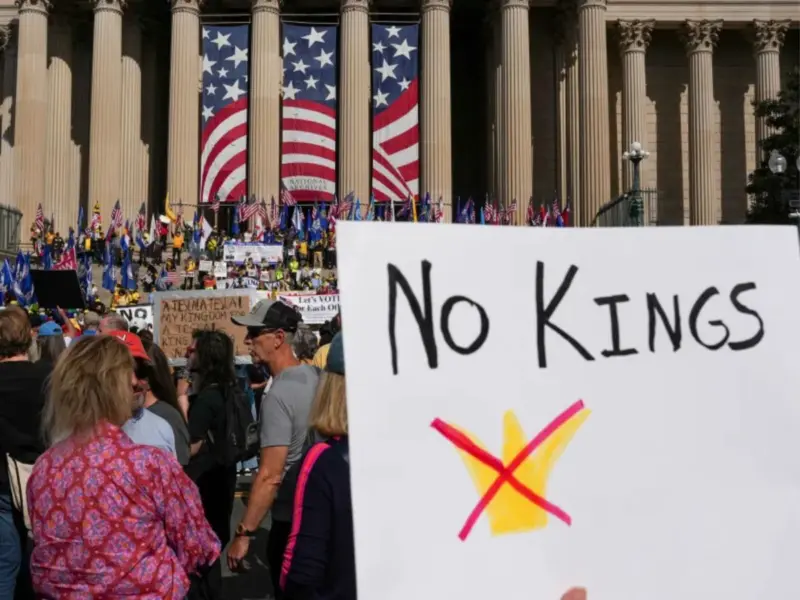

A large wave of coordinated protests has unfolded across the United States and several parts of Europe, as millions gathered under the "No Kings" banner.
Demonstrators voiced strong opposition to policies linked to US President Donald Trump, particularly on issues such as the Iran war, immigration enforcement, and civil liberties.
The protests stood out not only for their scale but also for their geographic spread, reaching both major cities and smaller towns. Organisers described the mobilisation as one of the most extensive in recent years.
The movement reflects growing public frustration and signals a wider debate over governance, rights, and the direction of US policy both at home and abroad.
'No Kings' Protests: What Is It & Why Are People Protesting?
The "No Kings" protests represent a broad-based movement aimed at challenging what participants see as authoritarian leadership and policy decisions. Protesters say they are standing up for democratic values and resisting actions they believe undermine civil rights.
The demonstrations draw attention to several key issues, including the ongoing war in Iran, strict immigration enforcement, and concerns about minority rights.
Participants have used slogans, placards, music, and symbolic gestures to communicate their message. The use of upside-down American flags, for example, reflects a sense of national distress.
Overall, the protests highlight a growing demand for accountability and policy change.
'No Kings' Protests: How Many People Joined 'No Kings' Rallies Across the US?
Organisers estimate that participation in the latest round of protests could reach as high as 9 million people. More than 3,100 events were organised across all 50 US states, indicating a nationwide mobilisation.
The protests were not limited to large metropolitan areas. They also spread to smaller towns and rural regions, reflecting broader engagement across different communities.
Previous rounds of the "No Kings" protests had already drawn millions, showing consistent growth in participation.
This scale of turnout suggests that the movement is gaining momentum and resonating with a wide cross-section of the population.
'No Kings' Protests: What Happened in Minnesota?
Minnesota became a focal point for the protests, with large crowds gathering at the state Capitol in St. Paul. The event combined political messaging with cultural performances, creating a high-energy atmosphere.
Musician Bruce Springsteen headlined the rally and addressed the crowd, highlighting recent incidents and public resistance.
Before performing, he said, "Your strength and your commitment told us that this was still America." "And this reactionary nightmare, and these invasions of American cities, will not stand."
The gathering also paid tribute to individuals affected by enforcement actions, adding emotional depth to the demonstration.
'No Kings' Protests: What Are Protesters Saying About Trump Policies?
Protesters voiced strong criticism of several policies, particularly those related to immigration enforcement and military involvement abroad. Many participants argued that these actions have raised concerns about civil liberties and governance.
In cities like Washington, demonstrators marched with signs and slogans targeting leadership decisions. Some used satire and creative expression as a way to make their message more impactful.
One protester said, "What we provide is mockery to the king." "It's about taking authoritarianism and making fun of it, which they hate."
Civil rights advocates also spoke out, reinforcing calls for resistance and public engagement.
'No Kings' Protests: How Has the White House Responded?
The White House has dismissed the protests, downplaying their significance and questioning their authenticity. Officials suggested that the demonstrations do not reflect widespread public opinion.
Spokesperson Abigail Jackson described them as "leftist funding networks" She also added, "The only people who care about these Trump Derangement Therapy Sessions are the reporters who are paid to cover them."
Republican leaders echoed similar views, framing the protests as politically motivated rather than grassroots movements.
'No Kings' Protests: Did the Protests Spread Beyond the US?
The protests were not confined to the United States and quickly spread to several international locations. Demonstrations took place in cities such as London, Paris, and Rome, reflecting global interest in US political developments.
Participants in these countries connected local concerns with broader global issues, including war and political extremism.
In Paris, organiser Ada Shen said, "I protest all of Trump's illegal, immoral, reckless, feckless, endless wars." The international turnout highlights how US policies continue to influence global public opinion.
'No Kings' Protests: What Happens Next After The Protests?
The scale of participation suggests that the "No Kings" movement may continue to grow in the coming months. Organisers have demonstrated the ability to mobilise large numbers of people across diverse regions.
Future protests could align with political developments, policy announcements, or election cycles. Sustaining momentum will be key to maintaining public attention and influence.
The movement's long-term impact will depend on whether it can translate public demonstrations into policy discussions or political outcomes. For now, the protests have clearly signalled widespread dissent and a demand for change.