
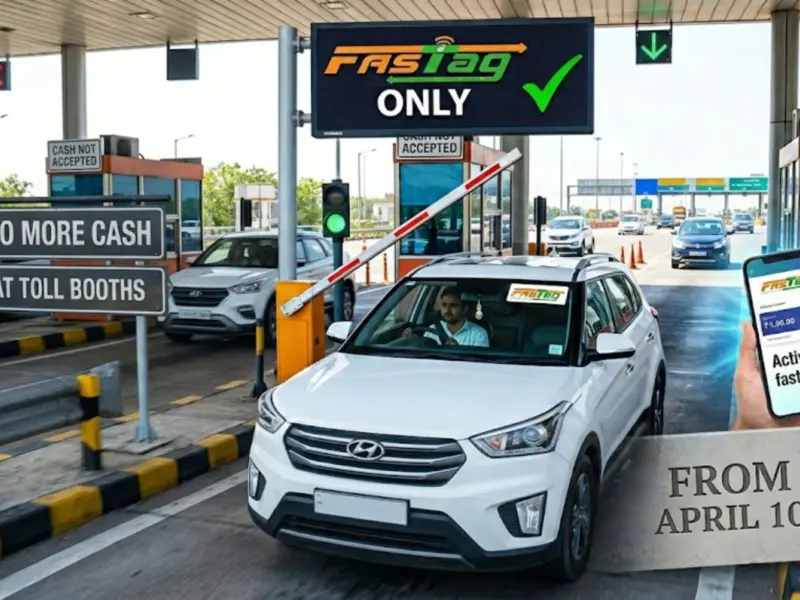

Toll Booths New Rules: Cash will no longer be accepted at Indian toll plazas starting April 10, 2026, following a gazette notification issued by the Ministry of Road Transport and Highways on April 2. Every driver on a national highway will now need either a working FASTag or a UPI payment app - and those without either have a system waiting for them too, with a 72-hour window to pay online before penalties kick in.
What Exactly Changes at Toll Booths From April 10?
The rule is straightforward. When you arrive at a toll gate, you pay via FASTag or you pay 1.25 times the normal toll fee via UPI. That is it. Cash is gone entirely. The option to pay double the applicable fee in cash - which existed before this notification - has been removed. The 1.25x UPI premium is not new. It existed before April 2. What is new is that the cash option has been completely eliminated. The government’s stated goals are faster traffic flow, reduced congestion, fewer disputes at booths, and an end to commuters flashing identity documents to avoid payment.
What If Your FASTag Is Not Working and You Have No UPI?
This is the question most drivers are asking. The answer lies in a March 18 release from the National Highways Authority of India, which introduced the concept of an “unpaid user fee.” If a vehicle passes through a toll booth without paying, an electronic notice - called an e-notice - is automatically generated and sent to the registered vehicle owner. It comes via SMS, email, mobile app, or through a designated online portal. The e-notice will show double the applicable toll amount. But here is the important part: if you pay within 72 hours of the notice being issued, you pay nothing extra. Zero penalty. Just the normal toll fee.
What Happens If You Miss the 72-Hour Window?
If payment is not made within 72 hours, the double fee applies. If no payment is made within 15 days, the amount is recorded in the road ministry’s VAHAN system - the national vehicle database - and “appropriate restrictions” are noted against the vehicle. The notification does not specify exactly what those restrictions are, but VAHAN records are linked to vehicle registration and renewal processes, making non-payment a problem that follows the vehicle long after the missed toll.
Why Is the Government Doing This Now?
The move is part of a broader push toward seamless, frictionless highway travel. Long queues at cash lanes, disputes over change, and commuters using identity cards to skip payment have been persistent pain points at toll plazas across India.
Since FASTag became required for all vehicles in 2021, adoption has increased dramatically; nonetheless, traffic at high-volume booths has continued to be slowed by cash lanes. That bottleneck is completely eliminated by the deadline of April 10. By establishing a digital audit record for each unpaid toll, the e-notice system also eliminates the possibility of cars just passing through without stopping.
FAQs: New Toll Rule
Q: When does the new rule take effect?
A: Starting April 10, 2026.
Q: Can I pay cash at toll plazas after April 10?
A: No. Cash payment has been completely ruled out.
Q: What are my payment options?
A: FASTag or UPI. Without FASTag, you pay 1.25 times the normal fee via UPI.
Q: What if I don’t have UPI or FASTag?
A: You will receive an e-notice. Pay within 72 hours with no penalty. After 72 hours, double the toll fee. After 15 days, restrictions apply via VAHAN system.
Q: What was the old cash payment rule?
A: Commuters without FASTag could pay double the toll fee in cash.
Q: Why is the government doing this?
A: To improve traffic flow, ease congestion, minimize disputes and reduce ID-flashing to skip payment.
Disclaimer: This article is based on the Ministry of Road Transport and Highways gazette notification issued April 2, 2026, and NHAI guidelines as of April 5, 2026.