
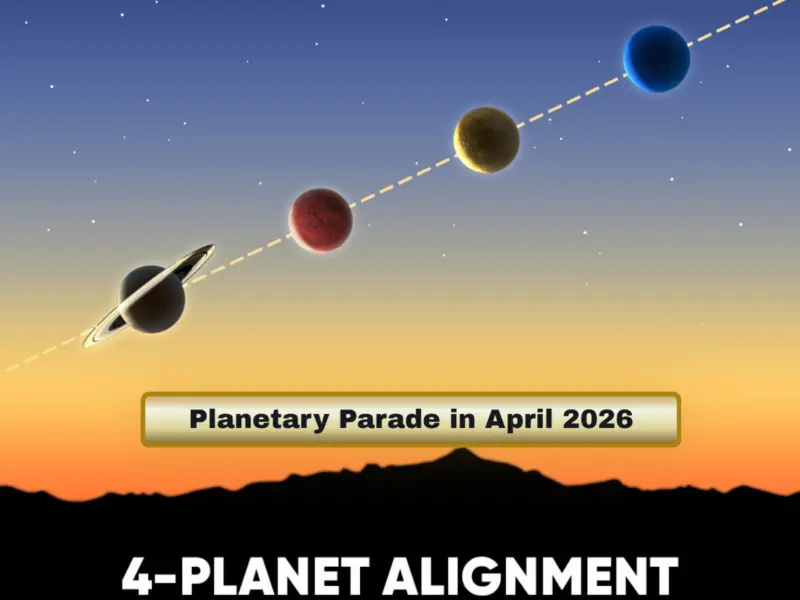

Planetary Parade in April 2026: A rare astronomical event is set to light up the early morning sky this April 2026, as four planets-Mercury, Mars, Saturn, and Neptune-appear in a compact grouping known as a "planetary parade." The celestial alignment will be visible before sunrise and is expected to draw interest from skywatchers across the world, including India.
Planetary Parade April 2026: Key Dates and Times
The planetary alignment will not be a single-day event but a short viewing window lasting several days.
Astronomers identify the main visibility period as:
– Peak visibility: April 16 to April 21, 2026
– Best viewing days: April 18 to April 20, 2026
– End of strong visibility: Around April 23, 2026
During this period, the planets will appear tightly grouped in the eastern sky before sunrise, offering the clearest and most dramatic view of the alignment.
Observers typically get only a 30-60 minute viewing window before sunrise, depending on location and horizon clarity.
Visibility Conditions: Where and How the Planet Parade Will Be Seen
The April 2026 planetary parade will be visible globally, but viewing quality depends heavily on location and sky conditions.
Best visibility conditions include:
– A clear, unobstructed eastern horizon
– Low light pollution (suburban or rural areas preferred)
– Clear weather with minimal haze or clouds
– Early morning wake-up (before sunrise)
In India and similar northern latitudes, the event will be best observed about 30 minutes before sunrise, when the planets sit low in the eastern sky.
Southern Hemisphere viewers may experience slightly longer and clearer visibility windows.
What You Will Actually See in the Sky
Although called a "four-planet parade," visibility varies:
– Mercury: Brightest and easiest to spot near the horizon
– Mars: Visible to the naked eye under clear skies
– Saturn: Slightly dimmer but still visible
– Neptune: Not visible without a telescope
The planets will appear clustered along the same line of sight due to their alignment along the ecliptic plane, the Sun's apparent path across the sky.
This is not a physical alignment in space-just a visual effect from Earth's perspective.
How to Watch the Rare Planetary Alignment
To get the best experience of this celestial event, follow these simple tips:
1. Choose the right time
Go out 30-45 minutes before sunrise, especially between April 18 and April 20 for peak visibility.
2. Find a dark location
Avoid city lights. Open fields, rooftops, or rural edges work best.
3. Look toward the eastern horizon
All planets will appear low in the east before sunrise.
4. Use binoculars or a telescope (optional)
-Binoculars can help separate faint objects
-A telescope may be needed to spot Neptune
5. Check weather conditions
Clear skies are essential-cloud cover can fully block the event.
Why This Planet Parade Is Special
Planetary alignments of four planets occur every few years, but compact groupings like this are still considered visually striking. The April 2026 event is particularly notable because:
– Multiple planets appear in a tight sky region
– It is visible from most of the world
– It occurs during a convenient pre-dawn window for observers
– It offers changing formations across multiple mornings
The April 2026 planetary parade offers a rare opportunity to witness four planets sharing the same slice of the dawn sky. While not all planets will be visible without equipment, the event still promises a memorable celestial display-especially between April 18 and April 20, when the alignment is at its most compact and visually stunning. For skywatchers in India and beyond, it's a short but rewarding early-morning spectacle worth setting an alarm for.
FAQs - Planetary Parade in April 2026
1. What is the Planetary Parade in April 2026?
It is a rare celestial event where four planets-Mercury, Mars, Saturn, and Neptune-appear close together in the pre-dawn sky, creating a visual alignment from Earth's perspective.
2. When is the best time to watch the planetary alignment?
The best viewing window is expected between April 18 and April 20, 2026, about 30-60 minutes before sunrise.
3. Can I see all four planets with the naked eye?
No. Mercury, Mars, and Saturn may be visible without equipment, but Neptune requires a telescope due to its faint brightness.
4. Where is the best place to watch the event?
A dark, open area with a clear eastern horizon-away from city lights-is ideal for the best visibility.
5. Is this a real alignment in space?
No. The planets only appear aligned from Earth's perspective along the ecliptic plane. They are not physically close to each other in space.
Disclaimer: This information is based on inputs from news agency reports. TSG does not independently confirm the information provided by the relevant sources.