




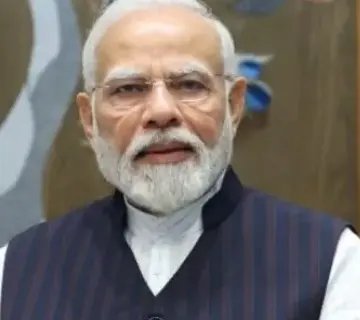

Prime Minister Narendra Modi has called for a "Swasth" (healthy) India and judging from his tireless reserves of energy, he personally practises what he preaches.
He has popularized yoga across the world and even secured international backing for a World Yoga Day. Yet the reality is that on a per capita basis, several countries have higher yoga practice rates than India does. This despite the fact that several world class yoga institutes are scattered across the country. It is his daily yoga practice that enables Prime Minister Modi to, in some months, circumnavigate the globe twice on a mileage basis. In each stop, there awaits a packed itinerary, leaving very little time even for essentials such as sleep. Yoga needs to be mainstreamed across the educational system, and this could happen were school and university boards to award credits to students practising yoga close to their classrooms. Teachers of yoga, as well as teachers of sports, ought to be given a higher ranking in schools and universities rather than remain on the margins as has been the situation since a long time. Daily sports practice by students should be given credits by schools and colleges.
There have been and still are several potential Sunil Gavaskars who have been told by their guardians to "focus on their studies" instead of "wasting time" at cricket practice. FIFA matches have been taking place in several cities, yet no team of footballers from India has managed to make the cut for the country to be represented. Even tiny Cape Verde, with its population of six lakh, enters the final round of the FIFA championship, while India with 1.4 billion people has not even qualified to enter the preliminary rounds. As for the Olympic Games, gold medals won by India can be counted on the fingers of a hand. The last Olympic hockey gold was 38 years ago for a country that once was pre-eminent in the game. Sports federations spend very little time on seeking out fresh talent from the impromptu hockey fields dotting the country. Instead, only a handful of players are looked at, and as a consequence, in hockey (as in track or other events) India is nowhere in the Olympics medal tally. Of course, there is a large contingent of sports officials accompanying the players to international destinations, living and travelling off taxpayer money rather than being dismissed for their lack of success in getting a single Olympic medal. Only cricket has been the exception, a game in which India continues to dominate across the decades. Well done, Board of Control for Cricket in India.
A field where India could score heavily is inbound tourism. Much smaller countries with far less variety are getting more foreign tourists than India, despite the cost advantage of a lower rupee. State governments need to assist in ensuring not just clean facilities for room and board but signs everywhere not just in local but in international languages. Some states have very few signs in languages other than their own. Tourists find their way around such locations with difficulty. Popularizing historical sites and training youth to be guides fluent in one or the other international language would boost tourism from abroad and add to the foreign exchange kitty. Similarly, other avenues could be created to ensure that youth are gainfully employed. As an illustration, carers for the elderly are in great demand in wealthy countries. Indian youth would be ideal carers, once properly trained in the profession.
In the past, there was compulsory commitment of time to the National Cadet Corps. Non-attendance had consequences on university attendance and credits. The NCC imparted discipline to the students, and helped in ensuring a spirit of camaraderie and love of country in them. Each cadet wore the same uniform and the son of a wealthy businessperson stood in the practice ground next to the son of a railway porter and established friendships. That the NCC as of old times needs to be revived is the view of several health professionals. India has a young population of 60% of the population. Very few are through their training getting fitted to succeed in a world where technology is changing by the second. Very few regard it as important to keep abreast of the news and current affairs. They need to take their cue from Prime Minister Modi, who seeks that a youth in India be enabled to compete globally. Experiments in giving underprivileged children in underdeveloped areas access to computers and the knowledge accessible via them shows that children can improve their knowledge skills rapidly, much faster than adults can. In the field of Artificial Intelligence, the youth have latent skill sets that should be developed. Very few Indians have the money or opportunity to work abroad. They need an environment at home that compares favourably with that abroad. Unless the "water" of useful knowledge is given educational and training "canals" to irrigate young minds, the inborn skills in them will go to waste and degenerate. We must act and do so now to make Prime Minister Modi see his dream of Superpower Bharat becoming a reality. The young are the most precious resource in such a task, and are capable of meeting not just domestic but worldwide needs. The next time an adolescent shows promise at sports field, there needs to be a track to take him or her to the top of the game as there is in cricket. Computer access needs to be universalised across classrooms, whether they be in privileged or underprivileged institutions. Only when opportunity for the young be universalised across the population will the objective of Prime Minister Modi for a strong, healthy India be actualised.