
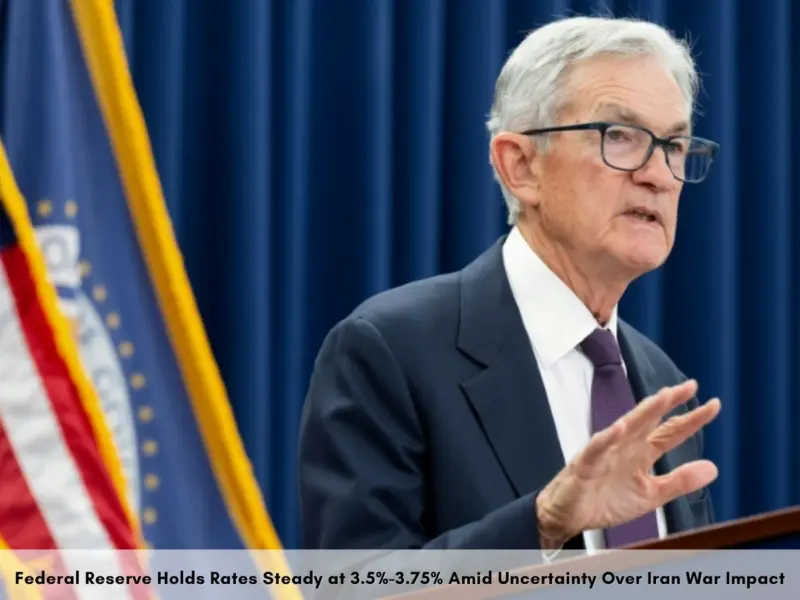
The Federal Reserve left its benchmark interest rate unchanged at 3.5% to 3.75% on Wednesday, marking the second consecutive meeting where rates have held steady as policymakers grapple with uncertainty stemming from the ongoing U.S.-Iran war.
The decision by the Federal Open Market Committee was reached by an 11-1 vote.
Chair Jerome Powell told reporters that the committee specifically cited “uncertainty” regarding the economic implications of the conflict in the Middle East, which has driven oil prices sharply higher and disrupted global shipping.
What Did the Fed Decide on Rates?
The FOMC voted to maintain the federal funds rate in its current range of 3.5% to 3.75%. This follows three consecutive 0.25% rate cuts in late 2025 and a pause in January 2026 as the economy showed unexpected strength.
Governor Stephen Miran was the lone dissenter, voting for an immediate 0.25% cut to support what he sees as a slowing labor market.
How Has the Iran War Affected the Fed’s Thinking?
The March meeting took place under the shadow of the U.S.-Iran war, which began roughly three weeks ago. Conflict in the Middle East has spiked Brent crude prices to $108 a barrel, and U.S. gasoline prices have surged 30% since the war began, reaching roughly $3.84 per gallon.
The Fed officially labeled the economic implications of the conflict as “uncertain” in its policy statement, a recognition that the path of inflation and growth now depends heavily on events beyond U.S. borders.
What Are the New Inflation Forecasts?
Updated projections show officials now expect core inflation to end 2026 at 2.7%, a slight increase from the 2.5% forecast in December. Headline PCE inflation was also lifted to 2.7% from the previous 2.4%. The economic growth projection for 2026 was slightly raised to 2.4%, suggesting the Fed sees the economy as resilient despite the oil shock.
Does the Fed Still Plan to Cut Rates This Year?
The median FOMC projection, reflected in the “dot plot,” still indicates one quarter-point rate cut is possible later in 2026. However, Powell emphasized this remains data-dependent. The Fed’s ability to cut rates will hinge on whether inflation continues to moderate and how the war affects the economy in coming months.
Why Is This Meeting Significant for Powell?
This was Chair Jerome Powell’s second-to-last meeting before his term expires on May 15, 2026. President Trump has nominated former Fed Governor Kevin Warsh to succeed him, but Powell stated he would serve as Chair pro-tem if a successor is not confirmed by the time his term ends.
How Have Markets Reacted?
Stocks showed modest moves following the announcement, with investors parsing the unchanged rate stance and updated projections. The decision to hold rates steady was widely expected, though the upward revision to inflation forecasts caught some attention.
FAQs: Fed’s March 2026 Decision
Q: What is the current federal funds rate?
A: The target range remains 3.5% to 3.75%.
Q: How has the Iran war affected the Fed?
A: The conflict has created “uncertainty” in the economic outlook, spiking oil prices to $108 a barrel and gasoline to $3.84 a gallon.
Q: What are the new inflation projections?
A: Core PCE inflation is now projected at 2.7% for 2026, up from 2.5% in December.
Q: Will the Fed cut rates this year?
A: The median projection still shows one quarter-point cut possible in 2026, but it’s data-dependent.
Q: When does Powell’s term end?
A: May 15, 2026. He would serve as Chair pro-tem if a successor isn’t confirmed.
Q: How many rate cuts happened before this pause?
A: The Fed implemented three consecutive 0.25% cuts in late 2025.
Disclaimer: This information is based on inputs from news agency reports. TSG does not independently confirm the information provided by the relevant sources.