




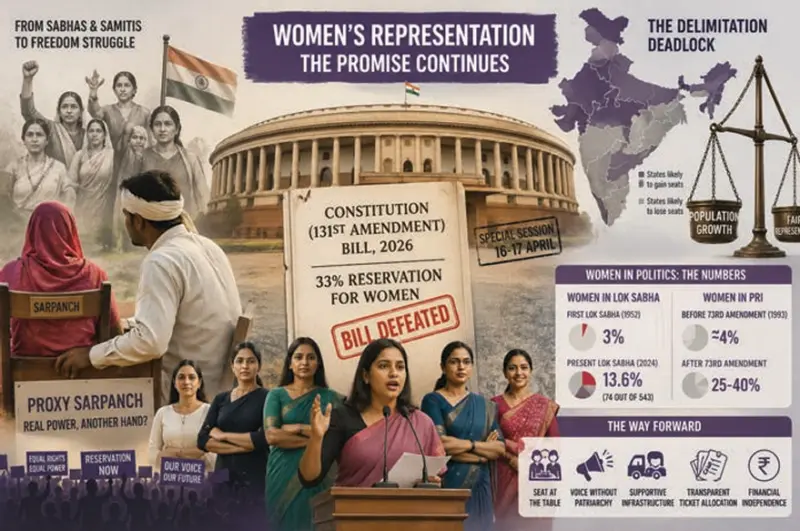

In a special session of Parliament on 16-17 April, the Constitution (131st Amendment) Bill, 2026, designed to finally operationalise 33% reservation for women, failed to secure the two-thirds majority it needed.
Starting from 1996 when the demand was raised through 81st Amendment Act to the 106th Constitution Act, 2023 promised that one in every three seats in the Lok Sabha and state legislative assemblies will be reserved for women. Though in 2023 the bill was passed with a huge majority, it linked implementation to the post-census delimitation exercise. Given that the 2021 Census has been indefinitely delayed, this meant reservation could not arrive until 2034 or beyond, therefore, effectively pushing the promise into the next decade. sent their constituencies? The reality is that the political parties are the biggest gatekeepers. And the bill never gave any guidelines for them on how they would select those women, how they fund them, or whether they are given real portfolio responsibilities after winning.
This special session attempted to untie that knot. The amendment proposed to remove the constitutional freeze on delimitation which was put in place in 1976. The new proposal was to allow delimitation based on "such Census as Parliament may by law determine". This could have advanced the timeline for operationalisation of 33% reservation for women.
Since ancient times, women in India have been given significant importance in decision-making. Women were part of political committees such as sabhas and samitis. Later due to multiple invasions, the position of women was restricted to household activities. However, with the rise of socio-religious movements and the national movement against the Britishers, women in India started holding important political positions, such as participation in Civil Disobedience Movement and Quit India Movement.
Post Independence, women were promoted to be part of politics through various provisions of the Constitution, which provided equal social, political and economic rights for men and reflect on is whether in reality, the passage of the bill standalone could have led to real decision-making power for women. Numbers matter. Shamika Ravi, Member PM-EAC, whose research has examined women's political participation across 50 years of Indian electoral data, has consistently argued that women bring distinctive governance priorities shaped by their lived experience. women. However, in the first Parliament, only 3% of women were part of it. But post 75 years of Independence, the present Lok Sabha has about 74 women MPs out of 543, that is roughly 13.6%. The present bill wanted to address these numbers.
At the grassroots level, women's representation has increased since the introduction of the 73rd Amendment Act, 1993, which provided for one-third reservation of seats for women in Panchayati Raj Institutions (PRI). Thereby, political participation in women went from approximately 4% to 25-40%. But it also produced the phenomenon of the "proxy sarpanch" where husbands or male relatives sat behind the woman who held the official title and exercised real power in her name. The Ministry of Panchayati Raj has itself flagged this in recent expert committee recommendations.
Apart from political representation, women are actively participating in the political process. There has been a decrease in the gap in voter turnout between men and women, and an increase in the number of questions asked by women. Even the political procedures are attempting to be gender-neutral. In 2014, the Rules of Procedure of the Lok Sabha were amended to refer to the Lok Sabha Committee Heads as Chairperson (not chairman) in all documents. These changes are a positive sign of gender inclusivity in the political sphere.
THE DELIMITATION DEADLOCK The linkage to delimitation created a lot of tensions and questions, which ultimately But numbers alone are insufficient. India ranks 147th globally in women's legislative representation. But women are not completely disengaged from Indian democratic history. Both in 2019 and 2024, women have voted in extraordinary numbers, and voter turnout was nearly equal. India is also a signatory to the Convention for Elimination of Discrimination Against Women and the International Covenant on Civil and Political Rights, which obligate them to take measures for the participation of women in government and politics.
led to its defeat, which in many ways was not inevitable. It was the consequence of bundling two separate constitutional questions into a single vote: one about women's representation, and one about how India's electoral map should be redrawn between its states.
The problem was structural, and not merely political. The proposed bill sought to increase the Lok Sabha's strength from 543 to up to 850 seats and amending Article 82 to remove the mandatory link between delimitation and decadal Census cycles. But the seat reallocation based on 2011 population figures would, in effect, be an advantage for the states that increased their population, primarily the northern states of Uttar Pradesh, Bihar, Madhya Pradesh, and Rajasthan. And states that effectively managed population growth, i.e. Tamil Nadu, Kerala, Karnataka, stand to see their proportional voice in Parliament diminish. Therefore, the voices are raised by a few parties. Even the missing of reservation for OBC category remained a contentious point.
But what is important to Now even though the bill is defeated, what stops the political parties from giving tickets to women to represent Therefore, while it was certainly important to pass the bills, transformation in Indian politics for women will require three things simultaneously: a seat at the table, the ability to speak at that table without the invisible weight of patriarchal structures, and the infrastructure and structural conditions, i.e. childcare, safe transport, toilet facilities at rallies, transparent ticket allocation, and financial independence. And therefore, before 2029 Lok Sabha elections, the political parties must start giving them voice despite the absence of reservation criteria and create infrastructure that would create conditions for their sustained participation.
Dr Cchavi Vasisht is an Associate Fellow at Chintan Research Foundation.