




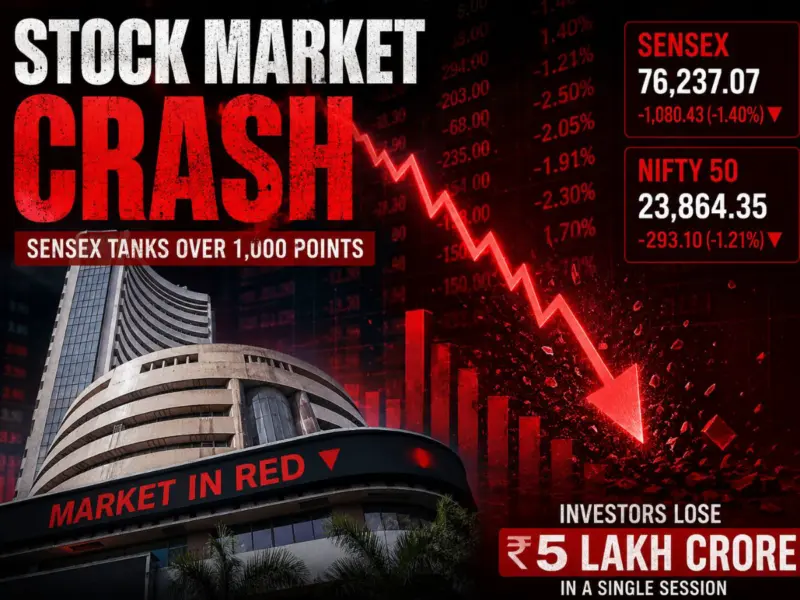

Stock Market Crash (May 11,2026): The Indian stock market recorded a heavy sell-off on Monday, May 11 due to the rising tensions, high crude oil prices and concerns regarding the economic growth.
In one trading day, the fall in indices has wiped away the wealth of investors exceeding ₹5 lakh crore. The BSE Sensex index, a benchmark of the Indian stock market comprising 30 major companies, registered a fall of around 1,100 points to reach a low of 76,237. The Nifty 50 index dropped by more than 1 per cent reaching a low level of 23,864.
The broader market indices have also fallen by up to 1 per cent in one trading session. The total market capitalization of the listed companies at Bombay Stock Exchange has decreased from ₹473.5 lakh crore to ₹468 lakh crore.
Here Are Key Reasons Behind Today's Stock Market Crash
US-Iran Peace Talks Collapse
The investor mood became negative after their expectations for positive developments in the prolonged US-Iranian war were ruined. US President Donald Trump rejected Iran's latest peace initiative, labeling it "unacceptable." This development raised concerns about escalating tensions in West Asia.
As reported, the lack of agreement is likely to trigger intensified military interventions against Iran by Washington. At the same time, Israeli Prime Minister Benjamin Netanyahu cautioned that Iran's nuclear program continues to pose a serious risk, despite recent military actions.
Uncertainty about the dispute has kept global crude oil prices at above $100 per barrel for over two months now, triggering inflation and reducing economic growth.
PM Modi's Appeal Weighs On Investors Sentiment
Market analysts also attributed Monday's crash to India's Prime Minister Narendra Modi telling people to cut back on their fuel intake, avoid making any unnecessary gold purchases and foreign trips in the wake of the global economic recession.
Addressing people on Sunday, Modi said people should be careful with their use of petrol, diesel and gas. VK Vijayakumar, Chief Investment Strategist at Geojit Investment, suggested that the Prime Minister's advice might have affected the confidence level of investors.
“I feel that what has impacted the markets today much more than the fact that we could not get an end in sight for the Iran situation is the Prime Minister’s austerity message. The Prime Minister called for restraint on consumption of petrol, diesel, gold, and also foreign travel,” Vijayakumar said.
He went on to say that, “An austerity message implies lower growth and lower profits and hence has a direct adverse effect on market performance.”
Sharp Rise In Crude Oil Prices
Prices of crude oil rose worldwide when the situation in West Asia worsened, and the worries over disruptions of oil supplies via Strait of Hormuz escalated even further. Brent Crude price saw a rise of more than 4 percent and touched the $105 per barrel mark once again.
India is a country that imports about 85-90 percent of its requirements of crude oil and hence faces major economic difficulties due to rising prices of oil.
Rupee Weakens Against US Dollar
The Indian rupee was also facing downward pressure. It opened trading at 40 paise down at 94.88 against the US dollar amid increasing prices of crude oil and robust demand for the dollar. A depreciating rupee makes imports more expensive and is likely to cause foreign investment inflows out of India. This could also result in inflationary pressures.
Technical Breakdown In Nifty 50
Moreover, there were signs from the technical side too suggesting weakening sentiments in the market. The Nifty 50 Index was unable to sustain the critical support level of 24,000.
Rajesh Palviya, Head of Research, Axis Direct stated that the index needs to break through vital resistance points for a positive bias on the index. "Until and unless we have a closing above 24,340, our bias remains cautious, with the next support zone being 23,800, in case this falls," he explained.
Currently, market participants are awaiting further direction based on developments in the US-Iran standoff and crude oil prices.