
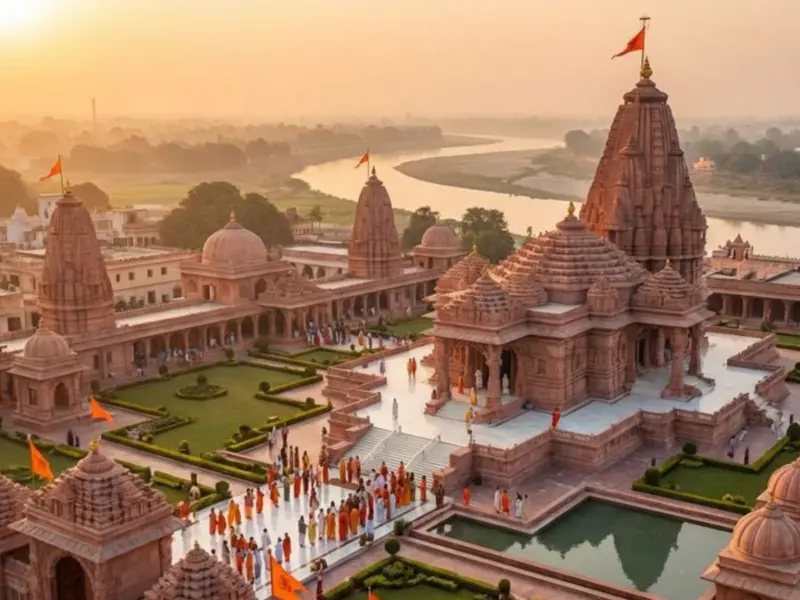

Uttar Pradesh is rapidly reclaiming its place as a hub of religious tourism. Under the leadership of Prime Minister Narendra Modi and implementation by Chief Minister Yogi Adityanath, a major cultural resurgence is taking place with reclamation and restoration of scared sites in accordance with rule of law.
The consecration of the Shri Ram Mandir in Ayodhya, the makeover of Kashi and Prayagraj with the Temple Corridor and modern facilities, the facelift of Gorakhpur's Gorakhnath Temple and rejuvenation of many other sacred sites reinforce cultural consciousness and also drive modernization. Enhanced connectivity through better roads, highways, enhanced train facilities, airports, hotels, upgraded amenities, and sustainability initiatives has spurred tourism, with Uttar Pradesh attracting more than 137 crore domestic tourists in 2025, besides 3.66 lakh foreign tourists. With 60% of India's tourism rooted in religious and spiritual travel, Uttar Pradesh is leveraging temple tourism to renew its cities, fuel the state's economy, and uphold the sanctity of its places of worship.
RESURGENCE OF CULTURAL CONSCIOUSNESS
Temples in UP are epicentre of the states' religious history, pluralistic traditions, heritage and unique architectural styles. Original temples of Hindu deities, Ram and Krishna at Ayodhya and Mathura respectively, dated thousands of years ago, served as foundational pillars of faith while the city of Kashi as the living soul of civilization and Prayagraj with their Ganga Arti blend tradition with spirituality.
Architecturally, they are marvels, mostly nagara style with ornate designs, intricate carvings, grand mandapams and pious garbh grihas. Serving as confluence of religion and cultural consciousness, the temples have attracted all Indic religions followers, pilgrims, tourists, seekers, hermits and unfortunately iconoclasts too.
The colonial period in India, marked by both Mughal invasions and European imperialism, systematically destroyed India's cultural identity. This translated into widescale attacks and razing of temples and shrines, with rulers such as Babur and Aurangzeb razing the Ram Temple and Mathura Temple and Kashi Vishwanath Temple. Later on, the European imperialism deepened the approach through distorting religious narratives and scriptures, interfering with traditions and culture and adopting aggressive conversion agenda; famously epitomized by British politician Thomas Macaulay's famous 1835 minutes which sought to replace anything native or related to Hindus/Hinduism.
Post-Independence, Congress rule and several regional parties carried forward the "Macaulay mindset". Further, the adoption of "secularism" in practice often meant appeasement and vote-bank politics.
Yet, priorities of leadership, the resilience of devotees and the power of Dharma laid the foundation for the eventual revival and restoration of temples. The construction of Ram Mandir at Ayodhya following Court's verdict was not just a defining moment of pride for Hindus worldwide but erosion of the warped idea of secularists to consider ancient as regressive. Its Pran Pratishtha and later the Dhwajarohan cermemonies, led by the Prime Minister, upheld Dharma and restore justice.
The inauguration of the Kashi Vishwanath corridor has transformed the city's stature. Prayagraj, which hosted 45 crore visitors during Maha Kumbh 2025, showcased state's developed management, technological and logistics' capacities. Likewise, Gorakhpur, home to Gorakhnath Math, symbolizes yogic wisdom and cultural resilience and draws lakhs of devotees annually.
Further, other temples and sacred sites are being restored under PRASADAM (Pilgrimage Rejuvenation and Spiritual Act) scheme and UP's own tourism policy, transforming the state into spiritual hub.
TEMPLES AS ENGINES OF DEVELOPMENT
Temple tourism in Uttar Pradesh is also a powerful facilitator of economic transformation in the state, bringing in significant revenue. For instance, Ayodhya's Master Plan 2031, construction of international airport, connectivity projects, hospitality boom, heritage complex and greenfield project are rapidly modernizing the ancient city and integrating it with adjoining areas and networks.
In coming years, tourism alone is projected to generate 1.2 lakh jobs. With these development initiatives, Ayodhya has now become Uttar Pradesh's prime pilgrimage attracting nearly 100,000-200,000 daily pilgrims, generating revenue close to Rs 330 crore in financial year 2024-2025.
In Kashi, investments worth nearly Rs 50,000 crore have been pumped to boost infrastructure, connectivity, strengthening basic sectors like health, education and agriculture, and ancient craft revival, raising the GDP from Rs 22,586 crore in 2017 to Rs 56,900 crore in 2026. Since its inauguration 2021, the Kashi Vishwanath shrine area drew more than 25 crores visitors, providing a boost of more than Rs 1.25 lakh crore to the state's economy. And the city of Gorakhpur, long gripped with backwardness, now features AIIMS, highways, sports and township projects.
Together, these sites demonstrate that cultural revival, when aligned with sound planning can lead to widescale modernization and material prosperity too.
FUTURE-READY DEVELOPMENT
What makes this development sustainable and future-ready is its integration with climate action and clean energy agenda. For instance, Ayodhya's Solar City programme, promotion of electric vehicles, participatory greening through the Green Ayodhya Fund, restoration of water bodies and the city's climate action plan; while in Kashi, measures such as wastewater treatment plants along the Ganga, afforestation drives, eco-friendly cremation practices, solar-powered street lighting and waste management practices and in Gorakhpur, the establishment of a solar and hydrogen plant affirm state's commitment to clean energy agenda.
Collectively, these initiatives address state-level climate concerns, align with state climate action plan, solar and hydrogen policy and crucially also advance UP's contribution to national climate objectives and net-zero commitment.
Beyond Ayodhya, Kashi, and Gorakhpur, proposed projects like the Vrindavan Corridor, revival of Hastinapur which once served as the capital of Pandavas and restoration of Sarnath (Buddha's sermon site).
In essence, temple tourism in UP is advancing economic development of the state while upholding the sanctity and civilizational legacies of religious and cultural sites.
Shehzad Poonawalla is National Spokesperson, Bharatiya Janata Party. Vijeta Rattani works on development and sustainability issues.