




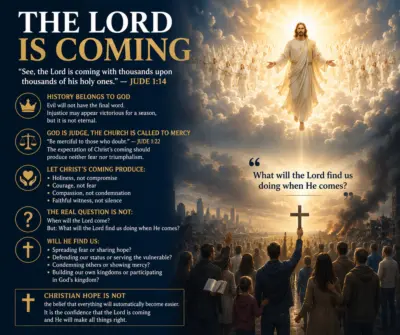

"See, the Lord is coming with thousands upon thousands of his holy ones" (Jude 1:14). Jude writes to a church troubled by false teaching, moral confusion, and spiritual compromise.
His response is not panic. He lifts the eyes of believers beyond the immediate crisis and declares: the Lord is coming. That is a powerful word for our own time. We live surrounded by troubling news-wars, corruption, violence, injustice, religious hostility, economic uncertainty, broken relationships, and deep anxiety about the future. It is easy to imagine that history is controlled only by those who possess political power, money, influence, or military strength. Jude reminds us otherwise. History belongs to God. The coming of the Lord means that evil will not have the final word. Injustice may appear victorious for a season, but it is not eternal. Human power is temporary. Every leader, institution, community, and individual finally stands accountable before God.
Yet this message should not make Christians harsh or self-righteous. Jude soon tells believers, "Be merciful to those who doubt" (v. 22). This is the beautiful balance of Christian faith: God is Judge, but the church is called to be a community of mercy. The expectation of Christ's coming should therefore produce neither fear nor triumphalism. It should produce holiness, courage, compassion, and faithful witness. Instead of endlessly asking, "When will the Lord come?" perhaps we should ask a more searching question: What will the Lord find us doing when he comes? Will he find us spreading fear or sharing hope? Defending our status or serving the vulnerable? Condemning others or showing mercy? Building our own kingdoms or participating in God's kingdom? Christian hope is not the belief that everything will automatically become easier.