
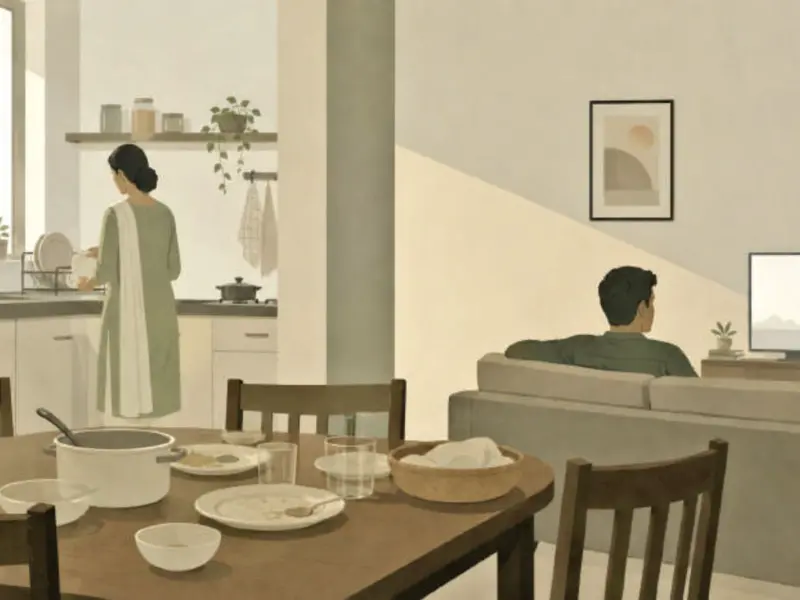

The institution of marriage is, among other things, one of the most elaborate structures humanity has built to contain human loneliness and give it social form.
It provides a framework within which the incompleteness of two people can be distributed, managed, and made largely invisible. The loneliness that drove each of them toward the other is not resolved inside the marriage; it is submerged, and what submerges it is not intimacy but function, the daily business of a shared life, which keeps both parties occupied enough that the original incompleteness rarely surfaces in its full, undeniable form. The arrangement works, and working is by and large the highest praise most marriages receive from both inside and outside, not because they are true or free or particularly examined, but because the machinery runs, and runs with a consistency that has given India one of the lowest divorce rates in the world, at under one per cent.
The Supreme Court of India recently ruled that a wife's refusal to cook does not constitute cruelty under the Hindu Marriage Act, that the woman who entered a marriage did so as a life partner and not as a domestic employee, and that her failure to produce meals could not be entered into a judicial record as grounds for divorce. The ruling was precise, the relief it offered was real, and a specific demand had been struck from the register of legal obligations. But courts deal in contracts, not in the questions that precede them, and this one was no exception; what the ruling could not touch was the deeper arrangement that produced the demand in the first place.
The prior question is simpler and harder: why did these two people enter the arrangement, and from where, exactly, did they enter it?
The honest answer is not clarity but fear, fear of loneliness, fear of social illegitimacy, fear of having no sufficient answer when the question of one's own life is pressed from outside. The mind that has not turned inward reaches outward for something to hold on to, and a partner promises that holding. The rituals follow, and then the roles, and then the quiet understanding, never spoken aloud, of what each party has agreed to provide. He will bring income and social legitimacy; she will bring order and warmth. Both will call the arrangement love, and for the most part they will mean it. What neither will have examined is the incompleteness each carried into the room, the incompleteness the marriage was designed to manage rather than address.
Consider what drives this pattern: the ego, the felt sense of 'I am something,' where 'something' is any object, quality, identity or attribute, is constitutionally incomplete, and that incompleteness drives it outward, toward objects, toward people, toward whatever might make the inner ache feel temporarily resolved. Watch what happens when the noise stops, when the first unscheduled hour opens and there is nothing that demands to be done: the reaching begins almost immediately, lunging for distraction, for approval, for the particular comfort of a presence that confirms the ego's sense of itself, that it matters, that the incompleteness does not show. What the world calls love is, most often, precisely this reaching, dressed in the language of devotion and solemnised in ritual.
The ego cannot survive real love, because love is the ego's movement toward its own dissolution, its attraction toward whatever is more real than the self it has assembled through decades of reaching. That direction is intolerable to the ego precisely because it asks the ego to loosen its grip on the certainties it has spent a lifetime building. So it reaches instead for the counterfeit: an arrangement that delivers the social form of intimacy without requiring any interior transformation. Two incomplete selves come together not to dissolve their incompleteness but to administer it jointly; the loneliness is halved, the incompleteness is not touched, and what circulates between them in place of genuine meeting is the management of expectations, the performance of roles, and the unspoken ledger each party keeps of what has been given and what remains owed.
Something restless persists inside even the most outwardly stable of these arrangements, because it is not a product of unhappiness but of incompleteness that has been housed rather than addressed. The ego does not name it accurately but as disappointment in the other party, as the faint recurring sense that something promised at the beginning has not quite been delivered; and the court record fills, year after year, with exactly these complaints, each one missing the deeper question by the same distance.
The husband who went to court claiming his wife's refusal to cook as cruelty was not simply a man who wanted his meals prepared. He was a man who had arrived at the marriage carrying an unexamined understanding of what he was owed, and he had arrived at that understanding not through deliberate calculation but through something absorbed long before the wedding day. The ego does not negotiate its expectations openly but receives them from the environment it grew up in, from the arrangements it watched being conducted around it, carrying them into each new relationship as though they were not expectations at all but simply the shape of things. The man who grew up watching his mother at the stove did not decide that cooking was a woman's obligation. He experienced it, in the register in which children experience everything, before language and before the capacity to question, as the definition of how a household functions. The expectation was not formed; it was installed, quietly, in the years before he had any means of refusing it.
This is why the court's ruling changes something real without changing everything that matters. The law can redefine the terms of the contract but cannot enter the ego's archive of received arrangements and revise what was deposited there before the person knew they were receiving anything.
Today is Mother's Day, and the occasion will unfold as it always does: flowers, phone calls, the kind of warmth that most people feel without thinking to examine it. What people carry toward their mothers tends to survive the analysis that dissolves most other emotions on inspection, and that survival is precisely what makes it worth looking at rather than simply honouring.
The mother being honoured today was, in most cases, the first person her children watched accept the settlement. She may not have called it settling; she would have called it managing, or adjusting, or holding the family together. She took on the terms of the arrangement without having chosen them from any position of deliberate consideration. She cooked not because she had examined the question of who should cook and arrived at a reasoned answer, but because the arrangement had already been decided, before she reached adulthood, by the same process of absorption that had decided it for her mother before her. Her feeling for her children, fierce and sustaining, was genuine beyond question. The structure within which she expressed that feeling was one she had received and not examined, and the child who grew up in that household received it in turn, without knowing anything was being received, not the instruction but the atmosphere, not the words but the total weight of a life being lived in front of her, day after ordinary day.
India's 2024 Time Use Survey put a number to what the arrangement had never named: women spend an average of over five hours a day on unpaid domestic work; men spend under two hours, a gap essentially unchanged over the five years since it was first measured, and one that independent research has placed at over three per cent of India's GDP. World Bank data shows that fewer than one in three Indian women participate in the formal workforce, against a global average of over one in two; the domestic settlement and the economic settlement, it turns out, are the same settlement.
This is the transmission no court ruling touches, and it is the most consequential one. The daughter who watched her mother's labour go unnamed, unthanked, and unquestioned did not even consider that cooking may be a form of oppression. She learned something subtler and more durable: that this is what care looks like, that devotion does exactly this, and that a settlement accepted without complaint and carried with grace passes, in most households, for love itself. She carries that template into her own marriage, not because she was instructed to but because she was formed by it. The son carries the mirror image of the same template for the same reason, and he too believes he is not inheriting an arrangement but simply observing reality.
Two people who have each absorbed a version of the same settlement enter a marriage, sign a contract the law has now begun to revise, and are told by the court that they are equal partners, and the law, in saying so, is not wrong; but equality of legal standing does not produce equality of interiority. If both parties entered the room from fear, from the ego's need to have its loneliness managed, its social role confirmed, its incompleteness administered by another, then the redistribution of domestic labour, however just, has rearranged the surface of an arrangement whose foundations were never examined.
The court has now said that a wife's refusal to cook cannot be called cruelty. What it cannot say is whether the woman who agrees to cook, who accepts the settlement in its entirety, who adjusts and endures and holds the household together across decades, has been any less shaped by an arrangement she never chose from a position of freedom. And if Mother's Day arrives each year to honour that acceptance, to celebrate the grace with which the settlement was carried, to place flowers beside the woman who took the arrangement and made it look like devotion: what, precisely, are we honouring?
Acharya Prashant is a philosopher and author whose work centres on self-inquiry and its application to contemporary life.