
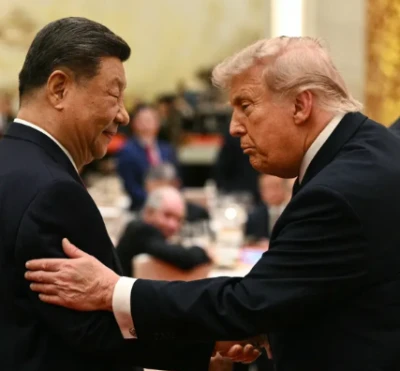

U.S.-China relations are likely to be defined neither by a full-scale Cold War nor by genuine strategic partnership, but by unstable coexistence.
It is ironic that US President Donald Trump's visit to Beijing, accompanied by a powerful delegation of influential American CEOs, took place at a time when the United States is effectively blockading Chinese ships in the Strait of Hormuz. At the same time, Marco Rubio, who was sanctioned by China, appeared in a Nike tracksuit reminiscent of the one worn by Nicolas Maduro during his capture and transfer to the United States, while Jensen Huang, CEO of NVIDIA, joined Trump's entourage at the last minute in Alaska. The visit to the Temple of Heaven on May 14 further carried deep symbolic meaning, evoking ideas of harmony, legitimacy through the "Mandate of Heaven," orderly governance, and China's place within a hierarchical world order. Taken together, the signalling from both sides reveals the contrasting worldviews that underpin their respective approaches to power and international order.
President Trump visited Beijing in the aftermath of extensive U.S. strikes against Iran beginning on February 28, 2026, aimed at regime change, degrading Iran's missile capabilities, and subsequently reopening the Strait of Hormuz. Yet Iran managed to inflict significant costs on U.S. and its allies in the region and assert control over Hormuz, leaving Washington's West Asian objectives largely unmet and the ceasefire precariously fragile as Trump embarked on his China visit. It is in this background that Trump, though lavishly treated by Chinese President Xi Jinping, but was also lectured on the "profound changes unseen in a century," "strategic stability" and was asked to be quite on Taiwan.
Xi Jinping asked Trump, "Can China and the United States avoid the 'Thucydides Trap' and pioneer a new model of major-power relations?" It was Graham T. Allison who argued in 2015 that the defining question of the twenty-first century is whether China and the United States can escape the "Thucydides Trap," wherein a rising power threatens an established hegemon, often leading historically to war. The Trump-Xi meeting in Beijing, therefore, carried significance far beyond bilateral diplomacy. It represented an attempt, however fragile, to manage a structural power transition that increasingly shapes the international order.
The antidote to the Thucydides Trap was Deng Xiaoping's doctrine of "hide your strength and bide your time" (韬光养晦), prioritizing peaceful development and economic modernization over ideological confrontation. Jiang Zemin later expanded it through the "new security concept," emphasizing mutual trust, mutual benefit, equality, and cooperation over Cold War-style alliances and confrontation. The idea evolved further under Xi Jinping into the framework of a "new type of great-power relations" that would transcend historically confrontational patterns of great-power politics through mutual respect, non-conflict, and win-win cooperation.
During the Trump-Xi meeting on May 14, Xi suggested "constructive strategic stability" for China-U.S. relations (中美建设性战略稳定关系) as a way out for such a structural power transition.Xi further explained it through "positive stability (积极稳定) centred on cooperation, healthy stability (良性稳定) with manageable competition, normalized stability (常态稳定) with controllable differences, and enduring stability (持久稳定) with the prospect of peace." He stressed that a "constructive strategic stability relationship" should not remain a slogan but should be reflected in concrete actions taken by both sides. Now, some of the major structural issues impeding this transition are trade, technology, Taiwan, and ideology.
The presence of leading executives from the aviation, technology, finance, and manufacturing sectors, whom Trump told Xi were "here to pay their respect to you and China", evoked echoes of the 1793 McCartney mission, when British envoys sought access to the Qing imperial market. Yet beyond the symbolism, the episode underscored the enduring structural depth of U.S.-China economic interdependence. Although the U.S. trade deficit with China has fallen from more than $400 billion in 2018 to roughly $200 billion, this contraction reflects less a decisive American strategic success than China's accelerating diversification toward the Global South. In particular, Beijing has expanded its commercial integration with Belt and Road Initiative (BRI) partners, with China's tradewith BRI countries reaching approximately $3.4 trillion in 2025.
China continues to supply the United States with affordable consumer goods and critical industrial inputs, while the United States exports advanced technology, aircraft, and high-end equipment to China. Reports surrounding the visit indicated that Boeing secured agreements to sell around 200 aircraft to China. Beijing also signalled greater purchases of American oil, beef, and soybeans. These negotiations highlighted China's growing leverage over key U.S. industries and reflected a central paradox of contemporary geopolitics: despite intensifying strategic rivalry, the American and Chinese economies remain deeply interdependent. No wonder Xi Jinpingtold Trump that "both sides should be partners rather than rivals, achieve mutual success and shared prosperity, and forge a correct path for major-country relations in the new era."
The Trump administration's tariffs triggered a broader U.S.-China technological confrontation centred on Beijing's "Made in China 2025" strategy in sectors such as semiconductors and artificial intelligence. Semiconductors became the core arena of competition as the Biden administration's CHIPS and Science Act restricted advanced production in China, prompting Beijing to expand investment through its semiconductor "Big Fund." Despite U.S. export controls, firms such as SMIC continued advancing domestic chip-making capabilities. As professor Jin Canrong has noted, China's semiconductor self-sufficiency reportedly rose from about 5% in 2018 to nearly 45% within a few years. China's growing leadership in AI, electric vehicles, and renewable-energy technologies has reinforced arguments that the United States cannot fully disengage from China without weakening global innovation networks.
The paradox is that sanctions themselves are accelerating efforts to create alternatives to U.S. financial dominance. Countries targeted by sanctions increasingly seek mechanisms to bypass the dollar system altogether. It is on the basis of these leverages that China has been able to issue a prohibition order on May 2, 2026, declaring that the relevant U.S. sanctions on 4 Chinese Shandong and Hebei petrochemical refineries including the second largest Hengli refinery shall not be recognised, enforced or complied with within China. Implying that the US controlled institutions and financial infrastructure, including correspondent banking networks, the SWIFT messaging system, maritime insurance mechanisms, and global capital markets have been challenged by China.
On trade and technology, Beijing also possessed tangible leverage in rare-earth processing, a critical sector for advanced electronics, electric vehicles, semiconductors, and military technologies. Besides, China's massive industrial capacity accounts for about one-third of global manufacturing output. By contrast, as argued by professor Huang Jing"the US industrial base has collapsed to such an extent that it's hard to find joint-venture partners. Manufacturing once made up 11.8% of US GDP, but has now fallen below 9.6%," adding that the US "lacks a manufacturing ecosystem, technical talent, and tax and distribution systems that support industry."
The Taiwan issue remains the most dangerous flashpoint in U.S.-China relations. Although economic interdependence across the Strait has deepened, political tensions have intensified since Nancy Pelosi's 2022 visit to Taiwan, with China conducting major military exercises and blockade simulations around the island. Beijing continues to treat Taiwan as a "core interest," with Xi Jinpingwarning that mishandling the issue could push bilateral relations toward confrontation or conflict. Significantly, Donald Trump remained unusually silent when questioned about Taiwan during a visit to the Temple of Heaven on May 14.
At the ideological level, the rivalry has increasingly become a contest over governance models and normative legitimacy. While Western liberal norms long dominated international institutions, China has promoted alternative frameworks through groupings such as BRICS, the Asian Infrastructure Investment Bank, and the Shanghai Cooperation Organization, alongside concepts such as "Chinese-style modernization." Under Joe Biden, ideological polarization intensified through initiatives like the Summit for Democracy, whereas Donald Trump's 2025 National Security Strategy deemphasized democracy promotion in favour of a more regionalist "Trump Corollary" approach. This shift may signal the gradual erosion of the post-Cold War liberal international order.
Ironically, as the United States appears increasingly willing to dismantle aspects of the global order it once created, China has positioned itself as one of the staunchest defenders of the UN Charter, multilateralism, and institutional stability. Beijing consistently emphasizes sovereignty, non-interference, and multilateral cooperation, particularly among developing countries. Simultaneously, many traditional U.S. allies in Europe have begun hedging against Washington due to Trump's confrontational approach toward NATO partners and the European Union. Against this backdrop, Trump's meeting with Xi in Beijing revealed both the fragility and necessity of continued engagement. Neither side appears capable of fully disengaging from the other without incurring immense economic and geopolitical costs.
Ultimately, U.S.-China relations are likely to be defined neither by a full-scale Cold War nor by genuine strategic partnership, but by unstable coexistence. Competition will continue over advanced technology, military modernization, and regional influence, especially in Taiwan and the Indo-Pacific, even as initiatives such as the Quad and AUKUS appeared less cohesive during Donald Trump's second presidency. Yet economic interdependence, nuclear deterrence, and the immense costs of direct conflict continue to constrain both powers. The Trump-Xi meeting, therefore, reflected an emerging order of managed rivalry, in which competition and cooperation coexist simultaneously. The central question remains whether Washington and Beijing can prevent structural tensions from escalating into open conflict or, in Xi Jinping's words, "jointly steer and guide the great ship of China-U.S. relations onto the right course."
* B.R. Deepak is Professor, Center for Chinese Studies, Jawaharlal Nehru University, New Delhi.