
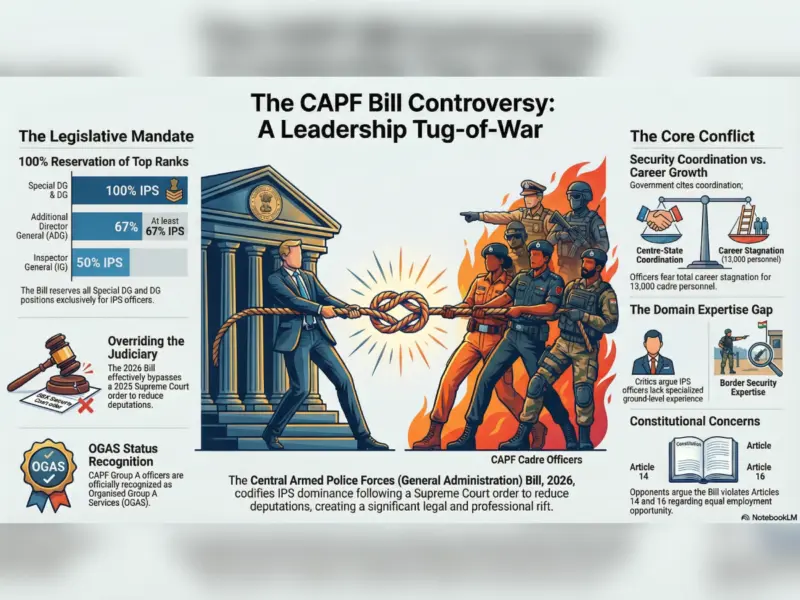

UPSC GK Questions with Answers: The Central Armed Police Forces (General Administration) Bill, 2026, recently introduced in the Rajya Sabha, proposes reserving most senior leadership roles in the CAPFs for IPS officers serving on deputation.
Under the proposed provisions, 50% of Inspector General (IG) positions, at least 67% of Additional Director General (ADG) posts, and all Special DG and Director General (DG) posts would be filled by IPS officers.
The proposal has triggered criticism from Opposition parties as well as retired CAPF personnel, who argue that such measures could restrict promotion opportunities and career growth for officers serving within the CAPF cadre.
1. Under the Central Armed Police Forces (General Administration) Bill, 2026, what is the proposed percentage of Additional Director General (ADG) posts to be filled by IPS officers?
A. 50%
B. At least 67%
C. 20%
D. 100%
Hint: The percentage for this specific rank is higher than the IG requirement but lower than the DG requirement.
2. In the May 2025 judgment, the Supreme Court recognised CAPF Group A officers as part of which service category?
A. Organised Group A Services (OGAS)
B. Defense Combatant Services
C. Central Civil Services (CCS)
D. State Police Service (SPS)
Hint: Consider the acronym that places these officers on the same administrative footing as the IAS and IFS.
3. Why did retired CAPF officers file a contempt petition against the Union Home Secretary in 2025?
A. The introduction of a new recruitment process outside the UPSC
B. Inadequate funding for border security infrastructure
C. Refusal to recognise the National Security Guard as a CAPF
D. Failure to implement the Supreme Court’s order to reduce IPS deputation
Hint: The legal action followed the government’s continued use of executive orders for appointments after the May 2025 ruling.
4. Which CAPF is specifically responsible for guarding the borders with Nepal and Bhutan?
A. Sashastra Seema Bal (SSB)
B. Assam Rifles
C. Border Security Force (BSF)
D. Indo-Tibetan Border Police (ITBP)
Hint: This force’s name translates to ‘Armed Border Force’, and it manages ‘open’ or friendly borders.
5. What is the primary justification provided by the government for maintaining IPS dominance in CAPF leadership?
A. Meeting the requirements of the UPSC recruitment cycle
B. Reducing the total number of CAPF personnel
C. Ensuring effective coordination between the Centre and States
D. Lowering the financial burden of pensions
Hint: The government views IPS officers as a bridge between federal security needs and local law enforcement.
6. Which Constitutional Articles are frequently cited by critics to argue that the Bill denies fair opportunities to CAPF cadre officers?
A. Articles 19 and 21
B. Articles 352 and 356
C. Articles 44 and 51
D. Articles 14 and 16
Hint: Look for the fundamental rights that deal specifically with equality and employment.
7. As of March 9, 2026, how many IPS posts are sanctioned in the Central Armed Police Forces?
A. 35
B. 13,000
C. 213
D. 4,594
Hint: This number is a small fraction of the total IPS pool, specifically designated for central paramilitary service.
8. Which concern focuses on the idea that IPS officers lack the long-term, ground-level experience necessary for complex CAPF operations?
A. Bureaucratic Control
B. Institutional Continuity
C. Lack of Domain Expertise
D. Career Stagnation
Hint: This issue is specifically about the ‘subject matter’ knowledge required for specialised missions like jungle warfare or border surveillance.
9. What percentage of IPS senior posts are generally earmarked for Central deputation across India?
A. 60%
B. 50%
C. 100%
D. 40%
Hint: This value represents the minority share of IPS senior posts, with the majority being held at the state level.
10. According to the source, what was the status of the MHA’s review petition against the 2025 Supreme Court judgment?
A. It is still pending in the Supreme Court
B. It was dismissed in October 2025
C. It was accepted, leading to a stay on promotions
D. It was withdrawn by the government in favour of the Bill
Hint: The dismissal occurred roughly five months after the initial judgment was delivered.
Answer
- B (The bill explicitly mandates that at least two-thirds of the ADG positions be reserved for IPS officers on deputation.)
- A (Granting OGAS status ensures that CAPF officers receive career progression benefits similar to those in the IAS and IPS.)
- D (The petition alleged non-compliance because the MHA continued appointing IPS officers despite a court directive to phase them out.)
- A (The SSB is the designated force for securing India’s borders with these two specific neighbouring nations.)
- C (The government argues that IPS officers’ experience in state police forces is vital for national security synergy.)
- D (These articles guarantee equality before the law and equal opportunity in public employment, which critics claim are violated by excluding cadre officers from top posts.)
- C (This represents the total number of senior leadership positions allocated for IPS officers within the CAPF structure at that time.)
- C (Critics argue that officers who rotate in from state police may not understand the specific nuances of border guarding or counter-insurgency as well as career cadre officers.)
- D (The standard distribution for IPS officers allocates 40% of senior roles to central duties, while the remaining 60% stay with the states.)
- B (The court rejected the government’s request to reconsider the ruling, leading the government to seek a legislative solution via the new Bill.)