

The reported destruction of a key US surveillance aircraft has raised serious concerns among defence experts about America's ability to monitor threats in the Middle East.
The aircraft, known for its advanced radar and battlefield coordination role, was damaged in a strike linked to Iran at a Saudi air base.
Analysts say this incident could significantly affect how the US detects incoming threats, especially drones and missiles, at long distances. The development also highlights vulnerabilities in protecting high-value military assets during ongoing regional tensions.
US E-3 Sentry Aircraft: What Happened to the Sentry Aircraft?
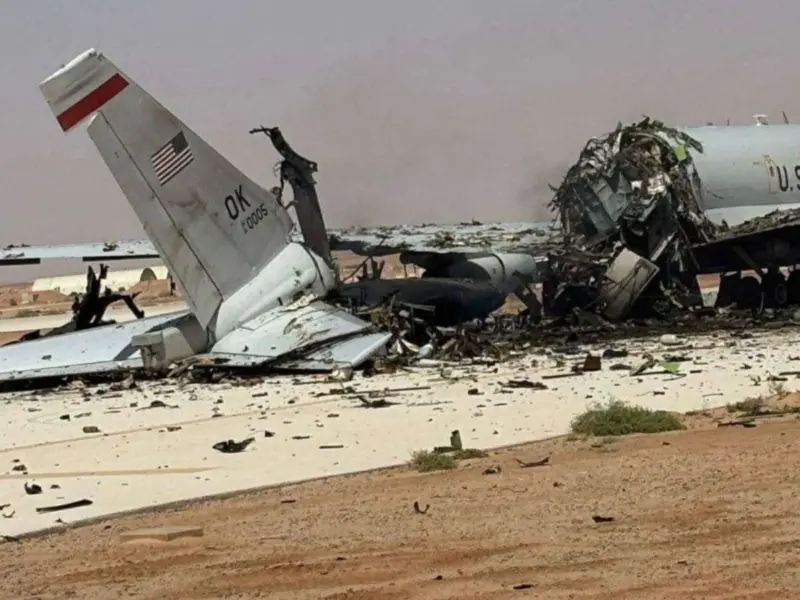
A US Air Force E-3 Sentry aircraft was reportedly destroyed in a strike targeting Prince Sultan Air Base. Images circulating online showed the aircraft severely damaged, with its tail section broken and its radar dome detached.
The aircraft was stationed on the ground at the time of the attack, making it vulnerable. Satellite image comparisons confirmed its location before and after the strike.
The incident also reportedly injured several US personnel and damaged other aircraft at the base. However, no fatalities were reported.
US E-3 Sentry Aircraft: How Was the Sentry AWACS Destroyed?
Initial assessments suggest that the E-3 Sentry was hit during a targeted strike linked to Iranian capabilities. The aircraft was not airborne at the time, which made it significantly more exposed compared to when it operates with protective measures in the sky.
Analysts believe that precision targeting played a key role, as the aircraft is a high-value asset usually protected under strict security protocols. The fact that it was struck on the ground has raised concerns about intelligence leaks or surveillance tracking by adversaries.
Experts also pointed out that such aircraft are rarely left unguarded, indicating a possible lapse in base defence systems. The strike highlights how even advanced military assets can become vulnerable under certain conditions.
US E-3 Sentry Aircraft: How Will It Impact US Radar Systems?
The loss of a key airborne system like the E-3 Sentry can significantly affect how the US detects and responds to threats in the region. Unlike ground-based radar, AWACS operates at high altitude, allowing it to scan a much wider area and identify incoming aircraft, missiles, and drones from long distances.
Without this capability, the US may face delays in detecting fast-moving threats such as Iranian drones or cruise missiles. Early warning time could be reduced, limiting the window available for interception or defensive action. This becomes critical in conflict zones where seconds can make a major difference.
AWACS also plays a key role in coordinating air operations. It not only detects threats but also guides fighter jets and shares real-time intelligence with command centres. Its absence can disrupt this coordination, making operations less efficient and more reactive rather than proactive.
US E-3 Sentry Aircraft: Why is the E-3 Sentry AWACS So Important?
The E-3 Sentry serves as an airborne warning and control system (AWACS), often described as the "eyes in the sky" for military operations. It can monitor vast areas and track hundreds of targets simultaneously, including aircraft, missiles, and drones.
"It can potentially impact (US) ability to control combat aircraft and vector them to their targets or protect them from engagements of hostile aircraft and missile systems,"
The aircraft plays a central role in coordinating air operations, guiding fighter jets, and relaying real-time battlefield data. Its loss reduces situational awareness in active conflict zones.
US E-3 Sentry Aircraft: How Does AWACS Help Detect Iranian Threats?
AWACS platforms significantly extend detection range compared to ground-based radar systems. Experts say an airborne radar system like the E-3 can detect incoming threats much earlier.
In scenarios involving Iranian drones, such as Shahed UAVs, an AWACS could provide up to an hour's additional warning time. This early detection allows military forces to prepare defensive responses or intercept threats before they reach targets.
Because the aircraft operates at high altitude, it covers a much larger surveillance area, making it critical in monitoring fast-moving threats across regions.
US E-3 Sentry Aircraft: Analysts Warn of Impact on US Military Operations
Military experts believe the loss of the aircraft could weaken US operational effectiveness in the region. According to analysts, AWACS systems act as command centres in the sky, helping coordinate complex missions.
The loss of even a single unit is significant because the US operates a limited fleet. With fewer aircraft available, maintaining continuous surveillance becomes more challenging.
Analysts also questioned how such a high-value asset was left exposed on the ground, calling it a major lapse in force protection.
US E-3 Sentry Aircraft: Was the Aircraft Targeted Deliberately?
Experts suggest that the strike may indicate a deliberate strategy to target critical US military assets. By focusing on surveillance systems, adversaries can reduce the effectiveness of air defence and coordination.
Some analysts believe the attack reflects a broader pattern of targeting radar systems, communication infrastructure, and support aircraft. The possibility of external assistance in identifying targets has also been raised, adding another layer of concern to the situation.
US E-3 Sentry Aircraft: Is the US AWACS Fleet Ageing?
The US fleet of E-3 Sentry aircraft is relatively small and ageing. Many of these aircraft have been in service since the late 1970s, making them decades old.
The fleet size has reduced over the years, increasing pressure on the remaining aircraft during active deployments. Maintaining older systems also becomes more challenging and costly.
Although the US is exploring replacement options, a full transition to newer systems has not yet been completed.
What Happens Next for US Air Surveillance?
The destruction of the AWACS aircraft may push the US to accelerate efforts to modernise its airborne surveillance systems. While alternatives like the E-2 Hawkeye exist, they cannot fully replace the capabilities of the E-3.
The US may also increase protective measures for critical assets deployed in conflict zones. Strengthening base security and improving intelligence coordination could become immediate priorities.
As tensions continue in the region, maintaining strong surveillance capabilities will remain essential for preventing further escalation and ensuring operational readiness.