
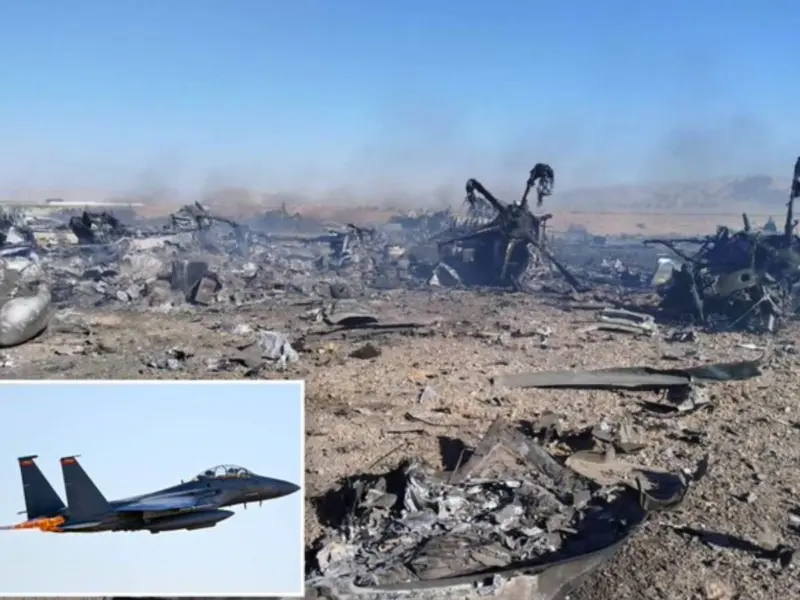

US-Iran War Update: A member of the United States Air Force who had been missing in enemy territory for more than a day after his F-15E fighter jet was shot down in Iran on Friday has now been rescued.
The announcement was made early Sunday by Donald Trump.
"WE GOT HIM!" Trump posted on Truth Social shortly after midnight. 'The U.S. Military sent dozens of aircraft, armed with the most lethal weapons in the World, to retrieve him. He sustained injuries, but he will be just fine,' he added.
US-Iran War Update: What Happened When the Fighter Jet Was Shot Down?
The F-15E jet was brought down over southwestern Iran, according to US officials. Both crew members-the pilot and the weapons systems officer (WSO) ejected safely. While the pilot was rescued quickly, the second airman, described by Trump as a "highly respected Colonel," remained stranded in hostile territory for more than 24 hours.
US-Iran War Update: Who Is the US Airman Who Survived in Iran?
The airman is a US Air Force Colonel serving as a Weapons Systems Officer (WSO). His identity has not been publicly revealed in early reports. He was part of the F-15E Strike Eagle crew that crashed on April 3, 2026, and managed to survive for nearly 48 hours behind enemy lines.
US-Iran War Update: How Did the US Airman Survive in Enemy Territory?
After ejecting from the aircraft, the injured airman relied heavily on his Survival, Evasion, Resistance, and Escape (SERE) training. Despite serious injuries, he managed to avoid capture by Iranian forces.
He climbed a 7,000-foot mountain ridge and hid in rocky crevices in the Zagros Mountains while Iranian troops, helicopters, and drones searched for him. Reports suggest he remained hidden for nearly 36 hours as search teams closed in.
Even while wounded, he covered over 1.3 miles in difficult terrain. A $60,000 bounty had reportedly been placed on his capture, increasing the danger. As Trump told Axios, "Thousands of those savages were hunting him down." Armed with only a pistol, communication equipment, and a tracking beacon, the airman used natural cover and his training to stay alive while waiting for rescue.
US-Iran War Update: How Did the Airman Contact US Forces?
The airman avoided using his tracking beacon because it could have exposed his position. Instead, he used a communication device to send a message. However, his message initially raised suspicion. According to Trump, the airman sent just three words: "God is good". US officials first feared this could be a trap, assuming he might have been captured and forced to send the message. It took several hours before they confirmed that he had sent it willingly.
US-Iran War Update: How Did the US Carry Out the Rescue Operation?
The CIA used advanced tracking methods to locate the airman. At the same time, US agencies launched a deception strategy, spreading false information that he had already been found and was being moved elsewhere. This was done to mislead Iranian forces and reduce pressure on the actual rescue location. The final rescue mission was highly complex and risky. It involved hundreds of personnel, including special forces and intelligence teams. In a daylight operation, the US deployed dozens of aircraft and MQ-9 Reaper drones to create a protective zone, attacking any hostile forces that came close. US Special Forces then entered the mountainous region, located the injured officer, provided medical support, and evacuated him safely.
US-Iran War Update: Challenges During the Extraction
The rescue mission faced complications when two MC-130J aircraft got stuck on an unpaved runway. To prevent them from falling into enemy hands, they had to be destroyed. Additional aircraft were later sent to extract the rescue teams and destroy remaining equipment. The injured airman was eventually flown to Kuwait for medical treatment.
US-Iran War Update: How Did Israel Support the Rescue Mission?
Reports suggest that Israel played a key role in the operation by providing intelligence and tactical support. According to reports, the Israel Defense Forces (IDF) carried out strikes on Iranian targets to distract their forces from the crash site.
These diversionary attacks helped shift Iranian attention, allowing US teams to carry out the rescue more effectively. Israeli intelligence also contributed to the success of the mission.
Israel's Prime Minister Benjamin Netanyahu congratulated Trump, saying, "Congratulations, President Trump! All Israelis rejoice in the incredible rescue of a brave American pilot by America's dauntless warriors." He added, "This rescue operation reinforces the sacred principle: no one is left behind."
In a post on X, he also said Israel was proud to assist, stating, "I am deeply proud that our cooperation on and off the battlefield is unprecedented, and that Israel could contribute to saving a brave American warrior."
US-Iran War Update: A Rare and High-Risk Military Rescue
Trump described the mission as historic, saying, "This is the first time in military memory that two US pilots have been rescued, separately, deep in enemy territory. We will never leave an American warfighter behind!"
The operation, completed on April 5, 2026, stands out as a rare example of a successful rescue deep inside hostile territory, highlighting the importance of training, coordination, and international support in modern warfare.