
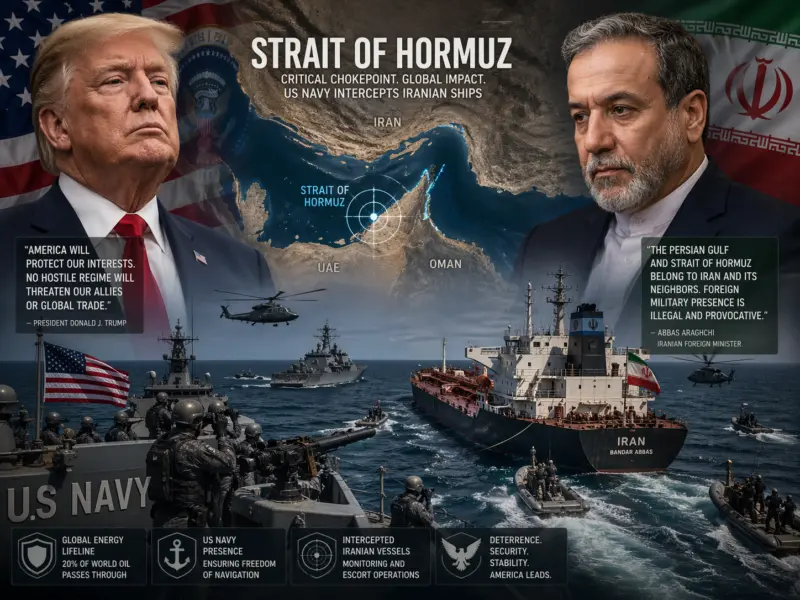

US President Donald Trump, on Friday, said that the US Navy is enforcing the closure of the world's most vital oil chokepoint, the Strait of Hormuz, not Iran.
At the same time, Tehran refuses to budge until a "suffocating" American blockade is lifted.
It is not Iran, but the US that's keeping the Strait of Hormuz closed, Trump said in a remark, adding that opening the critical waterway means that Iran will make "$500 million a day."
The statement comes as the global energy market reels from the total halt of the maritime traffic through the crucial waterway, where typically one-fifth of the world's oil supply passes.
"We have total control," Trump told reporters at the White House, dismissing claims that Iran's military was dictating the flow of trade. "They think they're closing it? No, I'm keeping it closed until we get the deal we want. It's under our thumb."
The US President noted that the US-Iran war is "going very well" as it hasn't been going on for as long as the Vietnam War. He continued that the US Navy blockade, which began a week ago, is "absolutely destroying Iran", and that his country, the US, was winning the conflict "by a lot".
US-Iran War, A Standoff Without A Deadline?
Despite a hardened rhetoric and aggressive posture, Trump appeared to distance himself from any further military escalation, specifically regarding nuclear options. While the US has maintained a heavy naval presence in the region to enforce what his administration calls a "maximum pressure blockade," Trump pushed back against suggestions that he had set a hard deadline for an Iranian diplomatic proposal.
"Don't rush me," Trump said during a press briefing, when asked if he had a deadline for when the war with Iran could end. "We have all the time in the world. They're the ones feeling the heat, not us." He emphasised that while he remains open to a new deal, he has turned down more extreme military contingencies for the time being, focusing instead on economic and maritime strangulation.
An Increasingly Defiant Iran Is A Containment Nightmare For Trump
The Iranian delegation never showed up for the truce talks brokered in Pakistan. The response that came from the Islamic Republic has been one of calculated defiance. Iranian officials stated on Friday that the Strait will remain "impassable" as long as the US continues its "illegal blockade" of Iranian ports.
Earlier this week, for the first time in the conflict, Iranian forces seized two foreign container ships. The seizures were a direct response to the US Navy's attempts to intercept Iranian tankers. Tehran has framed its actions as a defence of sovereign waters against American "piracy," vowing that no traffic will resume until its ability to export oil is restored. The US forces, enforcing their own blockade at the chokepoint, have directed 27 vessels to turn around or return to an Iranian port, according to the US Central Command (CENTCOM).
This week, the US forces intercepted and seized at least three Iranian-flagged ships in the Asian waters after the vessels tried to get through the blockade, navigating with the transponders switched off and failing to respond to the US Navy's warnings to stop.
Global Supply Chain Under Siege
The Iran-US conflict has strained the global supply chain, and the effective closure of the Strait of Hormuz-the narrow shipping route and the world's most vital trade corridor located between Iran and Oman- has sent shockwaves and a ripple effect through the global economy.
Shipping giants have suspended all routes through the Persian Gulf, leading to a surge in crude oil prices and a backlog of cargo that experts warn could take months to clear. Carriers, insurers and cargo owners are treating navigation through the maritime artery as a "high-risk" zone.
Military analysts noted that Trump's claim of "total control" represents a shift in rhetoric, moving from the traditional US role of "protecting the freedom of navigation" to actively using the waterway as a geopolitical bargaining chip.
The cascade of disruptions is affecting everything from basic energy costs to the manufacturing of high-tech semiconductors. According to insights from the Oxford College of Procurement and Supply, the crisis is not merely a regional issue but a systemic shock to international trade as the narrow waterway through which roughly 25% of the world's crude oil and a significant portion of its liquefied natural gas (LNG) pass daily remains under blockade for over six weeks.
The heightened military activity and threats of interception by either the Iranian or the American forces have led the world's shipping companies to halt or drastically reduce transit through this route. On the other hand, as the Strait of Hormuz route is now a high-risk zone, insurance premiums for vessels have skyrocketed, with some insurers withdrawing war-risk coverage entirely.
As the Persian Gulf becomes impassable and too dangerous, the logistics companies are forced to find alternatives. Many shipping lines, including giants like Maersk, have rerouted vessels around the Cape of Good Hope, Africa. This adds 8 to 15 days to transit times between Asia and Europe. Longer routes have led to higher fuel consumption; additionally, carriers have introduced "Emergency Conflict Surcharges," often adding thousands of dollars to the cost of a single container.
Energy-Driven Costs Skyrocket
The Iran-US conflict has caused Brent crude prices to spike, reaching $100 a barrel in early 2026. This spike in oil prices has impacted the supply chain far beyond the gas pump. As of publishing this report, the Brent prices were hovering around $105-$106 per barrel, and the WTI Crude rose over 4%, trading near $93-$97 per barrel.
The Path To De-escalation?
Diplomatic channels remain strained as the global actors have pushed for restraint and a free passage at the Strait of Hormuz. While Trump insists the US is in a position of strength, the BBC reports that European and Asian allies are growing increasingly concerned over the risk of a miscalculation that could lead to full-scale kinetic warfare.
For now, the world's most important maritime corridor remains a ghost town of stalled tankers and patrolling warships. With neither Washington nor Tehran willing to blink first, the "maximum pressure" campaign has reached a stalemate that threatens to redefine global energy security for the foreseeable future.