

Tensions between the United States and Iran have escalated again after peace talks in Islamabad collapsed, triggering strong political reactions and military signalling from Tehran.
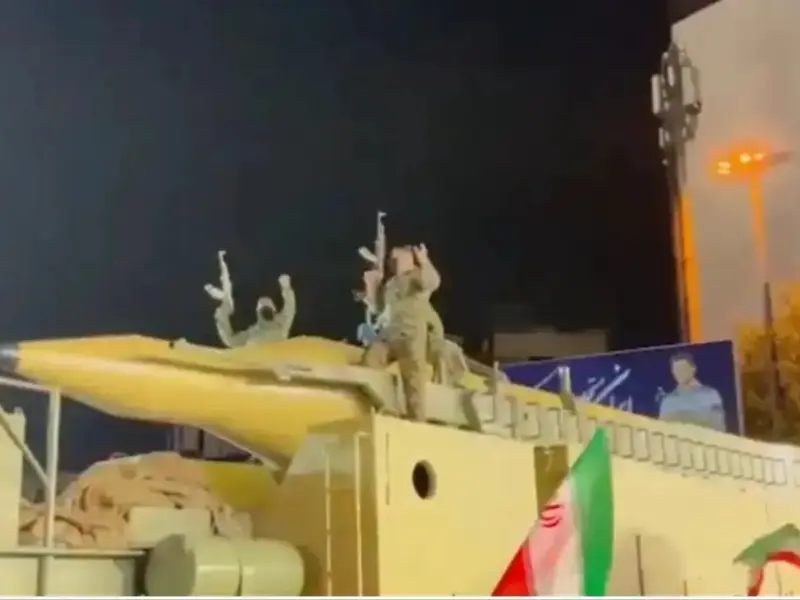
Hardline groups in Iran organised large rallies where members of the Islamic Revolutionary Guard Corps (IRGC) displayed heavy weaponry, including a Qadr ballistic missile.
The developments came shortly after US President Donald Trump extended the ceasefire, temporarily preventing escalation while keeping economic and naval pressure on Iran. Despite the pause in direct conflict, diplomatic efforts remain stalled, and both sides continue to exchange warnings.
US-Israel-Iran War Latest Update: Iran Rally Features Qadr Missile
Following the breakdown of negotiations between the US and Iran, hardline factions in Tehran staged rallies involving IRGC personnel and military displays. Footage aired on Iranian state media showed armed individuals carrying rifles alongside what appeared to be a Qadr ballistic missile mounted on a mobile launcher in Tehran. Protesters were also heard chanting anti-US and anti-Israel slogans during the demonstrations.
Reports indicate that these rallies took place shortly after talks in Islamabad reportedly collapsed without agreement. The display of military hardware is being seen as a symbolic response to stalled diplomacy and rising tensions with Washington.
US-Iran War: What is the Qadr Missile?
The Qadr missile is a medium-range ballistic missile developed by Iran, believed capable of striking targets at long ranges. Reports suggest it can carry conventional warheads and release submunitions, also referred to as cluster munitions.
Iran has previously used variants of the Qadr missile in regional strikes, making it one of the key elements of its missile programme. Its appearance at public rallies is widely viewed as a show of military capability and deterrence amid rising geopolitical pressure.
Has the Qadr Missile Been Used So Far in the US-Iran War?
Reports indicate that Iran has already used Qadr-class ballistic missiles during the ongoing conflict, particularly in strikes targeting Israel and US-linked positions in the region. These missiles have been deployed as part of larger waves of attacks involving drones and other long-range systems.
Some reports also suggest that Qadr missiles were equipped with cluster warheads in certain strikes, increasing their impact on targeted areas.
However, despite their use, many incoming missiles have been intercepted by US and allied air defence systems, limiting their overall effectiveness. At the same time, Iran is believed to still possess a significant stockpile of ballistic missiles, including Qadr variants, which could be used if hostilities escalate again.
US-Israel-Iran War: What Happened After the Iran Rally Escalation?
The rally added to already rising tensions after the collapse of US-Iran peace talks. Diplomatic sources suggest that disagreements over sanctions, maritime restrictions, and trust issues led to the breakdown in negotiations.
The public display of military equipment has further intensified concerns about escalation, although no direct military action has followed. Analysts believe the move reflects internal pressure within Iran's hardline political and military establishment.
US-Israel-Iran War Latest Update: Trump Extends Ceasefire
Despite the escalation in rhetoric, US President Donald Trump extended the ceasefire to prevent immediate conflict. In a post on Truth Social, he said the ceasefire would remain in place until Iran’s “leaders and representatives can come up with a unified proposal,” and negotiations are concluded.
“Based on the fact that the Government of Iran is seriously fractured… we have been asked to hold our attack,” he wrote, adding that the request came from Asim Munir and Shehbaz Sharif, whose government has been attempting to mediate between Washington and Tehran.
The decision marked a shift from earlier threats of military escalation, signalling a temporary pause rather than a resolution.
US-Israel-Iran War Latest Update: Strait of Hormuz Condition
The Strait of Hormuz continues to be a major point of tension between the two sides. Iran has repeatedly raised concerns over restrictions affecting its oil exports, while the US has linked any easing of pressure to progress in negotiations.
Trump defended the current position, stating that Iran is losing significant revenue due to maritime restrictions and insisting that economic pressure remains a key tool in negotiations. The strategic waterway remains central to global energy security, making it a critical issue in the dispute.
US-Israel-Iran War Latest Update: US Naval Blockade Continues
The US Navy continues to enforce maritime restrictions on Iran-linked shipping despite the ceasefire extension. Washington argues that the blockade is necessary to limit Iran's financial and operational capabilities until a diplomatic breakthrough is reached.
Iran, however, views the blockade as economic coercion and has accused the US of undermining peace efforts. The continued enforcement of naval restrictions has kept tensions high even as direct conflict has been paused.
US-Israel-Iran War: What's Next?
The situation remains highly unstable, with diplomatic talks stalled and military signalling intensifying. While the ceasefire has temporarily prevented escalation, key issues such as sanctions, nuclear concerns, maritime control, and regional security remain unresolved.
Pakistan continues to attempt mediation, but without confirmed negotiations or mutual trust, the risk of renewed escalation remains significant. The coming days will be critical in determining whether diplomacy restarts or tensions rise further.