





Iran has stepped up activity at its main oil export hub even as the United States intensifies efforts to curb its crude shipments through a widening naval blockade.
Fresh satellite imagery suggests that Tehran is moving quickly to load oil onto tankers before restrictions begin to severely impact its export capacity.
The situation reflects a growing tug-of-war at sea, where enforcement measures are expanding geographically, but on-ground loading operations continue at pace. Analysts say this phase could determine how long Iran can maintain production without major disruptions.
US-Israel-Iran War Latest Update: Is Iran Filling Supertankers at Kharg Island Despite US Blockade?
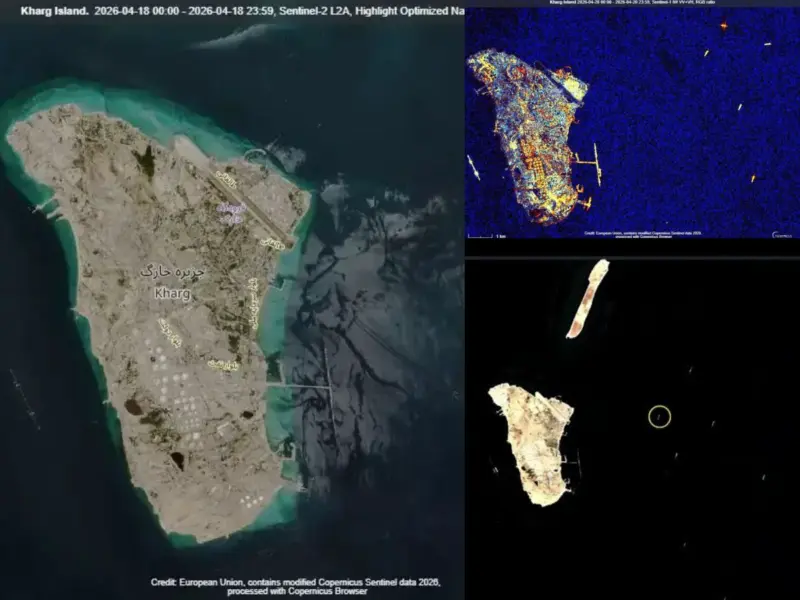
Evidence from satellite monitoring indicates that Iran continues to load supertankers at Kharg Island despite the ongoing blockade. Multiple very large crude carriers have been spotted docking and taking on cargo in recent days.
This suggests that while outbound movement of oil faces obstacles, inbound logistics and storage management remain active. Iran appears to be using every available tanker to store crude temporarily.
The move highlights a strategy focused on maximising short-term output while longer-term export routes remain uncertain. It also signals that enforcement at sea has yet to fully disrupt operations at the source.
US-Israel-Iran War Latest Update: What Does a Satellite Image Show?
Satellite images reviewed by Bloomberg show a sharp increase in tanker presence around Kharg Island. A large crude carrier capable of holding about two million barrels was seen docked at the terminal earlier this week.
In addition, around a dozen tankers were anchored nearby, waiting to load or already filled with crude. This marks a significant rise compared to images captured just before the blockade began.
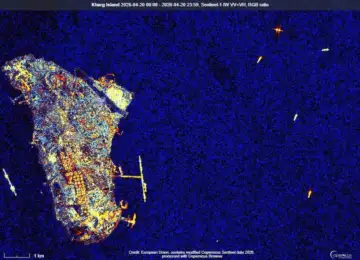
The clustering of vessels indicates a coordinated effort to accelerate loading operations. It also suggests that Iran is preparing for a prolonged disruption by building floating reserves.
US-Israel-Iran War: Tracking Challenges Complicate Enforcement
Tracking Iranian oil shipments remains a complex task due to deliberate evasion tactics. Many tankers switch off their tracking systems, making it difficult to monitor their exact routes.
This practice often begins near the Strait of Hormuz and continues until ships are well into international waters. As a result, vessels can disappear from tracking systems for several days.
Such gaps make it harder for enforcement agencies to determine whether shipments have successfully bypassed the blockade. It also creates uncertainty in global oil markets, as actual supply levels remain unclear.
US-Israel-Iran War: Why Kharg Island Holds So Much Importance?
Kharg Island serves as the backbone of Iran's oil export infrastructure, handling the majority of its crude shipments. Its deep-water terminals allow large tankers to dock efficiently, unlike many other coastal facilities in the country.
The island's strategic location in the Persian Gulf makes it a vital hub for connecting Iran's oil fields to global markets. Any disruption here can significantly impact export volumes. Because of its importance, Kharg Island remains central to both Iran's economic strategy and international efforts to restrict its oil trade.
US-Israel-Iran War Latest Update: US Blockade Situation
The blockade enforced by the US Navy has expanded beyond the immediate Gulf region. Authorities report that dozens of vessels have already been turned back in nearby waters.
Operations have also extended into the Indian Ocean, where tankers linked to Iranian oil shipments have been intercepted or boarded. This marks a significant escalation in enforcement reach.
The broader scope indicates that the US is targeting not just departure points but also transit routes, aiming to close off multiple pathways simultaneously.
US-Israel-Iran War Update: How Long Can Iran Hold Out?
Analysts believe Iran can manage the pressure in the short term due to its available storage and ongoing loading activity. By filling tankers and using them as floating storage, the country gains additional time.
However, this approach has limits. If exports remain blocked for an extended period, storage capacity will eventually run out. At that point, Iran may have to reduce production levels, which could impact both its economy and global oil supply dynamics.
US-Israel-Iran War Latest Update: Storage Limits & Production Pressure
Iran is estimated to have around 90 million barrels of storage capacity, which provides a temporary buffer against export disruptions. Current production levels remain close to 3.5 million barrels per day.
"They're getting tankers filled up, that does give them additional time," said Miad Maleki, a former US Treasury official who worked on sanctions policy during Trump's first term and is now a senior fellow at the Foundation for Defence of Democracies. "So that kind of gives them a relief from running out of storage."
Despite this, continued production without exports will eventually strain storage systems. Analysts at JPMorgan warn that sustained restrictions could force output cuts over time.
US-Israel-Iran War: Strait of Hormuz Current Situation
The Strait of Hormuz remains a critical flashpoint in the ongoing situation. A large portion of the world's oil supply passes through this narrow waterway. While shipping traffic continues, increased military presence and vessel interceptions have raised tensions.
Any disruption here could have immediate global consequences. The situation remains fluid, with both sides maintaining strong positions. For now, the strait stays open, but risks of escalation continue to weigh on global energy markets.