
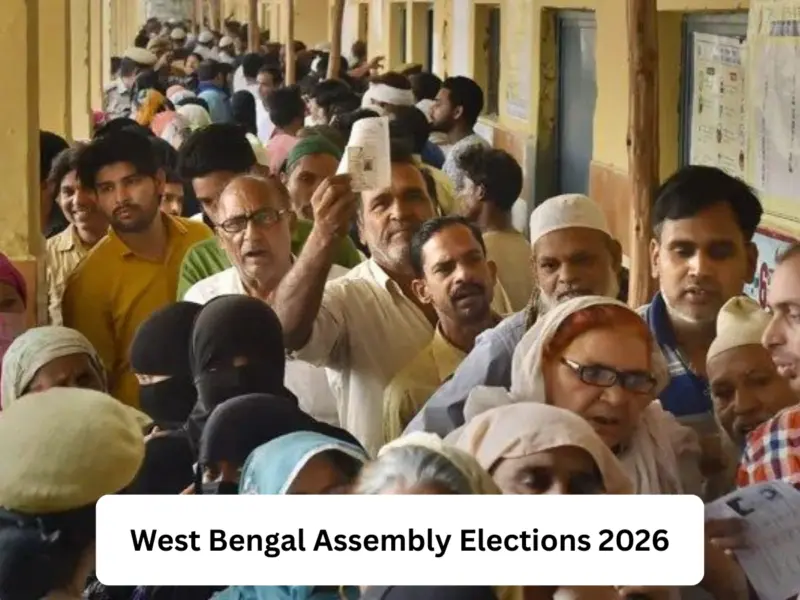

The Election Commission has announced the schedule for the West Bengal Assembly Elections 2026, along with polls in several other states.
Unlike most of the other states where elections will be held in a single phase, voting in West Bengal will take place in two phases.
The high-stakes election in the state will be conducted on April 23 and April 29, 2026, while the counting of votes will take place on May 4, 2026.
West Bengal Assembly Elections 2026: Polling Dates
Voting in the state will be held in two phases:
Phase 1: April 23, 2026
Phase 2: April 29, 2026
West Bengal Assembly Elections 2026: Result
The results for both phases will be counted together on May 4, 2026.
West Bengal Assembly Elections 2026: Total Seats
The West Bengal Legislative Assembly has 294 seats. The election is expected to witness a fierce contest between the ruling Trinamool Congress (TMC) led by Chief Minister Mamata Banerjee and the Bharatiya Janata Party (BJP).
West Bengal Assembly Elections 2026: Phase 1 Schedule
(152 Assembly Constituencies)
Notification: March 30, 2026
Last Date for Nominations: April 6, 2026
Scrutiny of Nominations: April 7, 2026
Last Date for Withdrawal: April 9, 2026
Polling Date: April 23, 2026
Counting of Votes: May 4, 2026
Completion of Election Process: May 6, 2026
West Bengal Assembly Elections 2026: Phase 2 Schedule
(142 Assembly Constituencies)
Notification: April 2, 2026
Last Date for Nominations: April 9, 2026
Scrutiny of Nominations: April 10, 2026
Last Date for Withdrawal: April 13, 2026
Polling Date: April 29, 2026
Counting of Votes: May 4, 2026
Completion of Election Process: May 6, 2026
West Bengal Elections: Phases Over the Years
Elections in West Bengal have often been conducted in multiple phases due to security considerations. In 2021, polling was held in eight phases and stretched for more than a month amid incidents of violence. Earlier, the 2016 and 2011 Assembly elections were conducted in six phases, while the 2006 elections were held in five phases. The state has not voted on a single day since 2001, with central paramilitary forces typically deployed to maintain law and order during the polling process.