




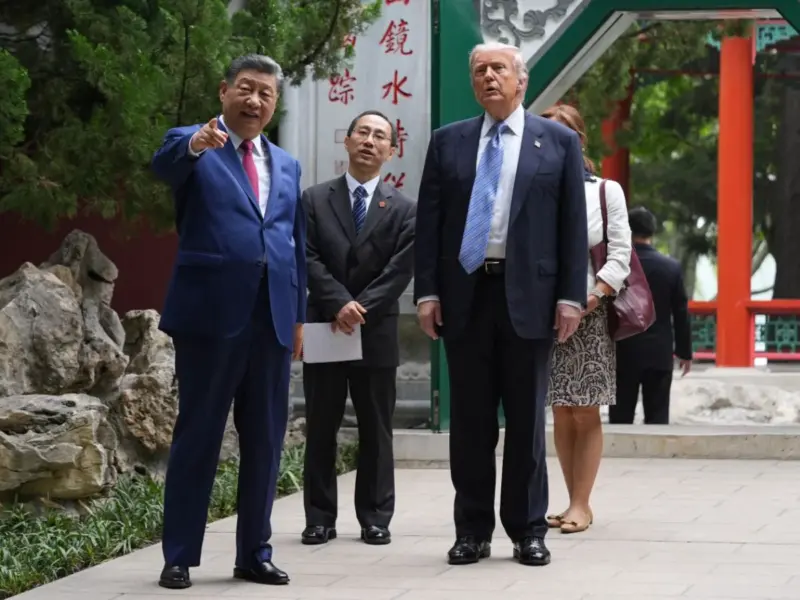

China's Secret Garden Zhongnanhai: US President Donald Trump's recent meeting with Chinese President Xi Jinping inside Zhongnanhai has once again drawn worldwide attention to one of China's most secretive and politically important locations.
Hidden behind centuries-old red walls near Beijing's Forbidden City, Zhongnanhai is often described as China's "secret garden" and the real centre of power for the country's Communist Party leadership.
The heavily protected compound rarely opens its gates to foreign leaders, making Trump's visit highly symbolic during the ongoing US-China diplomatic summit.
What is Zhongnanhai?
Zhongnanhai is a vast government and residential complex located in central Beijing, right next to the Forbidden City. Today, it serves as the headquarters of China's Communist Party leadership and the residence of several top officials, including Xi Jinping.
The name Zhongnanhai comes from two lakes situated inside the compound, Zhonghai and Nanhai, surrounded by gardens, temples, bridges and historic buildings.
Xi Jinping described the compound during Trump's visit, saying it "is the place where leaders of the (communist) party and the central government of China work and live, including myself," Xi told Trump on Friday.
Why is Zhongnanhai Called China's Secret Garden?
Zhongnanhai earned the nickname "China's secret garden" because of its hidden location, lush imperial-style gardens and extremely restricted access. The compound remains closed to the public and protected by elite security forces responsible for safeguarding China's top leadership.
Images and digital maps of the area are heavily censored, adding to its mysterious reputation. During the visit, Xi Jinping personally walked Trump through the historic gardens and pointed out several ancient trees inside the compound.
"In other places within this compound, there are trees that have lived to be over 1,000 years old," Xi told Trump. Trump appeared impressed by the surroundings and later remarked, "Nice place. I like it. I could get used to this."
Zhongnanhai's History Dates Back Hundreds of Years
Long before becoming China's political nerve centre, Zhongnanhai served as an imperial garden for Chinese emperors during the Ming and Qing dynasties.
Emperors used the area as a peaceful retreat away from official court duties inside the Forbidden City.
After the fall of imperial rule in 1912, the site briefly became a presidential compound before Communist leader Mao Zedong transformed it into the headquarters of the new Chinese government after 1949.
Mao intentionally avoided using the Forbidden City as the government headquarters because he wanted to separate Communist China from the country's imperial past.
Since then, Zhongnanhai has expanded significantly and now includes offices, meeting halls, residences, pavilions and ceremonial spaces spread across nearly 1,500 acres.
Which US Presidents Have Visited Zhongnanhai?
Only a few American presidents have ever visited the compound. Former US President Richard Nixon met Mao Zedong there during his historic 1972 trip to China.
Later, George W. Bush and Barack Obama also visited Zhongnanhai during diplomatic meetings with Chinese leaders. Trump's latest visit, therefore, carries historical significance as US-China relations remain closely watched worldwide.
Why Zhongnanhai Matters in Modern China?
Zhongnanhai is more than just a historic garden complex. It represents the heart of political power in China. Major decisions related to China's economy, foreign policy, military and governance are often made within the compound's walls.
Because of its political importance and strict secrecy, Zhongnanhai is frequently compared to the White House in the United States or the Kremlin in Russia. The compound continues to symbolise both China's ancient imperial legacy and the modern authority of the Communist Party leadership.