




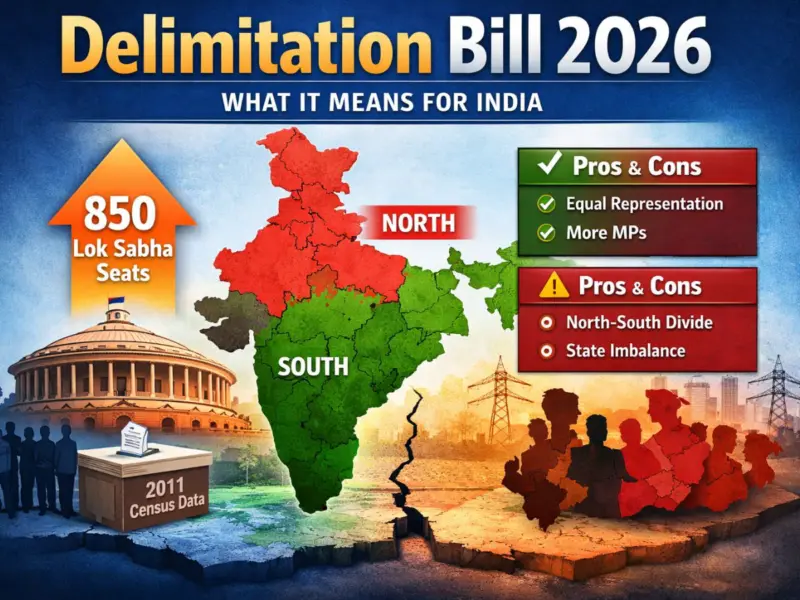

India is on the brink of one of its biggest electoral reforms in decades as the government moves forward with the Delimitation Bill 2026. The proposal aims to redraw Lok Sabha constituencies and significantly increase the number of seats in Parliament.
While the Centre presents it as a long-overdue correction to outdated representation, opposition parties and several states have raised serious concerns. The debate is no longer just technical, it now touches on federal balance, political power, and regional equity in India's democracy.
What is the Delimitation Bill?
Delimitation is the constitutional process of redrawing electoral boundaries and adjusting the number of seats based on population changes. Its goal is to ensure equal representation so that each MP represents a similar number of people. Over time, population shifts create imbalances, making delimitation necessary.
In India, this process is governed by Article 82 of the Constitution and carried out by an independent commission. The current system still reflects older population data, which has created disparities between fast-growing and slow-growing states. The Delimitation Bill seeks to correct these imbalances and modernise India's electoral map.
Delimitation Bill 2026
The Delimitation Bill 2026 is expected to dramatically reshape Parliament by increasing Lok Sabha seats from 543 to around 850. This is part of a broader constitutional amendment plan aimed at updating representation and enabling reforms like women's reservation.
This marks a major shift because India has not changed seat allocation significantly since the 1970s. The proposed expansion reflects population growth and changing demographics over the decades. However, such a large increase will also redistribute political influence, making it a highly sensitive issue.
Delimitation News: PM Modi to Address the Lok Sabha
Prime Minister Narendra Modi is expected to address Parliament during the special session where the bill is being discussed. His speech is likely to focus on strengthening democracy and ensuring fair representation.
The government has already reached out to political parties for support, especially as the bill is linked to women's reservation reforms. However, opposition leaders have demanded more clarity on how delimitation will affect states. This parliamentary discussion is expected to be intense and politically charged.
How Will Delimitation Bill 2026 Benefit?
Supporters argue that the bill will correct long-standing imbalances in representation. India's population has grown unevenly, but seat distribution has remained largely unchanged. Delimitation will ensure that each vote carries equal weight.
It may also improve governance by creating more manageable constituencies and increasing the number of MPs. Additionally, the expansion of seats will allow for better inclusion of women and underrepresented communities. The reform is seen as a step toward modernising India's democratic framework.
Pros & Cons of Delimitation Bill 2026
Pros:
- Ensures equal representation by aligning seats with current population levels
- Makes every vote more balanced across constituencies
- Updates outdated electoral boundaries for better governance
- Increases the number of MPs, improving representation of diverse regions and communities
- Supports reforms like women's reservation and inclusive politics
- Helps create more manageable constituencies for effective administration
Cons:
- May reduce the political influence of southern states with lower population growth
- Could shift power toward northern states, creating a regional imbalance
- Risks federal tensions between states over seat distribution
- Based on 2011 Census data, which may not reflect current demographics
- Concerns over the over-centralisation of political power
- An increase in MPs may lead to higher costs for Parliament operations
What are the Other 3 Bills to be Introduced with Delimitation Bill 2026?
As per the latest Parliament developments, the Delimitation Bill 2026 is not being introduced alone. The government has brought a package of key reform bills together in the Lok Sabha, aimed at restructuring representation, Parliament size, and women's participation.
1. Constitution (131st Amendment) Bill, 2026
This is the most important supporting bill. It proposes constitutional changes needed to increase Lok Sabha seats and implement delimitation properly.
It allows expansion of Parliament (reports suggest up to ~850 seats)
Provides the legal framework to apply new seat distribution
Links directly with women's reservation implementation
Without this amendment, delimitation changes cannot be enforced
2. Women's Reservation Implementation Bill (Linked to 2023 Law)
This bill focuses on implementing 33% reservation for women in Lok Sabha and state assemblies.
Ensures one-third seats reserved for women
Likely to be implemented from 2029 elections
Works together with delimitation to assign reserved seats
Aims to improve gender representation in politics
3. Union Territories Laws (Amendment) Bill, 2026
This bill deals with changes in representation rules for Union Territories.
Aligns UT representation with new delimitation framework
Adjusts laws related to assemblies in UTs
Ensures reservation and seat distribution apply uniformly
Why the Delimitation Bill 2026 is Important?
The bill is crucial because India's current representation system is based on outdated population data. This creates unequal political influence across regions.
Delimitation ensures fairness by aligning seats with population changes. It also strengthens democracy by making representation more accurate. In a country as large and diverse as India, such updates are essential to maintain balance and legitimacy.
Why is the Government Using the 2011 Census in the Delimitation Bill 2026?
The government is likely to use the 2011 Census because newer data is not yet available. The 2021 Census has been delayed, making 2011 the latest official dataset.
However, this decision has sparked criticism. Opponents argue that using old data could distort representation, especially in states where population trends have changed significantly. Some reports suggest the Centre may avoid reallocating seats between states to ease concerns.
What is the Delimitation Commission of India?
The Delimitation Commission is an independent body responsible for conducting the delimitation exercise. It is usually headed by a Supreme Court judge and includes election officials.
Its decisions are final and cannot be challenged in court, ensuring neutrality. The commission redraws boundaries, allocates seats, and ensures fairness in the electoral process. It plays a key role in maintaining democratic integrity.
Delimitation Bill 2026: States with the Highest Increase in Seats
Uttar Pradesh
- Current: 80 seats
- Expected: ~110-120 seats
- Increase: +30 to +40 seats
Bihar
- Current: 40 seats
- Expected: ~55-60 seats
- Increase: +15 to +20 seats
Madhya Pradesh
- Current: 29 seats
- Expected: ~40-45 seats
- Increase: +10 to +15 seats
Rajasthan
- Current: 25 seats
- Expected: ~35-40 seats
- Increase: +10 to +15 seats
Maharashtra
- Current: 48 seats
- Expected: ~60-65 seats
- Increase: +10 to +15 seats
West Bengal
- +8 to +12 seats
Jharkhand
- +5 to +7 seats
Chhattisgarh
- +4 to +6 seats
Haryana
- +3 to +5 seats
Delimitation Bill 2026: States with the Least Increase in Seats
Tamil Nadu
- Current: 39 seats
- Expected: 40-42 seats
- Increase: +1 to +3 seats
Kerala
- Current: 20 seats
- Expected: 20-22 seats
- Increase: 0 to +2 seats
Andhra Pradesh
- Current: 25 seats
- Expected: ~26-28 seats
- Increase: +1 to +3 seats
Telangana
- Current: 17 seats
- Expected: ~18-20 seats
- Increase: +1 to +3 seats
Karnataka
- Current: 28 seats
- Expected: ~30-32 seats
- Increase: +2 to +4 seats
Odisha
- +2 to +4 seats
Punjab
- +1 to +3 seats
Himachal Pradesh
- No major change expected
Uttarakhand
- Minimal increase (0-1 seat)
When was the Last Delimitation Bill Used?
The last delimitation exercise was conducted in 2002 using 2001 Census data. However, the number of Lok Sabha seats did not change due to a freeze imposed earlier.
That freeze aimed to encourage population control across states. The upcoming delimitation will likely be the first major change in seat allocation in decades, making it historically significant.
What Criteria Will be Followed for the Delimitation Bill 2026?
- Population (Primary Factor) - Seats allocated based on population size (likely using 2011 Census)
- Equal Representation - Each constituency to have roughly an equal number of voters
- Geographical Boundaries - Consideration of terrain, rivers, and natural divisions
- Administrative Units - Respect for existing districts, states, and local boundaries
- SC/ST Reservation - Seats reserved based on the Scheduled Caste and Tribe population share
- Accessibility - Constituencies designed for easy reach and effective governance
- Population Density Balance - Proper distribution between urban and rural areas
- Regional/Federal Balance - Avoid extreme imbalance between states
How Much Cost Will Increased for Parliament After the Delimitation Bill 2026?
Expanding the Lok Sabha to around 850 members will increase operational costs.
Total Expected Increase:
- Around ₹1,000 crore to ₹1,500 crore per year
What this includes:
- Salaries, allowances, and perks for an additional 250-300 MPs
- Increased spending on staff, security, and administration
- Operational costs like sessions, logistics, and maintenance
One-Time vs Recurring Cost
- One-time infrastructure cost: Mostly already covered (new Parliament building)
- Main increase: Recurring yearly expenses
Final Takeaway of the Delimitation Bill 2026
The Delimitation Bill 2026 could significantly reshape India's political structure by redistributing Lok Sabha seats based on population changes. While it aims to ensure fair representation and strengthen democracy, it also raises concerns about regional imbalance and shifting political power.
The challenge for policymakers will be to implement these changes in a way that maintains both democratic equality and federal harmony.