
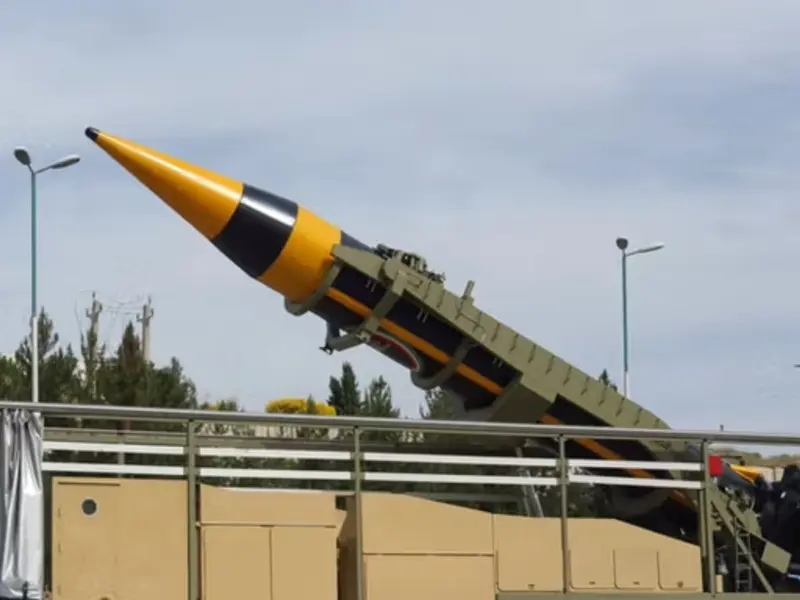

Iran's reported attempt to strike a distant US-UK military base in the Indian Ocean has triggered serious global concern over the true extent of its missile capabilities.
While Tehran has long claimed limits on its missile range, the latest development suggests that its actual reach may be far greater than publicly stated.
The focus is not just on whether the strike succeeded or failed, but on the distance involved. By targeting a location nearly 4,000 kilometres away, Iran has signalled a possible shift in its strategic posture and raised new questions for global defence planners.
What is Iran’s Ballistic 4,000 Km Missile?
Iran has not officially declared any ballistic missile with a 4,000 km range. However, experts believe that the reported attempt may involve either an advanced intermediate-range ballistic missile (IRBM) or a modified version of its existing missile systems.
IRBMs typically cover ranges between 3,000 km and 5,500 km, placing Diego Garcia well within potential reach if such systems exist. Iran may also be experimenting with upgraded propulsion systems, lighter payloads, or trajectory adjustments to extend range beyond declared limits.
The lack of official confirmation adds to the uncertainty, which itself becomes a strategic tool. By not revealing exact capabilities, Iran keeps adversaries guessing and forces them to prepare for worst-case scenarios.
What Are the Capabilities of Iran's Ballistic Missiles?
Iran has built one of the largest missile arsenals in the Middle East, with a mix of short-range, medium-range, and potentially intermediate-range systems. Key capabilities include:
1. Range Flexibility:
Iran's known missiles range from 300 km to 2,000 km, but emerging evidence suggests potential development of systems exceeding 3,000-4,000 km.
2. Intermediate-Range Ballistic Missiles (IRBM) Potential:
If the Diego Garcia attempt is confirmed, it indicates Iran may possess IRBMs capable of striking distant targets across the Indian Ocean and parts of Europe.
3. Precision Strike Ability:
Modern Iranian missiles are believed to use improved guidance systems, allowing them to target specific military installations with higher accuracy.
4. Solid and Liquid Fuel Systems:
Iran operates both liquid-fuel and solid-fuel missiles. Solid-fuel systems allow quicker launch times and greater survivability during conflict.
5. Manoeuvrable Re-entry Vehicles (MaRV):
Some advanced systems may include manoeuvrable warheads designed to evade missile defence systems during the final phase of flight.
6. Mobile Launch Platforms:
Iran uses mobile launchers, making it harder for adversaries to detect and destroy missile systems before launch.
7. Electronic Countermeasures:
Iran may deploy decoys or countermeasures to confuse radar and interception systems.
8. Payload Capability:
These missiles can carry conventional warheads and are theoretically capable of carrying other payloads, increasing their strategic value.
What is Iran's Claimed vs Actual Missile Range?
Iran has repeatedly stated that it limits its missile range to 2,000 kilometres, describing it as a defensive policy rather than a technical limitation. This range already allows it to cover much of the Middle East and parts of Europe.
However, the reported attempt to target Diego Garcia, located around 4,000 kilometres away, challenges this claim. If accurate, it suggests that Iran either possesses undeclared long-range systems or can extend the range of existing missiles.
This gap between declared and suspected capability introduces strategic ambiguity, making it harder for opponents to assess real threats and prepare accordingly.
Did Iran Really Attempt a 4,000 Km Strike?
Reports indicate that Iran launched two missiles toward Diego Garcia. One reportedly failed during flight, while the other may have been intercepted before reaching its target.
Even without a confirmed impact, the attempt itself carries major strategic weight. It demonstrates intent, tests long-range systems, and sends a clear signal about Iran's potential reach.
Iran’s semi-official Mehr news agency said targeting the base was a “significant step… that shows that the range of Iran’s missiles is beyond what the enemy previously imagined”.
This suggests that the operation may have been as much about messaging as it was about military action.
Which Other Country Has this Kind of Ballistic Missile?
Several countries already operate ballistic missiles in the 4,000 km and beyond range category, giving them the ability to strike targets across continents.
- US: Operates Intercontinental Ballistic Missiles (ICBMs) like Minuteman III with ranges of over 12,000-13,000 km, along with submarine-launched ballistic missiles (SLBMs) like Trident II exceeding 12,000 km.
- Russia: Possesses one of the largest arsenals, including ICBMs such as RS-28 Sarmat with ranges of 18,000 km or more, and other long-range systems above 10,000 km.
- China: Deploys missiles like the DF-41 with ranges of 12,000-15,000 km, and IRBMs like DF-26 with ranges of around 4,000 km, capable of targeting regional and distant bases.
- North Korea: Has tested long-range missiles like Hwasong-15 and Hwasong-17, estimated to reach 10,000-13,000 km, though real-world reliability remains under scrutiny.
- France and UK: Both rely on submarine-launched ballistic missiles such as the Trident system, with ranges of approximately 12,000 km, forming the backbone of their nuclear deterrence.
How Did the US Respond to the Missile Threat?
In response to the reported missile launch, the United States is believed to have deployed an SM-3 interceptor. This system is designed to destroy ballistic missiles during their mid-course phase, outside the Earth's atmosphere.
Even if the interception was successful, the situation highlights the high cost and complexity of missile defence. Each interception requires advanced systems, precise tracking, and rapid response.
From a strategic perspective, forcing the US to activate such defences can itself be seen as a tactical success, as it tests capabilities and demonstrates reach.
Why This Changes the Global Security Equation
This development expands the potential conflict zone from the Middle East to the Indian Ocean region. It signals that key military bases far from traditional conflict areas may no longer be out of reach.
For the US and its allies, this means reassessing defence deployments and possibly extending missile defence coverage to new regions. Gulf countries and Israel may also feel increased pressure to upgrade their systems.
The uncertainty surrounding Iran's true missile range adds another layer of complexity, making strategic planning more difficult and resource-intensive.
What Makes Diego Garcia a High-Value Target?
Diego Garcia is not just another military base; it is a critical hub for US global operations. It supports long-range bombers, surveillance missions, and naval deployments across multiple regions.
Targeting such a base carries both military and symbolic value. It demonstrates the ability to challenge US presence far from Iran's borders and sends a strong geopolitical message about reach and capability.