
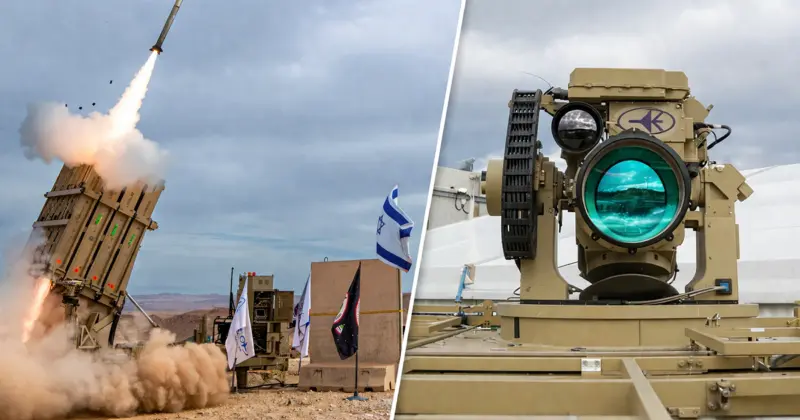

Israel has sent an advanced laser-based air defence system, called Iron Beam, to the UAE. The missiles are aimed at protecting the UAE from Iranian missiles and drone attacks.
This step shows the strategic relationship between the two countries in West Asia.
Israel used this laser system to counter Hezbollah projectiles from Lebanon. These missiles are designed to vapourise short-range rockets and drones with high precision.
What is an Iron Beam?
Iron Beam is a directed-energy air defence system developed by Israeli defence contractor Rafael Advanced Defence Systems. The defence system was first seen at the Singapore Airshow on 11 February 2014.
According to the official website of the Refael company, the Iron beam is a 100kW class High Energy Laser Weapon System (HELWS). It is the first operational system in its class. This defence system works at the speed of light and neutralizes threats from a range of hundreds of meters to several kilometres.
How Iron Beam work?
An iron beam generates a laser beam with the help of a fibre laser to destroy an airborne target. Its surveillance system detects the threat, and vehicle platforms detect it in order to engage it.
Developed by Rafael and Elbit Systems, this system has reportedly passed the testing as of September 2025 and is on track for operational deployment.
The ammo in this system is essentially electricity. Hence, the marginal cost per engagement is low. There are reports which claim that the marginal cost per engagement is around $2.50 to $10. The capabilities of the Iron beam are subject to atmospheric effects like dust, moisture, and turbulence, as well as power and cooling requirements.
The effective range of the Iron beam is up to around 10 km in favourable conditions. The system majorly relies on laser energy, which is why it can tackle multiple threats in rapid succession as long as the power and thermal systems hold up. In that case, the 'magazine' is only limited by available electrical and cooling infrastructure.
What are the Advantages and Disadvantages of Iron Beam Systems?
Advantages of Iron Beam Systems
1. Very Low Cost per Shot
Once the system is installed, each shot costs almost nothing compared to expensive missiles.
2. Speed of Light Attack
The laser hits the target instantly with no travel time like missiles.
3. Unlimited "Ammo" (Almost)
As long as there is power, it can keep firing. No need to reload physical weapons.
4. High Precision
The best thing about laser beams is their accuracy, which reduces damage to nearby areas.
5. Best Against Drones & Small Threats
Iron beams are perfect for stopping cheap drones, rockets, and mortars, especially in large numbers.
Disadvantages of Iron Beam Systems
1. Weather Dependent
Dust, fog, rain, or pollution can weaken or scatter the beam, reducing effectiveness.
2. Needs Huge Power
These systems require a lot of electricity and strong cooling systems.
3. Limited Range
Compared to missiles, lasers usually work at shorter distances.
4. Requires Continuous Target Lock
The beam must stay focused on a target for a few seconds to destroy it, not always easy.
5. Line-of-Sight Limitation
It can only hit targets it can directly "see" without going around obstacles.