
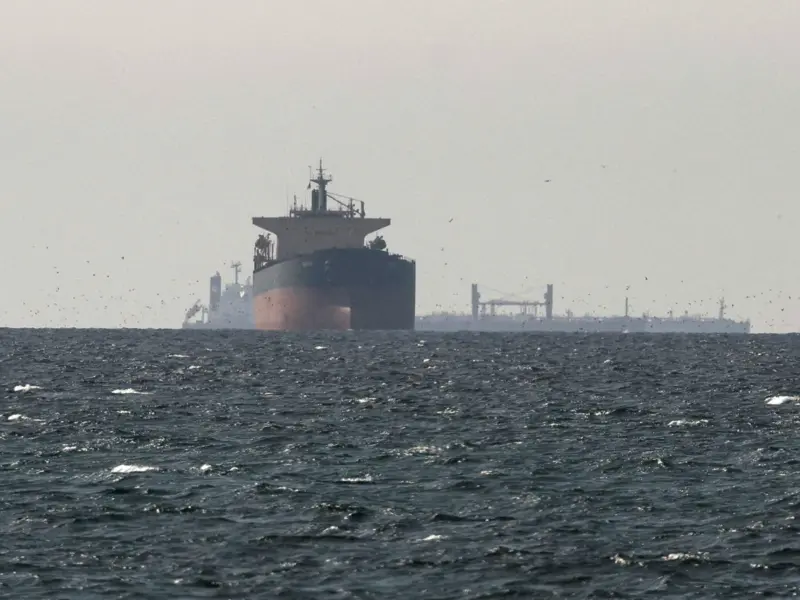

The Strait of Hormuz, a narrow waterway between Iran and Oman, has become one of the most sensitive flashpoints in the escalating US-Iran-Israel war.
Recent reports indicate that Iran has begun laying sea mines in the strait, aiming to disrupt commercial shipping and exert economic pressure amid the conflict.
These relatively simple explosive devices are proving to be powerful tools of asymmetric warfare, capable of threatening one-fifth of the world's daily oil exports that pass through this critical route.
What Are ‘Sea Mines’ in Iran?
Sea mines are underwater explosive devices designed to damage or destroy ships and submarines. They can be anchored to the seabed, float below the surface, or drift freely with currents. These weapons are triggered by contact or by sensing a ship's magnetic, acoustic, or pressure signatures.
Iran possesses a sizeable inventory of these mines, potentially thousands, and can deploy them using a variety of platforms, from submarines and warships to small boats hidden among civilian traffic.
The Islamic Revolutionary Guard Corps (IRGC) and the regular Iranian navy have both been linked to mine warfare capabilities that are part of Tehran's broader anti-access strategy in the region.
How ‘Sea Mines’ Are One of the Most Powerful Weapons in Iran?
Although sea mines are relatively low-tech compared to missiles or drones, their impact can be profound. In the confined waters of the Strait of Hormuz, even a small number of mines can paralyse shipping traffic. The mere threat of mines can force commercial carriers to avoid the route, spike insurance costs, and push global oil prices higher due to fears of supply disruption.
Experts describe sea mines as tools of asymmetric warfare: inexpensive to produce and deploy but capable of causing significant economic harm and strategic leverage against larger and more technologically advanced militaries. This is especially true in strategic chokepoints where shipping lanes are narrow and difficult to reroute.
How These ‘Sea Mines’ Threaten Ships in the Strait of Hormuz?
Reports from defence sources suggest that Iran has already laid a few dozen mines in the Strait of Hormuz, with the capacity to deploy many more using its fleet of small boats and mine-laying vessels. The mines could be moored at specific depths or sit on the sea floor, waiting to detonate when a ship passes overhead.
Because commercial ships are not designed to withstand underwater explosions, even a single mine strike can severely damage a tanker or cargo vessel, endanger crews, and halt maritime traffic. In some historical conflicts, sea mines have been responsible for a majority of ship losses, underscoring their effectiveness despite their relative simplicity.
Sea Mines in the Strait of Hormuz
The Strait of Hormuz is a critical global chokepoint; nearly 20% of the world's crude oil and a significant share of liquefied natural gas (LNG) pass through it every day. Any disruption here threatens far-reaching consequences for global energy markets and economic stability.
In recent days, the US Central Command reported striking and destroying multiple Iranian vessels believed to be involved in laying mines near the Strait. In a post on social media, CENTCOM confirmed that 16 Iranian mine-laying boats and other naval assets were eliminated as part of efforts to prevent the strait from being effectively blockaded.
US President Donald Trump also publicly demanded that Iran remove any mines, warning of severe military consequences if they remain. He said immediate removal would be "a giant step in the right direction," even as US forces hunted mine-laying craft and storage facilities.
Impact of Mine Threats on Oil Prices and the Global Economy
Even the threat of mine deployment affects global markets. Shipping companies may reroute vessels, increase insurance, or delay deliveries, causing oil and LNG prices to spike. Analysts warn that prolonged disruption could slow global trade, affect energy-intensive industries, and increase costs for consumers worldwide.
Naval Mine Countermeasures and Clearing Challenges
Clearing mines is complex and risky. Mine countermeasure ships, drones, and specialised divers are deployed to locate and neutralise underwater explosives. Despite advanced technology, detection is slow and dangerous, prolonging the economic and strategic impact of mined waters.
Sea mines have historically played decisive roles in conflicts. During the Iran-Iraq Tanker War in the 1980s, mines sank dozens of oil tankers, causing global oil price spikes. More recently, mined waters in the Black Sea disrupted regional shipping in 2022. These examples highlight the long-standing effectiveness of mines as an asymmetric tool.