




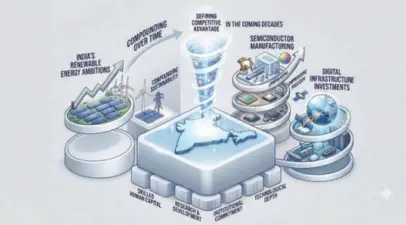

India's renewable energy ambitions, its push into semiconductor manufacturing, its digital infrastructure investments if pursued with depth and consistency, carries the potential to create factor conditions that compound over time.
In 1776, Adam Smith asked a question that seems almost quaint today: why are some nations wealthy and others not? His answer that the division of labour drives productivity, and productivity drives prosperity launched two centuries of economic thought, but it left something important unresolved. If labour is the source of wealth, why do some countries extract so much more value from theirs than others? The answer lies not in the workers themselves, but in what surrounds them. Economists called these surroundings the factors of production or the inputs through which an economy converts effort into output. Land, labour, capital: the classical trinity.
For most of economic history, this was a sufficient framework. In 1990 however Porter's landmark study of ten nations, found that the most competitive industries rarely emerged from countries most obviously endowed to produce them. Switzerland had no iron ore but became a global leader in specialty chemicals and pharmaceuticals. Denmark's dominance in industrial food processing equipment could not be explained by natural endowment alone and yet it became one of the world's leading exporters of precisely that technology.
The pattern, repeated across sectors and countries, pointed to something the classical framework missed: the factors that actually drive competitive advantage are not found but they are made. Advanced factors as they are called include specialised knowledge, deep human capital, sophisticated physical and institutional infrastructure. The crucial distinction was that these cannot be inherited. They can only be built, deliberately, over time, through sustained national investment and institutional commitment.
This reframing carries a consequence that policymakers have still not fully absorbed. If advanced factors are created rather than endowed, then competitive advantage is always a choice. A country is not competitive because of where it sits on the map or what lies beneath its soil. It is competitive because of decisions made about education, about research, about the quality of institutions, about whether domestic competition is fierce enough to force firms to upgrade. Take for instance the case of Japan which was nation with almost no natural resources that became one of the most productive economies on earth, partly because resource constraints forced a discipline of efficiency and precision.
What makes this framework newly urgent is that the content of advanced factors has undergone a quiet but consequential transformation. While these factors remain critically important and foundational, it is equally important to acknowledge the current environment that they operate in.
The first is artificial intelligence, not as a sector, but as a new condition of production. The critical distinction today is between digital reach and digital productivity: between having platforms and embedding intelligence into how things are actually made, organised, and delivered. The gap between the two is wider than most economies acknowledge. Having internet access, even at scale, does not automatically translate into AI-embedded manufacturing or AI-augmented services. Nations that deploy AI across firms and sectors compound their factor productivity faster than any traditional investment can match. Those that remain at the level of access users of systems conceived and owned elsewhere find their productive gap widening precisely as they believe they are catching up.
The second is the convergence of energy and climate into a single structural force. The World Meteorological Organization confirms that 2023-2025 were the three warmest years on record, with temperatures reaching 1.48°C above pre-industrial levels. This is no longer an environmental headline, but it is a productivity variable. By 2030, heat stress alone is projected to reduce global working hours by 2.2%, equivalent to 80 million full-time jobs, with South Asia facing losses exceeding 5.3% of working hours which is among the highest of any region. Climate volatility is now a recurring shock to labour output, energy demand, logistics, and fiscal capacity. There is also a consequential shift is on the trade side. The EU's Carbon Border Adjustment Mechanism, fully operational from January 2026, imposes charges on carbon-intensive imports based on embedded emissions and Canada, Australia, and the UK are building their own versions. A nation's carbon intensity is becoming as consequential to its market access as its tariff schedule. Countries that integrate energy efficiency, circular resource use, and climate resilience into their industrial systems early are not merely meeting compliance requirements. They are building barriers to entry that latecomers will find genuinely expensive to clear.
Where does India sit in this evolving landscape? Global supply chains are actively seeking alternatives to concentrated risk. Capital is mobile and looking for credible destinations. India's growing domestic market generates the kind of demanding home demand which is a catalyst for competitive upgrading. India's strengths in pharmaceuticals, software services, and increasingly in digital public infrastructure are not incidental. They reflect domains where concentrated, advanced factor conditions have been built: specialised knowledge clusters, real institutional depth, and technical human capital that has proven internationally competitive. Yet there is scope of improvement in these sectors. R&D intensity in pharma is high but absolute investment is modest. India's share of high-impact AI publications has declined relative to peers. Digital infrastructure has delivered remarkable reach, but the conversion from access to embedded productivity remains incomplete.
The opportunity now is to extend the logic of deliberately built, deeply concentrated advanced factors into domains that will define competitive advantage in the coming decades. India's renewable energy ambitions, its push into semiconductor manufacturing, its digital infrastructure investments if pursued with depth and consistency, carries the potential to create factor conditions that compound over time.
Competitive advantage has never been static, and the nations that have sustained it across disruptions are precisely those that treated their factor base not as an inheritance to protect but as a system to continuously deepen till it becomes durable. For India, the foundations are real and the moment is significant. The structural conditions that once took decades to assemble like credible institutions, knowledge clusters, technological depth are being compressed and disrupted simultaneously. What this demands is not a single bold bet but a sustained, adaptive commitment to factor-building across domains that the next decade will make decisive.
Amit Kapoor is chair and Meenakshi Ajith is development policy lead at Institute for Competitiveness. X:@kautiliya.