
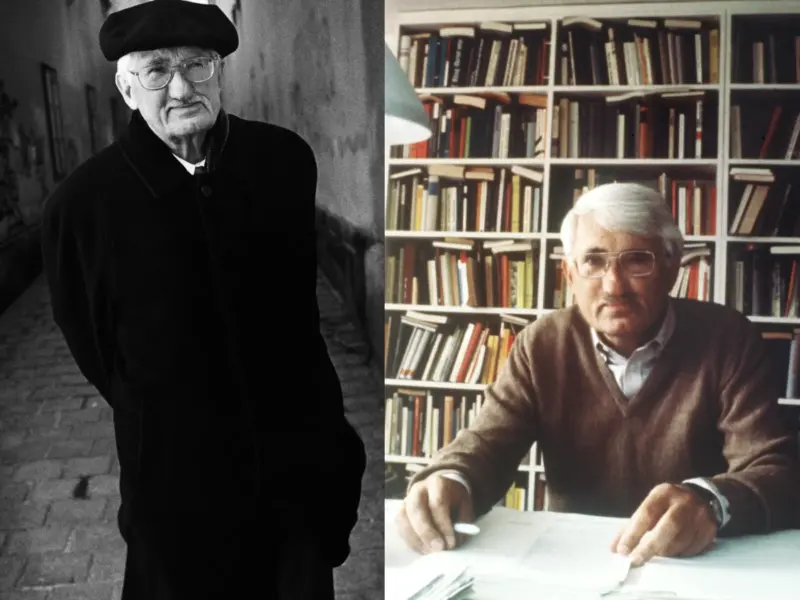
German philosopher Jurgen Habermas died at age 96 and it is the conclusion of a spectacular intellectual life that has influenced more than 60 years of political philosophy.
Being generally regarded as one of the most powerful post-war philosophers, Habermas constructed theories stating the strengthening of democratic communities by the means of open discussion and rational debate. His work had impact on European and other social movements as well as academics as well as policymakers.
Who is German Philosopher Jurgen Habermas
Habermas was a German philosopher and sociologist who belonged to the renowned Frankfurt School of criticism. His thoughts were devoted to the democracy, rational communication and the part of citizens in formulating the decisions of the population. As time went by, his work became the focus of discourse in political theory, sociology and communication studies.
Jurgen Habermas Early Life
Habermas was born in the 18 th of June, 1929 in the city of Dusseldorf, Germany. He grew up in the times of the Nazi and the Second World War, which had a strong influence on his intellectual perspective. He had to live in a time of authoritarian government and propaganda and these experiences made him investigate ways in which societies could avoid the recurrence of the totalitarian politics.
Jurgen Habermas Educational Background
Habermas enrolled in a number of schools studying philosophy, sociology and economics at the university of Bonn and University of Gottingen. He attained a doctorate in philosophy in 1954. The initial academic writings focused on conflicts between historical change and philosophical thought on truth and reason.
Jurgen Habermas Family
Habermas enjoyed a comparably secret family life in spite of the international intellectual recognition. He had a wife and children and one of them, historian Rebekka Habermas was a distinguished scholar of German social and cultural history. Early speech challenges, family background and his upbringing also made him have lifelong interest in communication.
Jurgen Habermas Career
- He Began his professional life working as a journalist in the 1950s.
- He Joined the Institute for Social Research linked to the Frankfurt School.
- He became professor of philosophy and sociology at the University of Frankfurt in 1964.
- He served as co-director of the Max Planck Institute in Starnberg during the 1970s.
- He returned to Frankfurt in 1983 and taught until retirement in 1994.
- He continued writing and participating in public debates well into his nineties.
Jurgen Habermas: The Concept of the Public Sphere
Habermas came up with a powerful concept of the so-called public sphere wherein he explains the arenas where citizens go to deliberate on issues that impact the society. In democratic regimes and he claimed, these deliberations enable individuals to play a part in the political decision processes by making informed arguments as opposed to exercising power.
Jurgen Habermas: Theory of Communicative Action
Habermas described the role of communication in social cooperation in his seminal two-volume book The Theory of Communicative Action, which was published in 1981. In his theory, societies are developed when people solve disputes out of a dialogue based on reason and understanding.
Jurgen Habermas: Influence on European Political Thought
Habermas was always on the side of European unity as he believed that the further political integration might reinforce some democratic institutions. In his arguments on economic crises and their migration policies, he encouraged leaders to involve citizens more in decisions.
How His Ideas Changed Political Theory
Habermas brought a revolution to the contemporary political theory by focusing the importance of communication rather than power as the basis of democracy. The ideas that he proposed indicated that democratic legitimacy is achieved when policies are developed in an open-minded dialogue between citizens and are not dictated by the top.
Jurgen Habermas: Major Works & Scholarly Impact
Habermas authored many books that influenced the social science studies across the globe. His significant publications are The Structural Transformation of the Public Sphere and The Theory of Communicative Action. His ideas were studied academically and over 14,000 books and articles focusing on his theory were written by scholars.
Jurgen Habermas: Notable Theories
- Public Sphere Theory
- Communicative Rationality
- Deliberative Democracy
- Legitimation Crisis in advanced capitalism
- Discourse Ethics
Jurgen Habermas: Awards & Global Recognition
1974 - Hegel Prize for contributions to philosophical thought
1976 - Sigmund Freud Prize for outstanding academic prose
1980 - Theodor W. Adorno Award recognizing achievements in philosophy and sociology
1985 - Geschwister-Scholl Prize for his work Die neue Unubersichtlichkeit
1986 - Gottfried Wilhelm Leibniz Prize, Germany's highest research award
1987 - Sonning Prize for contributions to European culture
1995 - Karl Jaspers Prize for philosophical achievements
1999 - Theodor Heuss Prize for contributions to democratic culture
2001 - Peace Prize of the German Book Trade, honoring his role in public intellectual debate
2003 - Prince of Asturias Award for Social Sciences recognizing global academic impact
2004 - Kyoto Prize in Arts and Philosophy, one of the world's most prestigious intellectual awards
2005 - Holberg International Memorial Prize, valued at about €520,000, for major contributions to humanities and social sciences
2006 - Bruno Kreisky Award for political literature
2008 - European Prize for Political Culture awarded by the Hans Ringier Foundation
2010 - Ulysses Medal from University College Dublin for contributions to scholarship
2011 - Viktor Frankl Prize for work related to ethics and human values
2012 - Georg August Zinn Prize for contributions to democratic discourse
2012 - Heinrich Heine Prize for cultural and intellectual achievements
2012 - Cultural Honor Prize of the City of Munich
2013 - Erasmus Prize for contributions to European culture and social thought
2015 - Kluge Prize recognizing lifetime achievement in human sciences
2021 - Sheikh Zayed Book Award initially accepted but later declined due to concerns over freedom of expression
2022 - Dialectic Medal honoring contributions to philosophy
2022 - Pour le Mérite for Sciences and Arts, one of Germany's highest distinctions
2024 - Johan Skytte Prize in Political Science, often considered the "Nobel Prize of political science"
Jürgen Habermas: Cause of Death
Habermas passed away on March 14, 2026, in the town of Starnberg, Germany, which he had inhabited since 1971. His death in age 96 was confirmed by his publisher Suhrkamp Verlag. There was no particular medical cause which was publicly described but he had not lost his intellectual activity till his end.
FAQ's About Jurgen Habermas
1. Who was Jurgen Habermas?
Juergen Habermas was a German philosopher and sociologist who had made his mark in the field of democracy, communication and the debate. One of the brightest representatives of the Frankfurt School, he influenced the theory of politics and social life in modern times by his concepts of the reasonable dialogue and democratic involvement.
2. What is Jurgen Habermas famous for?
The most remarkable works of Habermas are the theory of communicative action and the concept of the public sphere. The concepts hold that democratic society requires open debate and discussion among citizens.
3. What are Jurgen Habermas's most important books?
The Structural Transformation of the Public Sphere, The Theory of Communicative Action and This Too a History of Philosophy were some of his most influential works that influenced the discourse in the field of philosophy, sociology and political science.
4. What awards did Jurgen Habermas receive?
Throughout his lifetime, Habermas achieved many international awards including the Holberg Prize, Kyoto Prize, Prince of Asturias Award and the Peace Prize of the German Book Trade to acknowledge his contributions to the intellectual thinking of the world.
5. When and where did Jurgen Habermas die?
Juergen Habermas died in Starnberg, Germany March 14, 2026, at age 96 and his publisher, Suhrkamp Verlag confirmed his death.