




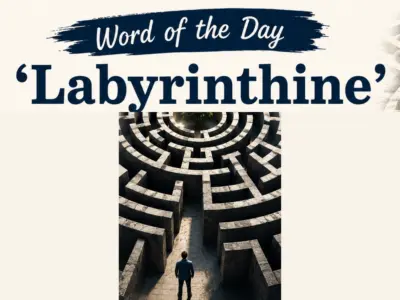

Word of the Day 'Labyrinthine': "Labyrinthine" is one of those descriptive English words you use when something feels extremely complicated, confusing, or like your standing inside a maze, sort of.
People use it in literature, politics, law , technology and also in everyday talks, to describe systems or situations that are hard to move through, or even to grasp at all.
Labyrinthine Meaning
"Labyrinthine" means something that looks like a labyrinth or maze, so it is highly complex, with intricate detail, and kind of hard to follow.
You'll often see it used for
- Complicated rules or procedures
- Confusing road networks
- Difficult bureaucratic systems
- Complex plotlines in books, movies, and stories
Labyrinthine Origin
"Labyrinthine" comes from "labyrinth", which is tied to Greek mythology. The Labyrinth was a huge maze built to trap the Minotaur, according to those old legends.
After that, the suffix "-ine" basically turns the noun into an adjective, like "having the qualities of a labyrinth" , or being labyrinth-like.
Labyrinthine Example Sentences
Here are some examples of how the word is used:
- The city's labyrinthine streets confused many tourists.
- She struggled to understand the labyrinthine legal process.
- The movie featured a labyrinthine storyline full of twists.
- Government paperwork can sometimes feel labyrinthine.
Labyrinthine Phonetic & IPA
Phonetic Spelling: lab-uh-RIN-thine
IPA: /ˌlæbəˈrɪnθaɪn/
The stress is placed on the "RIN" syllable.
Labyrinthine Relevance in Today's World
It's pretty relevant right now because modern systems, digital platforms, laws, and paperwork processes are often described as overly complex. You see the word in journalism, in academic writing, and in business communication, basically whenever someone wants to explain a situation that feels not just complicated but also annoyingly difficult to navigate, or understand in the first place.
"Labyrinthine" is a powerful vocabulary word used to describe confusing, complicated, or maze-like situations. Understanding and using such advanced descriptive words can improve both spoken and written English communication skills.